

The Spiral Illusion Solved: Are These Shapes Concentric Circles?
Visual illusion memes frequently highlight the gaps between physical reality and brain perception. By using angled patterns and alternating contrast, these optical tricks fool the visual cortex into seeing movement, tilt, or spiral trajectories where none exist.
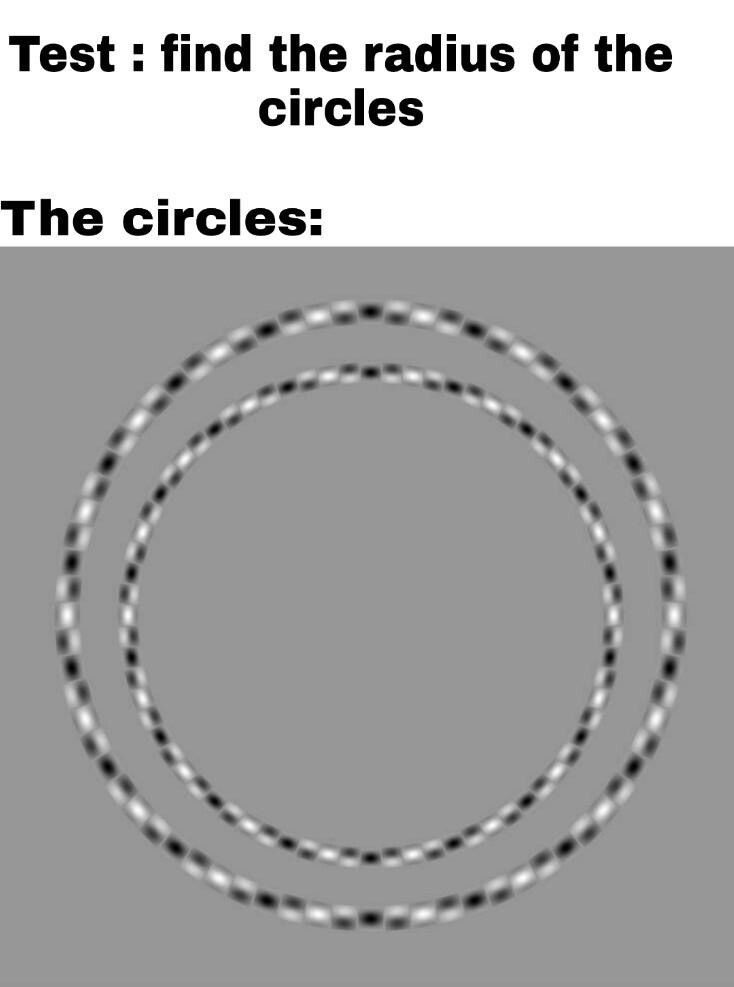
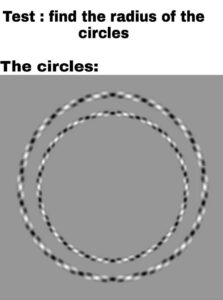
A popular meme graphic presents a famous visual illusion titled:
“Test: find the radius of the circles”
“The circles:”
Below the caption sits an image featuring blurred, checkered rings against a solid grey background. To most viewers, the rings appear to twist into an interlocking spiral that winds inward toward the center.
In this guide, we break down how to test the image yourself, explain the neurobiology behind the Fraser Spiral illusion, and reveal why our eyes perceive spirals instead of perfect circles.
How to Test the Illusion Yourself
To break the optical trick and prove to your brain that the shapes are concentric circles, follow these simple steps:
                    [ SPIRAL ILLUSION DECONSTRUCTION ]
                                    |
      --------------------------------------------------------------
     |                              |                               |
 [ 1. TRACE WITH FINGER ]    [ 2. COVER SECTIONS ]       [ 3. VERIFY CONCENTRICITY ]
 • Place your finger on      • Block out neighboring     • Notice that the line
   any point of a ring        sections of the ring        returns to its exact
 • Follow the pathway        • Removes angular contrast    starting point without
   all the way around          clues                       spiraling inward
1. The Finger-Trace Test:
Pick any point on either the outer or inner ring and trace it continuously with your finger or cursor. Rather than winding inward toward the center as a true spiral would, your finger will return to its exact starting point in a complete, closed circle.
2. The Concentric Reality:
Despite looking like intertwined spirals, the image consists strictly of two separate, perfectly round concentric circles sharing the same center point.
Visual Element & Perception Analysis
| Visual Feature | Graphic Element | Perceptual Effect on Brain |
| Ring Shapes | Two perfect concentric circles | True physical geometry of the image |
| Segment Angling | Alternating light/dark tilted micro-pattern | Introduces false directional “vector” signals |
| Blur / Soft Focus | Gradients along segment edges | Blurs sharp boundaries, forcing brain to infer shape |
| Perceived Result | Intersecting, winding spiral arms | Optical Illusion created by visual cortex |
The Science: Why Your Brain Sees a Spiral
This illusion is a variation of the classic Fraser Spiral Illusion (first described by British psychologist James Fraser in 1908):
-
Tilted Components vs. Global Shape: The human visual system processes local directional cues before combining them to identify overall shapes. The alternating black-and-white segments along the circular paths are tilted at a slight angle.
-
Directional Orientation Bias: Because the individual pattern components are angled inward, the brain integrates these micro-angles into a continuous global path. Instead of perceiving a simple closed circle, your primary visual cortex misinterprets the angled segments as a continuous inward-winding spiral.
Why Optical Illusion Memes Go Viral
-
Active Screen Engagement: Readers are prompted to physically touch or trace their screens to verify whether the shapes are spirals or circles.
-
Brain vs. Logic Conflict: The cognitive dissonance between what your eyes see (a spiral) and what your finger proves (a circle) creates a fun “aha!” moment that drives readers to share the post with friends.
Conclusion
The “Find the radius of the circles” meme showcases a classic Fraser-type illusion. While your visual cortex perceives a twisting spiral due to angled contrast segments, tracing the lines proves they are actually two perfect concentric circles.
Frequently Asked Questions (FAQ)
Are the shapes in the image circles or spirals?
They are perfect concentric circles. The spiral appearance is entirely a visual illusion.
How does the Fraser spiral illusion work?
The illusion works because the individual black and white segments along the ring are tilted. Your brain interprets these local angled patterns as a continuous spiral path rather than a closed circle.