


Word riddles and hidden-word visual puzzles are a classic way to test your attention to detail, linguistic observation, and lateral thinking. They challenge your brain to look past word boundaries and spot hidden patterns right in front of your eyes!
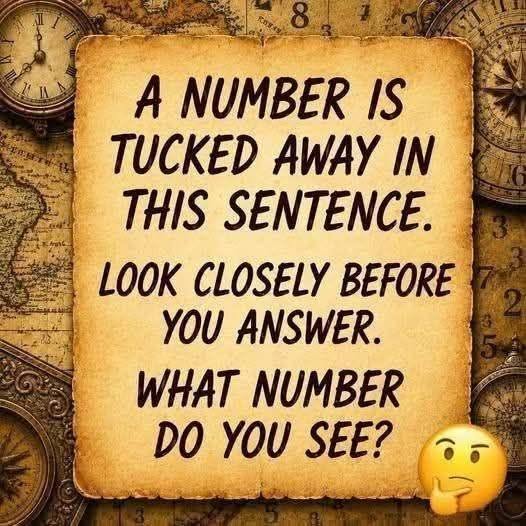
Social media posts featuring text puzzles like “A number is tucked away in this sentence. Look closely before you answer. What number do you see?” are designed to spark friendly debate and brain-teaser fun.
Below, we break down the exact solution to this viral riddle, explain how word-search puzzles work, and share tips for solving wordplay riddles faster.
The Hidden Number Revealed
If you look closely at the very first sentence:
“A NUMBER IS TUCKED AWAY IN THIS SENTENCE.”
The hidden number word is TEN!
Where is it hidden?
It is spelled across two adjacent words near the end of the first sentence:
-
“…THIS SENTENCE.”
By taking the last three letters of the word SENTENCE (or bridging across “SENTENCE”), the letters T-E-N are clearly spelled out inside the word!
Why Our Brains Miss Words Hidden in Plain Sight
When we read sentences, our brains process language using a visual mechanism called whole-word recognition. Instead of analyzing individual letters one by one, our minds scan entire word shapes and process their meanings automatically.
Because of this, when letters of another word are embedded inside a larger word (like TEN inside SENTENCE), our visual processing system naturally skips over the sub-word to read the full context. Spotting the hidden word requires breaking your habitual reading pattern and focusing on letter sequences!
3 Easy Tips for Solving Wordplay Riddles
Want to get better at solving word search riddles and hidden text games? Keep these techniques in mind:
1. Read Letter-by-Letter
Ignore sentence grammar and read through the text slowly, focusing on small letter groupings ($3\text{ or }4$ letters at a time) to spot number names like ONE, TWO, SIX, or TEN.
2. Look Across Word Boundaries
Riddle creators frequently split hidden words across spaces—for example, bridging the end of one word and the start of the next (e.g., “SIX” or “FIVE“).
3. Check Long Words for Embeds
Longer words like SENTENCE, FOURTEEN, or THIRTEEN naturally contain smaller words or numbers hidden right within their own spelling!
Fascinating Facts About Word Puzzles
-
Cognitive Reserve: Solving daily word riddles, anagrams, and crosswords helps strengthen executive brain function and maintains cognitive agility as we age.
-
The Stroop Effect: Brain teasers that trick your perceptual expectations rely on the same cognitive pathways as famous neurological tests like the Stroop Test, which measures mental processing speed and flexibility.
Conclusion
Riddles like this are a quick, enjoyable way to give your brain a mini workout during the day. Whether you spotted TEN right away or needed a small hint, keeping your mind sharp with wordplay is always a fun challenge!
Frequently Asked Questions (FAQ)
What is a hidden word riddle?
A hidden word riddle (or embedded word puzzle) is a linguistic brain teaser where a specific word or number is concealed within the spelling of adjacent words or a single larger word.
Why are riddles good for brain health?
Engaging with riddles exercises lateral thinking, spatial processing, working memory, and language skills, helping keep your focus and problem-solving abilities sharp!