



Every once in a while, a strange object appears online and sparks a wave of curiosity across the internet. A simple photograph is shared with little or no explanation, inviting people to guess its purpose. Within hours, thousands of comments begin pouring in from collectors, mechanics, chefs, historians, and curious social media users, each offering a different theory.
Some people are convinced they’ve seen the object before. Others insist it’s something entirely different. As more opinions appear, the mystery only grows, turning an ordinary-looking item into a viral sensation.
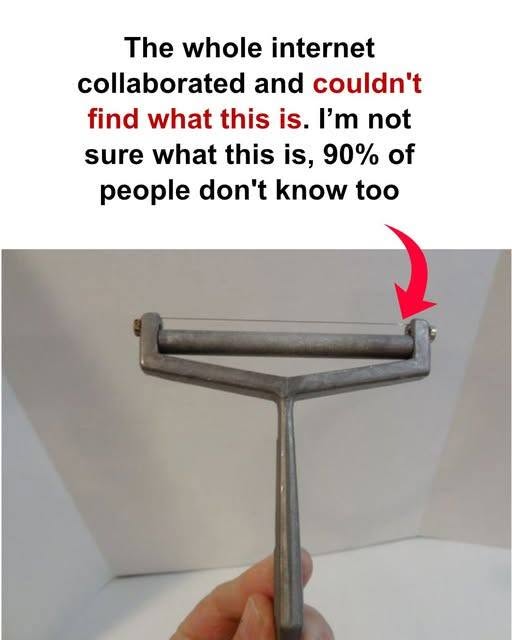
One such object has recently captured widespread attention. It features a sturdy metal frame with a T-shaped handle and a rotating wheel fitted with evenly spaced cutting blades. The caption accompanying the image usually reads something like:
“The whole internet collaborated and couldn’t identify this object. Do you know what it is?”
The challenge quickly spreads across social media platforms, with thousands of people offering wildly different answers.
Some believe it’s an old farming tool.
Others think it’s used for woodworking.
A few guess it’s part of an antique machine.
Some even claim it’s a vintage pizza cutter.
The reality, however, is much simpler—and surprisingly useful.
The Answer: A Pastry Lattice Roller
The mysterious object is commonly known as a pastry lattice roller, sometimes called a lattice dough cutter.
It is a specialized baking tool designed to create decorative lattice patterns in dough for pies, pastries, tarts, and other baked desserts.
Rather than cutting individual strips of dough by hand, this tool allows bakers to create a beautiful woven pattern in just a few seconds.
Although it may look unusual today, it was once considered an essential tool in many home kitchens and professional bakeries.
How Does It Work?
Continued on next page:
Using the tool is surprisingly simple.
First, a sheet of pastry dough is rolled out on a clean work surface.
The lattice roller is then pressed firmly onto the dough while being rolled forward.
As it moves, the sharp cutting wheels create evenly spaced slits throughout the dough without cutting it into separate pieces.
Once the dough is gently stretched, those slits open into the familiar diamond-shaped lattice pattern seen on many traditional fruit pies.
The finished sheet can then be carefully placed over the pie filling before baking.
The result is a professional-looking pie that would otherwise require much more time and effort to prepare by hand.
Why Was It So Popular?
Before modern kitchen appliances became common, specialized hand tools helped bakers save both time and effort.
A lattice roller offered several advantages:
- It created perfectly even patterns.
- It produced consistent results every time.
- It was much faster than cutting dough manually.
- It added an elegant decorative finish.
- It required no electricity.
For generations, it became a favorite tool among home bakers who regularly prepared pies for holidays, family gatherings, and celebrations.
Why Do So Few People Recognize It Today?
Over the years, kitchens have changed dramatically.
Many traditional baking tools gradually disappeared as newer products entered the market.
Today, many people rely on:
- Ready-made pie crusts
- Silicone baking mats
- Electric mixers
- Food processors
- Multi-purpose kitchen gadgets
Because homemade lattice pies are prepared less frequently than in previous generations, younger people often grow up without ever seeing a lattice roller.
As a result, an object that was once instantly recognizable now appears mysterious to millions of internet users.
Why Vintage Tools Often Go Viral
Continued on next page:
Old household tools have become one of the internet’s favorite guessing games.
They attract attention because they challenge people to think beyond modern technology.
A simple photograph can generate thousands of comments as people compare memories, ask older relatives, or search through antique catalogs trying to identify the object.
These discussions combine nostalgia, history, and curiosity into entertaining puzzles that encourage users to interact and share their own ideas.
Even when someone eventually provides the correct answer, many readers remain fascinated by the story behind the object and the way everyday life has evolved over time.
Can You Still Buy One Today?
Yes.
Although they are no longer found in every kitchen, pastry lattice rollers are still widely available.
Many baking supply stores and online retailers sell modern versions made from stainless steel, aluminum, or durable food-grade plastic.
Professional bakers continue to use them because they produce clean, uniform designs that are difficult to achieve by hand.
Some vintage metal models have even become collectible items, appreciated both for their craftsmanship and their connection to traditional home baking.
Tips for Using a Pastry Lattice Roller
If you decide to try one yourself, a few simple tips can help you achieve the best results:
- Chill the dough before rolling it.
- Lightly flour both the dough and the roller.
- Apply even pressure while rolling.
- Stretch the cut dough gently to open the lattice pattern.
- Clean the tool immediately after use to prevent dough from drying between the blades.
With a little practice, you can create bakery-style pies that look both elegant and professional.
Final Thoughts
Continued on next page: