

I Have 6 Eggs: Riddle Answer and Logical Explanation
Brain teasers, logic puzzles, and riddle-based social media posts regularly go viral across platforms like Facebook. By presenting seemingly straightforward math problems with clever grammatical twists, these posts spark engaging debate, encourage commenting, and test critical thinking.
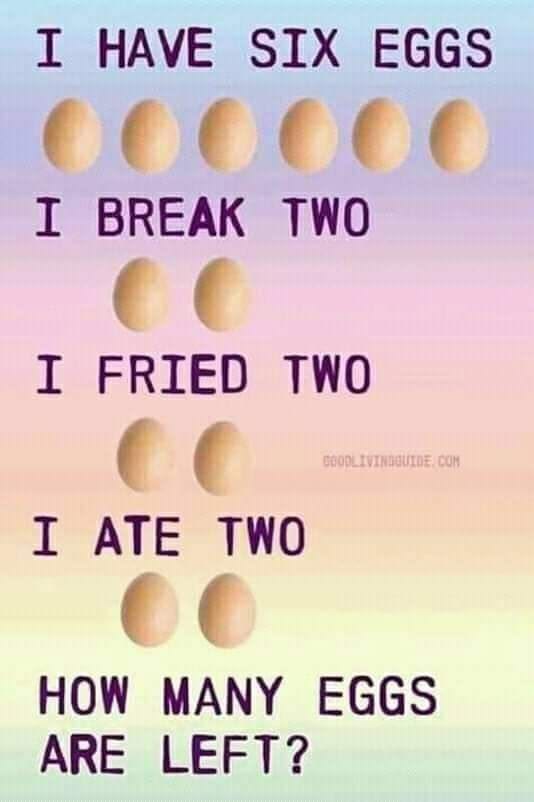
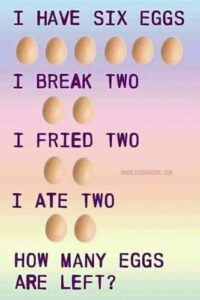
A colorful pastel infographic asks:
“I HAVE SIX EGGS
I BREAK TWO
I FRIED TWO
I ATE TWO
HOW MANY EGGS ARE LEFT?”
While many solvers quickly do the math $6 – 2 – 2 – 2 = 0$, the actual logic behind cooking an egg reveals a completely different answer.
In this guide, we break down the primary solution, explain the step-by-step cooking process logic, and look at alternative interpretations of this popular riddle.
The Primary Answer Explained
The most widely accepted logical answer to this riddle is 4 EGGS LEFT.
                       [ LOGICAL ACTION TIMELINE ]
                                     |
      --------------------------------------------------------------
     |                                                              |
 [ 2 EGGS PROCESSED ]                                   [ 4 EGGS UNTOUCHED ]
 • Step 1: You BREAK 2 eggs                              • Remain intact in the carton
 • Step 2: You FRIED those same 2 eggs                   • No actions performed on them
 • Step 3: You ATE those same 2 eggs                     • Total remaining = 4
The Step-by-Step Cooking Sequence
To eat two fried eggs, you must follow a sequential process using the same 2 eggs:
-
First, you break two eggs to open them.
-
Next, you fry those same two broken eggs in a pan.
-
Finally, you eat those same two fried eggs.
Because all three actions (broke, fried, ate) describe the exact same pair of eggs, you have only processed 2 eggs in total.
Breakdown of Interpretations
Depending on how literally you read the tense and phrasing, there are three common interpretations:
| Interpretation | Logic Used | Final Count |
| Sequential Cooking Process (Standard Solution) | You broke, fried, and ate the same 2 eggs. | 4 Eggs Left (intact) |
| Independent Actions | You broke 2, fried 2 other eggs, and ate 2 more eggs ($2 + 2 + 2 = 6$). | 0 Eggs Left |
| Physical Form Remaining | You still have 4 raw eggs plus the shells/remains of the 2 eaten ones. | 4 Intact Eggs |
Clue Breakdown Table
| Riddle Statement | Action Analysis | Impact on Total (6 Eggs) |
| “I have six eggs” | Starting count. | 6 total |
| “I break two” | 2 eggs prepared for cooking. | 2 eggs changed state |
| “I fried two” | Cooking the 2 broken eggs. | Same 2 eggs cooked |
| “I ate two” | Consuming the 2 cooked eggs. | Same 2 eggs consumed |
| “How many are left?” | Unprocessed raw eggs remaining. | 4 eggs remain |
Conclusion
The answer to the riddle “I have 6 eggs. I break 2, I fried 2, I ate 2. How many eggs are left?” is 4. It serves as a classic reminder to think through the real-world sequence of events rather than treating every text statement as a separate mathematical subtraction!
Frequently Asked Questions (FAQ)
What is the correct answer to the 6 eggs riddle?
The standard answer is 4. You broke 2 eggs, fried those same 2 eggs, and ate those same 2 eggs, leaving 4 untouched raw eggs.
Could the answer be 0?
Yes, if you interpret the riddle as describing 6 separate eggs undergoing 6 distinct actions (2 broken, 2 cooked raw/in-shell, 2 eaten separately), then $6 – 2 – 2 – 2 = 0$. However, in normal language and cooking logic, the actions refer to the same set of eggs.