

The Magic Ring Optical Illusion: How Your Vision Tricks Your Brain
Interactive optical illusions and visual perception tricks generate massive engagement across social media platforms. They invite viewers to participate directly with their screens, testing the limits of human binocular vision, peripheral alignment, and depth perception.
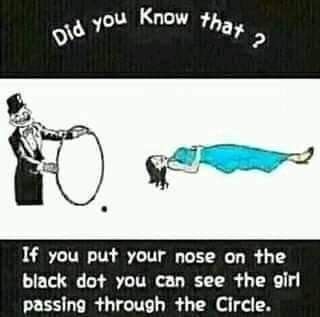
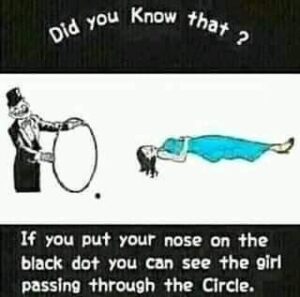
A popular viral graphic depicts a magician holding a large hoop next to a levitating woman in a blue dress, accompanied by simple instructions:
“Did you know that?”
“If you put your nose on the black dot you can see the girl passing through the Circle.”
When you place your nose directly against the screen at the designated dot, the two distinct figures—the magician’s hoop on the left and the levitating woman on the right—appear to merge together, creating the illusion of the woman floating straight through the ring.
In this guide, we break down the physiological science behind this visual phenomenon, explain how your visual cortex processes overlapping images, and explore why interactive illusions work so well.
Deconstructing the Optical Trick: Step-by-Step
To experience the illusion correctly, follow the visual mechanics breakdown:
                    [ BINOCULAR FUSION EXPERIMENT ]
                                   |
      -----------------------------------------------------------
     |                                                           |
 [ LEFT EYE FIELD ]            [ NOSE PLACEMENT ]            [ RIGHT EYE FIELD ]
 • Views magician & hoop       • Positioned at black dot     • Views levitating woman
 • Peripheral offset           • Shifts focal distance       • Peripheral offset
1. How to Test It:
-
Position your face extremely close to the screen until your nose touches (or almost touches) the small black dot at the center bottom of the visual frame.
-
Keep both eyes open and look forward without focusing too hard on either side image.
-
As your field of view splits between the left and right sides of your nose, your brain attempts to superimpose the two images into a single composite view, causing the woman to shift inside the hoop.
Visual & Physiological Mechanism Breakdown Table
| Optical Mechanism | Biological Process | Visual Outcome |
| Binocular Convergence | Eyes rotate inward or outward to focus at varying depths | Extreme proximity breaks normal convergence alignment |
| Field Separation | The bridge of the nose blocks each eye’s view of the opposite side | Left eye sees only the hoop; right eye sees only the woman |
| Visual Fusion | The visual cortex merges two distinct monocular images into one | The woman appears shifted inside the frame of the hoop |
The Science: Binocular Vision & Image Superimposition
This illusion relies on how the human visual system processes 3D space:
-
Physiological Diplopia & Field Overlap: Humans have binocular vision, meaning each eye receives a slightly different angle of the world. Normally, the brain fuses these two views into a single 3D image.
-
Disrupting Normal Focus: When an object is placed closer to your face than your eyes’ minimum focal distance, your nose acts as a physical barrier. The left eye focuses predominantly on the left side of the graphic (the hoop), while the right eye focuses on the right side (the woman).
-
Cortical Overlap: Because the brain tries to blend the inputs from both eyes into a central frame, it overlaps the two disparate shapes, making it appear as though the woman is passing directly through the center of the ring.
Why Interactive Perception Memes Go Viral
-
Direct User Participation: Unlike static images, interactive illusions require the viewer to physically test a claim, driving higher retention and dwell time on the post.
-
Instant Curiosity: Viewers want to test whether the trick actually works on their phone or monitor, leading them to re-share and tag friends in the comment section to see if they experience the same effect.
Conclusion
The “nose on the black dot” illusion is a classic demonstration of how binocular vision and eye placement dictate visual perception. By forcing each eye to view separate elements of an image, simple static artwork turns into a dynamic optical trick!
Frequently Asked Questions (FAQ)
How does putting your nose on the dot work?
It disrupts your normal binocular vision by using your nose to separate your left and right eyes’ fields of view, forcing your brain to superimpose the left image (hoop) over the right image (woman).
Why does the woman look like she moves through the hoop?
Because your eyes cannot converge properly at extremely close range, your brain overlays the image from your right eye onto the image from your left eye, creating a merged composite view.