

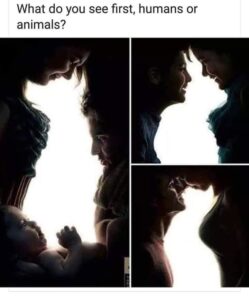
What Do You See First, Humans or Animals? Negative Space Optical Illusion Solved
Negative space artwork and figure-ground optical illusions are exceptionally effective at driving viral engagement across social media platforms. They challenge viewers’ perceptual grouping mechanisms by using positive shapes (the foreground subjects) to define secondary, hidden forms (the negative background space).
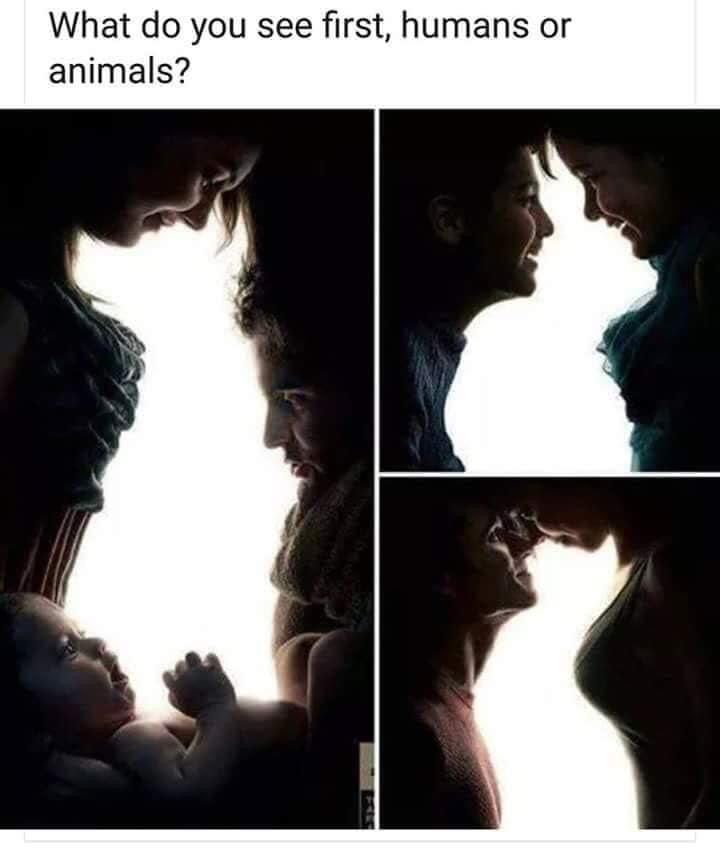
A widely shared visual challenge features a collage of three portraits with the prompt:
“What do you see first, humans or animals?”
At first glance, viewers usually focus on either the lit silhouettes of people facing each other or the distinct animal silhouettes formed in the bright white space between them.
In this guide, we analyze the dual imagery present in each of the three panels, detail how the negative space creates animal figures, and explain the visual psychology behind gestalt perception.
Deconstructing the Dual Images Panel-by-Panel
Each frame in this visual collage uses the negative space (the illuminated background area bounded by dark human silhouettes) to render a recognizable domestic animal:
                  [ NEGATIVE SPACE COLLAGE BREAKDOWN ]
                                   |
      -----------------------------------------------------------
     |                             |                             |
 [ LEFT PANEL ]            [ TOP RIGHT PANEL ]        [ BOTTOM RIGHT PANEL ]
 • Foreground:             • Foreground:              • Foreground:
   Woman, man & baby         Man & woman facing         Man & woman facing
 • Negative Space:         • Negative Space:          • Negative Space:
   **DOG SILHOUETTE**        **CAT SILHOUETTE**         **PUPPY / KITTEN**
1. The Large Left Panel (The Dog)
-
Foreground Image: A family profile consisting of a woman on the left, a man on the right, and a baby lying at the bottom holding its hands up.
-
Negative Space (Hidden Animal): The bright white space between their bodies forms the outline of a sitting dog (such as a Labrador or Retriever). The curve between the mother and father forms the dog’s head and snout, while the space above the baby forms its front legs and chest.
2. The Top-Right Panel (The Cat)
-
Foreground Image: A young man and woman leaning towards each other looking downward.
-
Negative Space (Hidden Animal): The white gap between their faces and necks outlines the profile of a cat standing upright, with the space between their foreheads creating the cat’s pointed ear shape.
3. The Bottom-Right Panel (The Small Dog / Puppy)
-
Foreground Image: A man looking up towards a woman who is leaning forward.
-
Negative Space (Hidden Animal): The white gap between their torsos and faces creates the silhouette of a small dog or puppy (or sitting cat), with their touching foreheads defining the top of the animal’s head.
Visual Element Mapping Table
| Panel Location | Human Figures (Positive Space) | Hidden Animal (Negative Space) | Key Contour Landmark |
| Left (Large) | Mother, Father, and Baby | Large Dog | Space between heads forms dog’s ears & snout |
| Top Right | Man and Woman leaning in | Cat | Forehead gap forms cat’s pointed ears |
| Bottom Right | Man and Woman facing closely | Puppy / Small Pet | Space between torsos forms animal back and neck |
The Answer: Both Are Present!
There is no single “correct” answer to what you see first:
-
Humans: The dark, detailed profiles of the parents and children form the positive space.
-
Animals: The bright white openings between the people form the negative space outlines of a dog, a cat, and a puppy.
Why Figure-Ground Illusions Work
-
Gestalt Principles (Figure-Ground Perception): The visual brain naturally tries to separate an image into a focal object (“figure”) and a background (“ground”). Because the white background forms clear, high-contrast contours of animals, the brain rapidly alternates between reading the dark silhouettes as figures and reading the white space as figures.
-
Priming Effects: The caption (“humans or animals?”) primes the visual cortex, allowing viewers to intentionally toggle their perception between the human family and the pet silhouettes.
Conclusion
Whether your eyes locked onto the human family or the hidden pets first, this collection of negative space art cleverly embeds both into every frame!
Frequently Asked Questions (FAQ)
What animals are hidden in the image?
The negative space forms three domestic animals: a large dog in the left frame, a cat in the top-right frame, and a small dog/puppy in the bottom-right frame.
How does negative space art work?
Negative space art uses the blank area around and between subjects to form a secondary, meaningful image or visual motif.