

Square Root Math Puzzle Explained: How to Solve $(\sqrt{81} + \sqrt{9}) / \sqrt{36}$
Math riddles and basic arithmetic brain teasers generate strong engagement across social media platforms like Facebook. By presenting square root equations on eye-catching visual backgrounds, these puzzles challenge readers to apply basic order of operations and arithmetic principles.
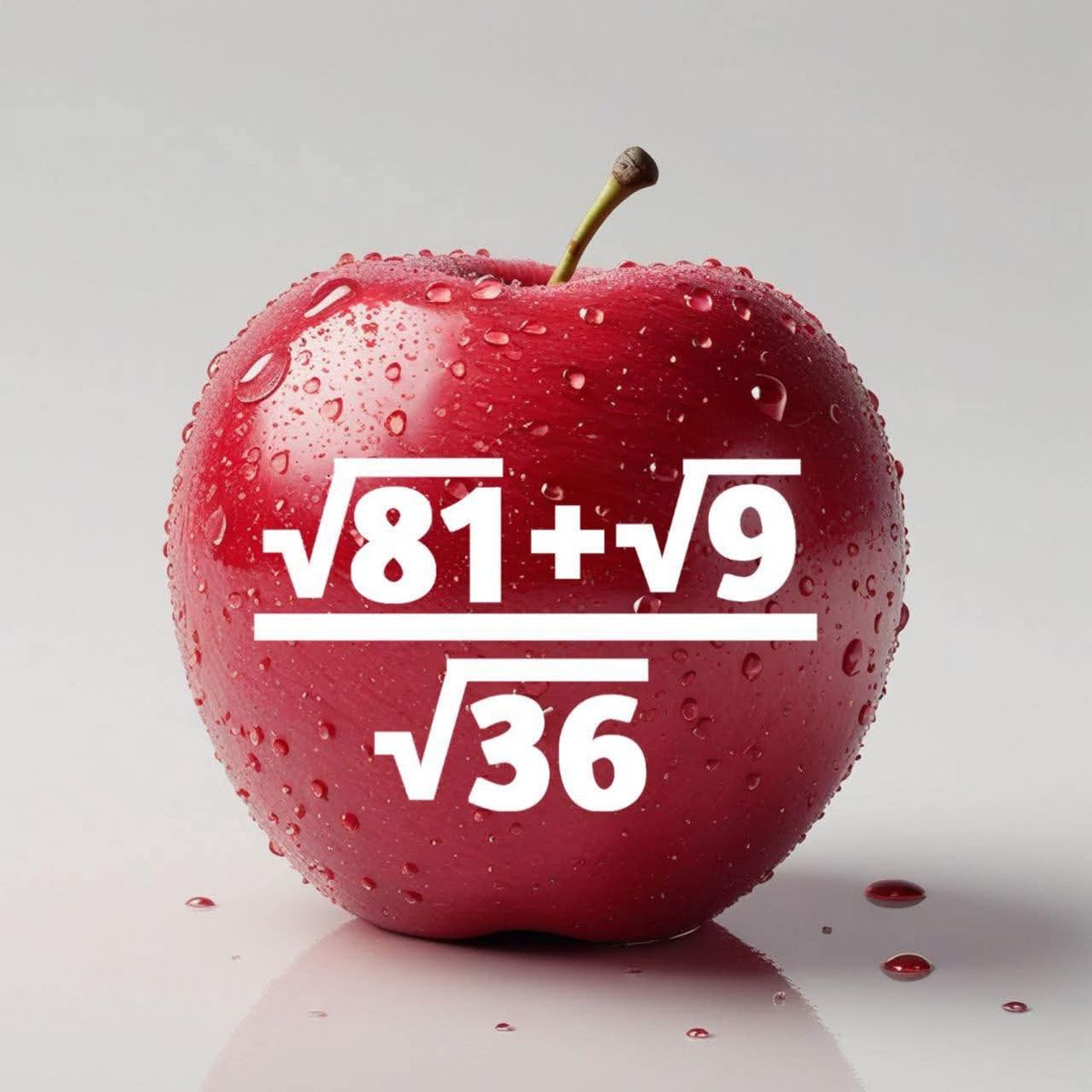
A crisp graphic featuring a fresh red apple with water droplets displays the following math expression:
While multi-term fractions can appear tricky at first glance, breaking down each square root independently reveals a clean and simple solution: 2.
In this guide, we break down the calculation step-by-step, review the order of operations for fractions, and explain how each part of the equation simplifies.
Step-by-Step Mathematical Solution
To solve the equation $\frac{\sqrt{81} + \sqrt{9}}{\sqrt{36}}$, evaluate each radical term before performing the final division:
                           [ EQUATION WORKFLOW ]
                                     |
      ---------------------------------------------------------------
     |                               |                               |
 [ NUMERATOR radicals ]     [ DENOMINATOR RADICAL ]      [ FINAL DIVISION ]
 • √81 = 9                  • √36 = 6                    • 12 / 6 = 2
 • √9  = 3
 • 9 + 3 = 12
1. Simplify the Numerator Radicals
-
Find the principal square root of 81:
$$\sqrt{81} = 9 \quad (\text{since } 9 \times 9 = 81)$$ -
Find the principal square root of 9:
$$\sqrt{9} = 3 \quad (\text{since } 3 \times 3 = 9)$$ -
Add the numerator terms together:
$$9 + 3 = 12$$
2. Simplify the Denominator Radical
-
Find the principal square root of 36:
$$\sqrt{36} = 6 \quad (\text{since } 6 \times 6 = 36)$$
3. Perform the Final Division
-
Divide the simplified numerator by the simplified denominator:
$$\frac{12}{6} = 2$$
Radical Breakdown Table
| Term in Expression | Original Radical Form | Simplified Value | Role in Expression |
| First Numerator Term | $\sqrt{81}$ | $9$ | Added to second numerator term |
| Second Numerator Term | $\sqrt{9}$ | $3$ | Added to first numerator term |
| Combined Numerator | $9 + 3$ | $12$ | Dividend (Top of fraction) |
| Denominator | $\sqrt{36}$ | $6$ | Divisor (Bottom of fraction) |
| Final Answer | $12 / 6$ | $2$ | Final Simplified Result |
Order of Operations Rule for Fractions
When simplifying fractional expressions with operations in the numerator or denominator:
-
Group Numerator and Denominator: Treat the entire numerator and the entire denominator as if they are enclosed in parentheses:
$$\frac{\sqrt{81} + \sqrt{9}}{\sqrt{36}} \equiv (\sqrt{81} + \sqrt{9}) \div (\sqrt{36})$$ -
Evaluate Radicals First: Calculate all exponents and radicals before applying basic addition or division.
-
Simplify Top and Bottom: Fully compute the numerator value ($12$) and denominator value ($6$).
-
Divide: Execute the division operation last to arrive at the final integer answer ($2$).
Conclusion
The answer to the square root apple puzzle is 2. By evaluating each square root ($\sqrt{81}=9$, $\sqrt{9}=3$, $\sqrt{36}=6$), the fraction simplifies to $12 / 6$, giving a final result of $2$.
Frequently Asked Questions (FAQ)
What is a principal square root?
The principal square root refers specifically to the non-negative (positive) square root of a number. In standard order of operations, the $\sqrt{\quad}$ symbol denotes the positive root ($\sqrt{81} = 9$).
Why do we add before dividing in this fraction?
In fractional expressions, the fraction bar acts as a grouping symbol. All terms above the bar (numerator) must be completely simplified into a single number before dividing by the denominator.