




The “9 Sons and a Sister” Family Riddle Solved: Can You Count the Family?
Family tree logic puzzles are among the most popular riddles on the internet. They play on how our brains process words like “each” and “sister,” often tricking readers into multiplying numbers unnecessarily.
A classic riddle written on a pinned note poses the following question:
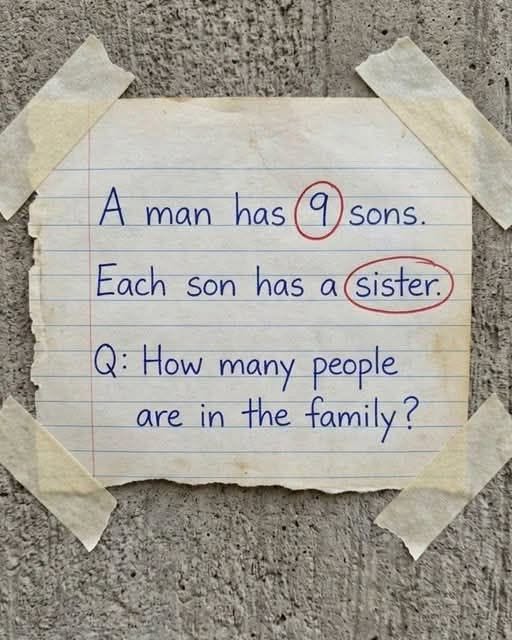
“A man has 9 sons. Each son has a sister. Q: How many people are in the family?”
At first glance, many people multiply 9 by 2 or assume there are 9 individual sisters ($9 \times 1 = 9$). However, looking at shared family relations reveals the simple, elegant math behind the riddle!
Below, we break down the exact family count step-by-step.
Step-by-Step Logic Breakdown
To find the minimum number of people in this immediate family unit, count each member by their role:
-
The Father (1 Man): The prompt begins with “A man has…”, which accounts for 1 person.
-
The 9 Sons: The man has 9 sons, adding 9 people to the total count.
-
The Sister (1 Daughter): This is where the wordplay trick happens! Because all 9 sons are brothers in the same immediate family, they all share the exact same sister. You do not need 9 different sisters—just 1 daughter gives all 9 sons a sister!
The Primary Equation (Minimum Family Unit)
What About the Mother?
Depending on how strictly you define the immediate family in logic puzzles, there are two primary accepted answers:
1. The Core Stated Family (11 People)
If you count strictly the individuals explicitly mentioned in the text:
-
1 Father + 9 Sons + 1 Daughter = 11 People
2. The Complete Household / Two-Parent Unit (12 People)
If you include the mother required to have the children within a conventional family model:
-
1 Father + 1 Mother + 9 Sons + 1 Daughter = 12 People
Family Breakdown Matrix
| Family Role | Count | Explanation |
| Father | 1 | The man introducing the statement |
| Mother (Optional/Implied) | 1 | Implied parent in a 2-parent model |
| Sons | 9 | The 9 brothers |
| Daughter / Sister | 1 | Shared sister to all 9 brothers |
| TOTAL (Stated Only) | 11 | Minimum logical solution |
| TOTAL (Including Mother) | 12 | Complete nuclear family model |
Why People Get This Riddle Wrong
-
The Multiplication Trap ($9 + 9 = 18$): Many readers interpret “each son has a sister” as meaning each son has a different sister, leading to a calculation of 9 sons + 9 sisters + 1 father = 19 (or 18 without the father).
-
Forgetting the Father: People often focus so heavily on the children (9 sons + 1 sister = 10) that they forget to add the man who is the father of the family!
Conclusion
The trick lies in recognizing that all 9 sons share one single sister. Counting the father, the 9 sons, and their 1 shared sister gives a total of 11 people (or 12 if including the mother)!
Frequently Asked Questions (FAQ)
Is the answer 11 or 12?
Both are considered valid depending on context! 11 is the strict logical answer based only on the explicitly mentioned individuals (1 father + 9 sons + 1 daughter), while 12 includes an implied mother.
Why doesn’t each son need his own separate sister?
Since the 9 sons are brothers, any sister born to their parents is automatically a sister to every single one of the 9 brothers simultaneously.






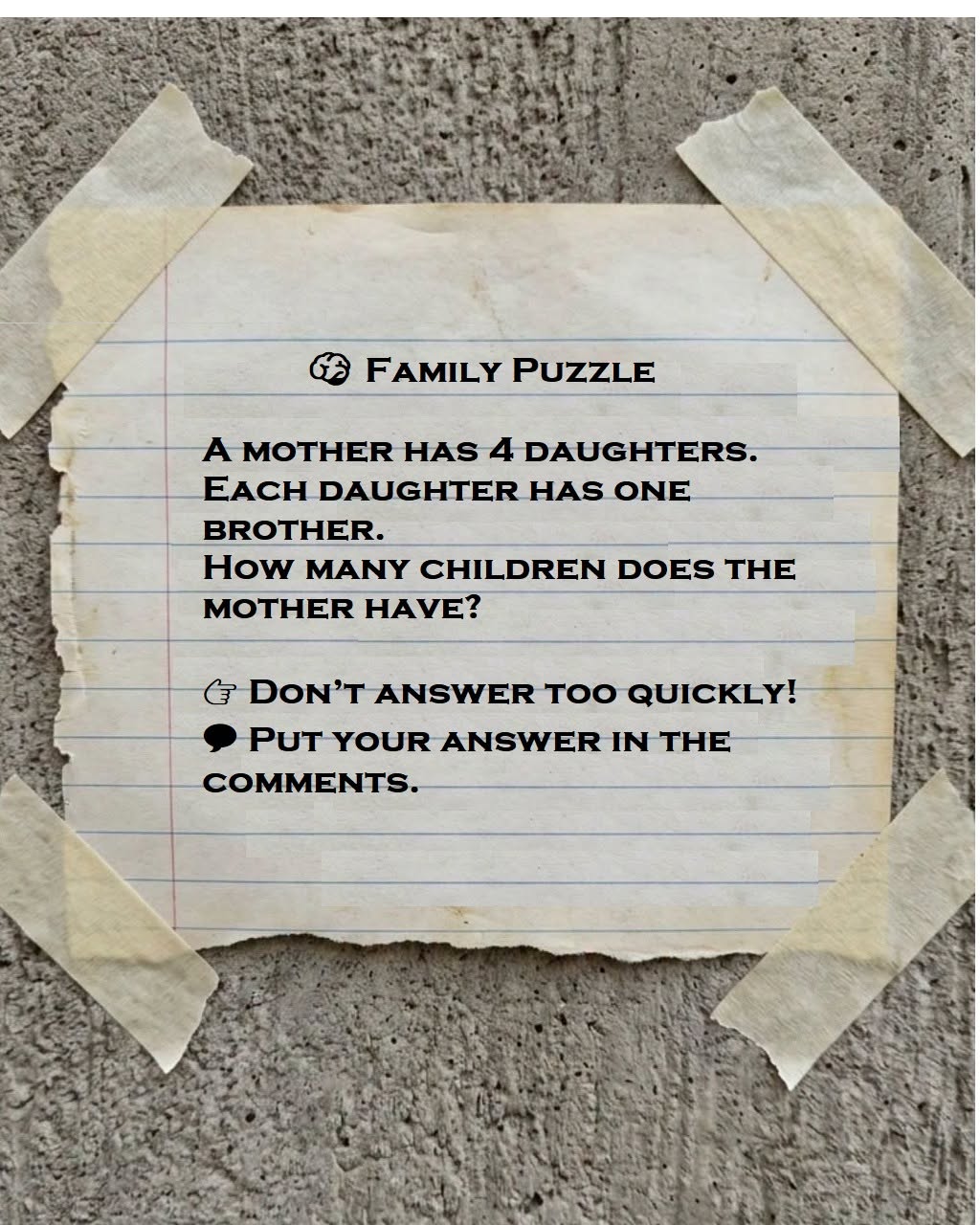


That there is One mother Only is not implied in the equation, therefore I will think you can answer a number, neither 12, 11 or any other number