[ FAMILIAL SET STRUCTURE ]
                                     |
     -------------------------------------------------------------------
    |                                                                   |
[ SHARED SISTER RELATIONSHIP ]                      [ BASE PARENTAL MEMBERSHIP ]
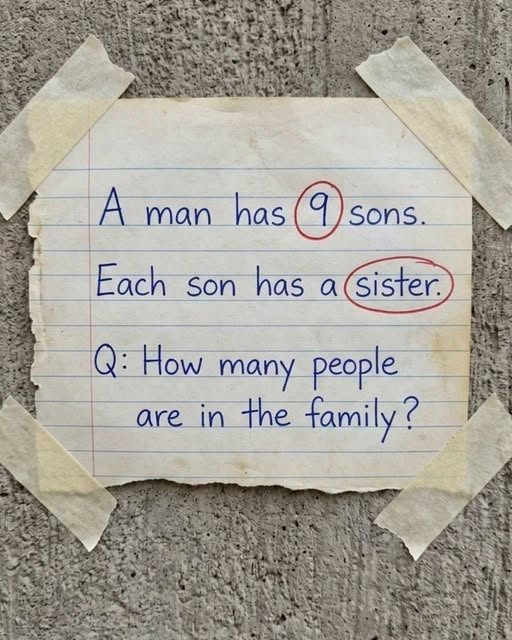
• 1 daughter serves as a sister to ALL 9 brothers  • "A man" establishes 1 father
• Total children = 9 sons + 1 sister = 10 children  • Inclusion of a mother adds 1 second parent
• Avoids the false accumulation trap (9 + 9)        • Baseline nuclear count = 11 (or 10 without mother)
1. Sibling Set Overlap
The Shared Sister Concept: If a family has nine brothers and one daughter, every single one of those nine sons has a sister. The sister is a shared relation across the entire set of brothers. Family
The Overcounting Trap: The human brain often interprets “each son has a sister” as a 1:1 pairing ($9 \times 1 = 9 \text{ sisters}$), leading to an incorrect total of 18 children ($9 \text{ sons} + 9 \text{ sisters}$).
2. Parent Counting Conventions
The Man (Father): The premise explicitly begins with “A man has…”, establishing 1 father.
The Mother Assumption: While the prompt does not explicitly name a mother, standard nuclear family definitions imply the presence of a mother. Including or excluding the mother accounts for the slight variance in total headcounts (10 vs. 11).
Family Headcount Calculation Matrix
Interpretation Framework
Included Members
Mathematical Breakdown
Total Headcount
Nuclear Family (Standard)
Father + Mother + 9 Sons + 1 Shared Sister
$1 + 1 + 9 + 1$
11 People
Explicit Text Only
Father + 9 Sons + 1 Shared Sister (No Mother)
$1 + 0 + 9 + 1$
10 People
Literal 1:1 Fallacy
Father + Mother + 9 Sons + 9 Individual Sisters
$1 + 1 + 9 + 9$
20 People(Incorrect)
Key Takeaways
The Primary Answer: Assuming a standard nuclear family structure (father, mother, children), the family has 11 people (1 father + 1 mother + 9 sons + 1 sister). Family
Text-Strict Answer: If strictly counting individuals explicitly mentioned or implied without adding a mother, the answer is 10 people (1 father + 9 sons + 1 sister).
Linguistic Trick: The riddle exploits quantifier scope ambiguity—interpreting “a sister” as a universal shared element versus multiple unique individuals.
Other uncategorized cookies are those that are being analyzed and have not been classified into a category as yet.
Necessary
Necessary
Necessary cookies are absolutely essential for the website to function properly. These cookies ensure basic functionalities and security features of the website, anonymously.
Advertisement
Advertisement cookies are used to provide visitors with relevant ads and marketing campaigns. These cookies track visitors across websites and collect information to provide customized ads.
Analytics
Analytical cookies are used to understand how visitors interact with the website. These cookies help provide information on metrics the number of visitors, bounce rate, traffic source, etc.
Functional
Functional cookies help to perform certain functionalities like sharing the content of the website on social media platforms, collect feedbacks, and other third-party features.
Performance
Performance cookies are used to understand and analyze the key performance indexes of the website which helps in delivering a better user experience for the visitors.
We value your privacy
This website uses cookies to improve your experience while you navigate through the website. Out of these, the cookies that are categorized as necessary are stored on your browser as they are essential for the working of basic functionalities of the website. We also use third-party cookies that help us analyze and understand how you use this website. These cookies will be stored in your browser only with your consent. You also have the option to opt-out of these cookies.