

How Many Triangles Do You See? The Chocolate Pyramid Puzzle Solved
Visual counting teasers and geometric arrangement puzzles are massive hit drivers on social media. They test your spatial awareness and systematic counting ability by taking simple triangular objects and arranging them into a larger triangular pyramid structure.
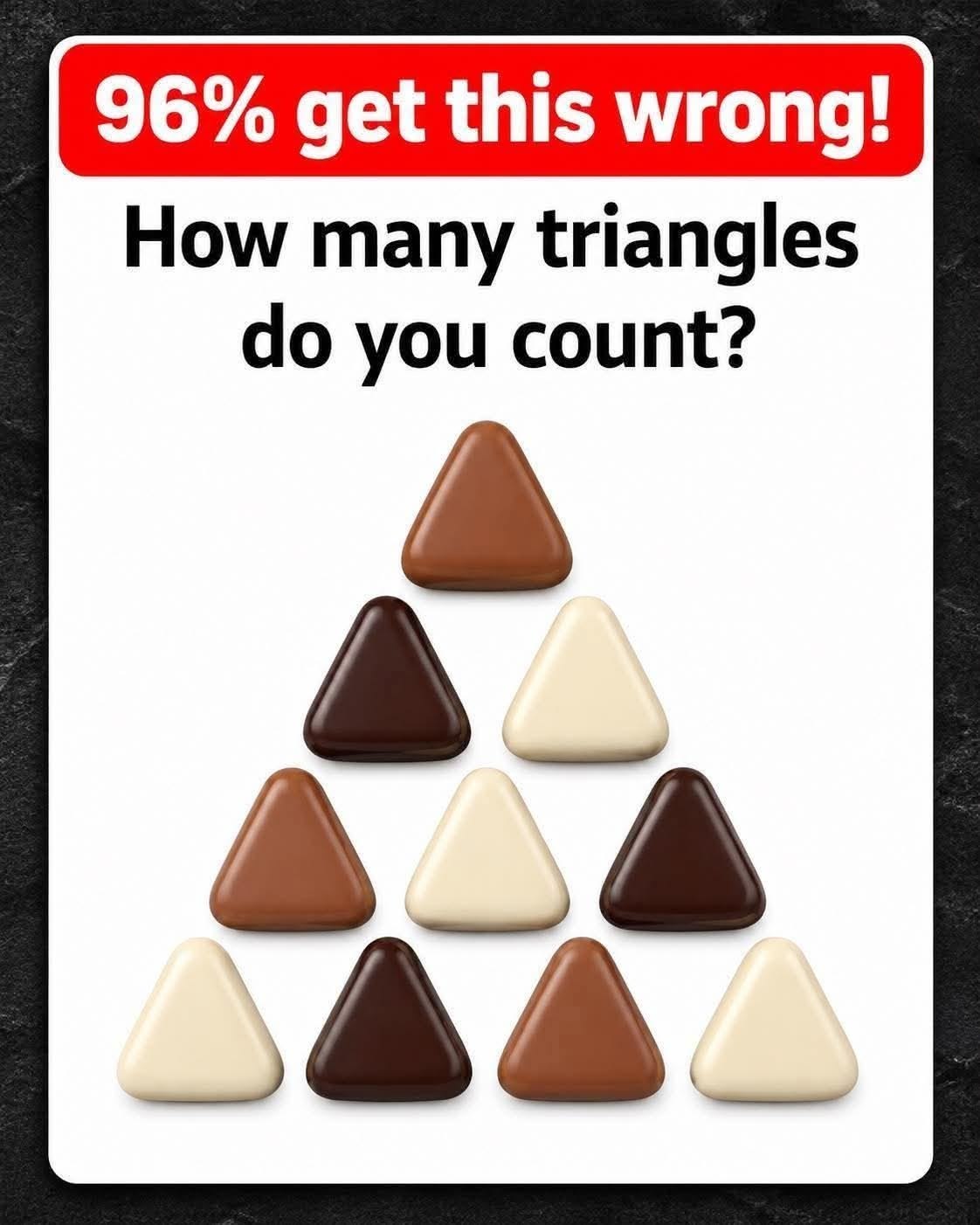
A widely shared viral puzzle shows 10 chocolate-like triangular candies stacked in four neat rows, accompanied by a bold challenge:
“96% get this wrong! How many triangles do you count?”
While the puzzle looks simple at first glance, the answer depends on whether you are counting just the individual pieces or calculating all the composite triangles formed by combining adjacent pieces within the grid.
In this guide, we break down both counting methods, analyze the grid math layer by layer, and reveal the exact totals for every interpretation.
Method 1: Counting the Individual Pieces
If you only count the physical single triangular objects displayed in the pyramid:
                  [ INDIVIDUAL PIECES BY ROW ]
                               |
      --------------------------------------------------
     |                  |                 |             |
 [ ROW 1 (TOP) ]    [ ROW 2 ]         [ ROW 3 ]     [ ROW 4 (BASE) ]
 • 1 Medium Brown   • 1 Dark Brown    • 1 Med Brown • 1 Cream
                    • 1 Cream         • 1 Cream     • 1 Dark Brown
                                      • 1 Dark      • 1 Med Brown
                                                    • 1 Cream
 • Count = 1        • Count = 2       • Count = 3   • Count = 4
Method 2: Counting All Upright Composite Triangles (Grid Math)
In geometric puzzle solving, adjacent triangular elements form larger overlapping upright triangles of varying sizes. Here is the systematic breakdown of all upright triangles formed by the layout:
1. Single-Piece Triangles (Size 1)
-
Every individual piece is a triangle.
-
Count: 10
2. 3-Piece Composite Triangles (Size 2)
-
Made by grouping 1 top piece with 2 pieces directly beneath it.
-
Top section (Rows 1–2): 1 triangle
-
Middle section (Rows 2–3): 2 triangles
-
Bottom section (Rows 3–4): 3 triangles
-
Count: $1 + 2 + 3 = \mathbf{6}$
3. 6-Piece Composite Triangles (Size 3)
-
Made by grouping 3 stacked rows together.
-
Upper half (Rows 1–3): 1 triangle
-
Lower left (Rows 2–4 left): 1 triangle
-
Lower right (Rows 2–4 right): 1 triangle
-
Count: $1 + 2 = \mathbf{3}$
4. 10-Piece Full Pyramid (Size 4)
-
The entire overall shape formed by all 4 rows combined.
-
Count: 1
Method 3: Counting Inverted (Downward-Pointing) Groups
If your visual spatial test includes upside-down triangular arrangements formed between the rows:
-
Rows 2 & 3: 1 downward group (2 top pieces + 1 middle bottom piece)
-
Rows 3 & 4: 2 downward groups (left pair + middle bottom piece, right pair + middle bottom piece)
Triangle Count Summary Table
| Category / Interpretation | Description | Count |
| Individual Pieces | Single triangular chocolate candies | 10 |
| Upright Composite Triangles | Size 1 (10) + Size 2 (6) + Size 3 (3) + Size 4 (1) | 20 |
| Inverted Composite Shapes | Downward-pointing piece combinations | 3 |
| TOTAL (All Upright Grid Triangles) | Standard Combinatorial Solution | 20 |
| TOTAL (Including Inverted Shapes) | Complete Spatial Solution | 23 |
The Answer
-
Standard Geometric Solution: 20 (All upright single and composite triangles).
-
Extended Solution: 23 (Including the 3 downward-pointing composite formations).
-
Literal Object Count: 10 (Just the individual candy pieces).
Why 96% of People Get It Wrong
-
Stopping at 10: Most casual viewers simply count the 10 visible chocolate pieces and move on, ignoring the larger sub-triangles created by combining them.
-
Missing Overlapping Combinations: When manually counting size-2 and size-3 composite triangles, people frequently double-count or skip overlapping sections along the middle columns.
Conclusion
The definitive mathematical answer to “How many triangles do you count?” is 20 upright triangles (or 23 if you count downward composite shapes).
Frequently Asked Questions (FAQ)
How many individual pieces are in the image?
There are 10 individual triangular pieces arranged in a 4-row pyramid (1, 2, 3, and 4 pieces per row).
What is the mathematical formula for counting triangles in a pyramid grid?
For a regular triangular grid with $n$ levels of upright triangles, the number of upright triangles is given by the 3D triangular number formula:
For $n = 4$ levels: