

How Many Numbers Can You See? The Viral Visual Illusion Solved
Overlapping number puzzles and optical brain teasers are a constant favorite on social media. They challenge our perception and cognitive agility by combining multiple alphanumeric shapes into a single continuous drawing.
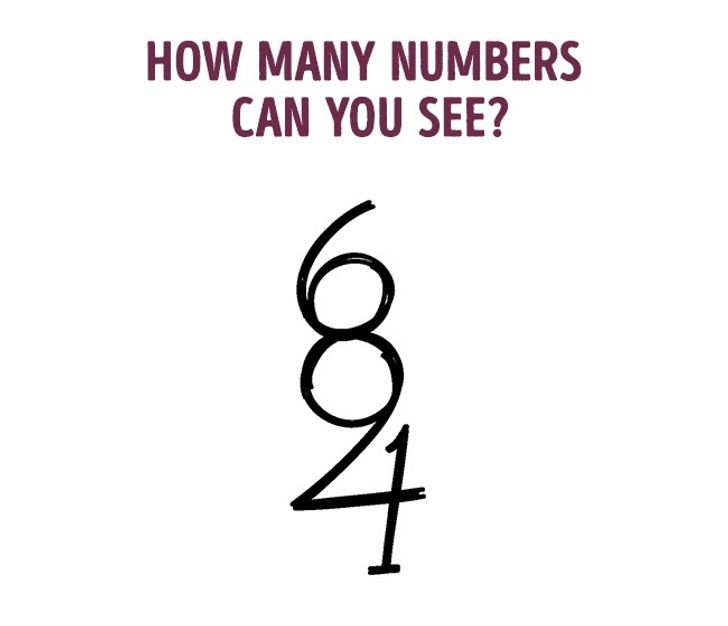
A popular visual puzzle asks a simple question above a stacked set of overlapping black numbers:
“HOW MANY NUMBERS CAN YOU SEE?”
At first glance, your eyes naturally spot the most prominent digits: the curved loop at the top, the central circle, or the sharp angles at the bottom. However, when you analyze the strokes, intersections, and negative space, almost every single digit from 0 to 9 can be decoded from the graphic.
In this guide, we break down every hidden digit embedded in the artwork, explain the cognitive science behind overlapping visual puzzles, and reveal the complete solution.
Deconstructing the Image: Digit-by-Digit Breakdown
By examining the top, middle, and bottom sections of the continuous line drawing, here is how all ten single-digit numbers ($0$ through $9$) are formed:
                    [ OVERLAPPING DIGIT STRUCTURE ]
                                   |
      -------------------------------------------------------------
     |                             |                               |
 [ TOP SECTION ]           [ MIDDLE SECTION ]          [ BOTTOM SECTION ]
 • 6 (Top loop & arc)      • 8 (Double stacked loops)  • 4 (Triangular base)
 • 9 (Inverted top loop)   • 0 (Central circle loop)   • 1 (Vertical stem at base)
 • 3 (Right curved arcs)   • 2 (Curved top to diagonal)• 7 (Top bar to diagonal stem)
                           • 5 (Top horizontal, loop)
1. The Obvious Primary Numbers
-
Number 6: Forms the entire upper section with the curved top tail sweeping down into the top loop.
-
Number 8: Made by combining the top loop and the lower loop in the middle.
-
Number 4: Found at the very bottom, formed by the horizontal crossbar, diagonal stem, and vertical base line.
-
Number 0: Represented by the central circle (the lower loop of the 8 or middle section).
2. The Secondary & Hidden Numbers
-
Number 1: The vertical straight line extending down at the bottom of the 4.
-
Number 2: Formed by the top curve of the middle loop, sweeping down along the diagonal line of the 4, and ending on the horizontal base.
-
Number 3: Formed by taking the right halves of the top loop and middle loop together.
-
Number 5: The top flat stroke, left down-stroke, and bottom curved loop of the middle section.
-
Number 7: Formed by the horizontal line of the 4 and the diagonal line going downward.
-
Number 9: An inverted version of the 6 using the top loop and vertical downward stroke.
Summary Matrix: All 10 Digits Hidden in Plain Sight
| Digit | Location in Image | Key Features / Strokes Used |
| 0 | Middle | The lower circular loop |
| 1 | Bottom | The straight vertical base stem |
| 2 | Middle to Bottom | Upper right arc down the diagonal to horizontal base |
| 3 | Right Side | Right half curves of upper and lower loops |
| 4 | Bottom | Triangular frame, horizontal bar, and vertical line |
| 5 | Middle | Top horizontal line connected to the lower loop arc |
| 6 | Top | Upper loop with extended top tail |
| 7 | Lower Middle | Horizontal cross line connected to the main diagonal line |
| 8 | Upper Middle | Stacked top and lower circular loops |
| 9 | Top | Top loop connected to the long downward stem |
The Psychology: Pareidolia and Figure-Ground Perception
Why do people see different quantities of numbers in this puzzle?
-
Gestalt Figure-Ground Perception: The brain tends to group lines into familiar whole shapes first (like a clear
6or4). Dissecting those shapes into secondary digits (2,5, or7) requires overriding automatic visual processing to isolate individual strokes. -
Cognitive Flexibility: People who frequently solve visual puzzles quickly recognize how shared lines work in overlapping graphic art, allowing them to decode all ten digits ($0–9$).
Conclusion
The complete answer to “How Many Numbers Can You See?” is 10! Every single digit from 0 through 9 is clever embedded into this single continuous line drawing.
Frequently Asked Questions (FAQ)
What is the official total number of digits in this puzzle?
The puzzle contains all 10 single-digit numbers ($0, 1, 2, 3, 4, 5, 6, 7, 8, 9$).
Which numbers are easiest to spot first?
Most viewers spot 6, 8, 0, and 4 first because their main outlines dominate the top, middle, and bottom sections.