

How Many Balls Are In This Picture? The Viral 3D Pyramid Puzzle Solved
Pyramid counting puzzles and spatial reasoning math riddles are viral favorites across social media. They challenge your 3D perception by asking you to calculate not just the visible objects on the surface, but also the hidden supporting objects beneath them.
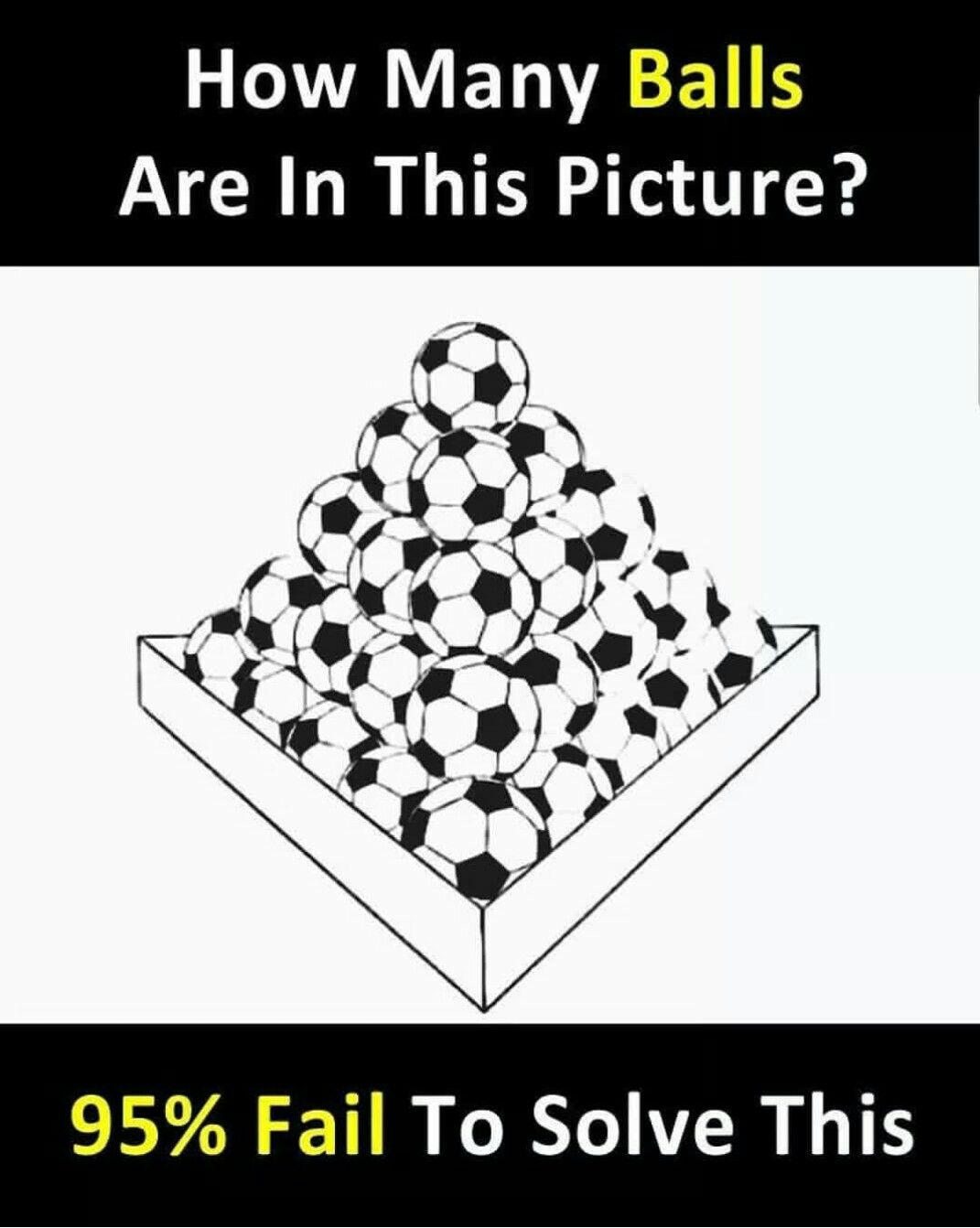
A classic 3D geometry teaser presents a stack of soccer balls arranged inside a square tray under a bold headline:
“How Many Balls Are In This Picture?”
“95% Fail To Solve This”
At first glance, many people simply count the soccer balls visible on the outer faces. However, to form a stable 3D square pyramid, every elevated ball must be supported by a full layer of balls directly underneath it.
In this guide, we break down the 3D geometry of square pyramid numbers, count each layer from top to bottom, and reveal the exact mathematical solution.
Deconstructing the Geometry: Layer-by-Layer Breakdown
The stack forms a standard square pyramid (where each level $n$ consists of a square grid of $n \times n$ balls).
                       [ PYRAMID STRUCTURE ]
                                 |
      -------------------------------------------------------
     |                  |                 |                  |
 [ LAYER 1 ]        [ LAYER 2 ]       [ LAYER 3 ]        [ LAYER 4 ]
  • Top level        • Second level    • Third level      • Base level
  • 1 x 1 = 1        • 2 x 2 = 4       • 3 x 3 = 9        • 4 x 4 = 16
1. Level 1 (Top Level)
-
Dimensions: $1 \times 1$
-
Total Balls: $1^2 = \mathbf{1}$ ball sitting at the very peak.
2. Level 2 (Second Level Down)
-
Dimensions: $2 \times 2$ grid
-
Total Balls: $2^2 = \mathbf{4}$ balls supporting the top ball.
3. Level 3 (Third Level Down)
-
Dimensions: $3 \times 3$ grid
-
Total Balls: $3^2 = \mathbf{9}$ balls supporting the upper two layers.
4. Level 4 (Base Level at the Bottom Tray)
-
Dimensions: $4 \times 4$ grid
-
Total Balls: $4^2 = \mathbf{16}$ balls forming the foundation in the square tray.
Mathematical Summary Table
To find the grand total, we sum the square numbers for each layer:
| Layer Level | Grid Dimensions | Mathematical Calculation | Number of Balls |
| Layer 1 (Top) | $1 \times 1$ | $1 \times 1$ | 1 |
| Layer 2 | $2 \times 2$ | $2 \times 2$ | 4 |
| Layer 3 | $3 \times 3$ | $3 \times 3$ | 9 |
| Layer 4 (Base) | $4 \times 4$ | $4 \times 4$ | 16 |
| GRAND TOTAL | Square Pyramid | $1 + 4 + 9 + 16$ | 30 |
The Answer
The total number of balls in the pyramid is 30.
Common Mistakes & Why 95% Fail
-
Only Counting Visible Surface Balls: Many viewers attempt to manually point and count only the visible soccer balls, landing on numbers like 16 or 20 while completely ignoring the interior hidden balls.
-
Ignoring Physics and 3D Structure: In gravity-bound 3D space, elevated balls cannot float; a single ball on layer 2 requires 4 supporting balls below it, and layer 3 requires 9 beneath that.
-
Miscounting the Base Dimensions: mistaking the $4 \times 4$ base grid for a $5 \times 5$ base grid. Counting the outer edge of the bottom tray clearly reveals 4 balls along each outer side.
Conclusion
The complete solution to “How Many Balls Are In This Picture?” is 30. By applying the formula for square pyramid numbers ($1 + 4 + 9 + 16$), we get the precise count accounting for both visible and structural support balls!
Frequently Asked Questions (FAQ)
What is the formula for calculating total balls in a square pyramid?
The total number of objects in a square pyramid of height $n$ is given by the sum of squares formula:
For a 4-layer pyramid ($n=4$):
How many layers are in this soccer ball pyramid?
There are 4 distinct layers starting from a $1 \times 1$ top down to a $4 \times 4$ base in the tray.