

Businessman vs. Entrepreneur: The Power of Value Addition & Innovation
While the terms “businessman” and “entrepreneur” are often used interchangeably, they represent two fundamentally different mindsets in commerce. A traditional businessman focuses on market trading and standard distribution, whereas an entrepreneur focuses on innovation, problem-solving, and unlocking hidden value within existing resources.
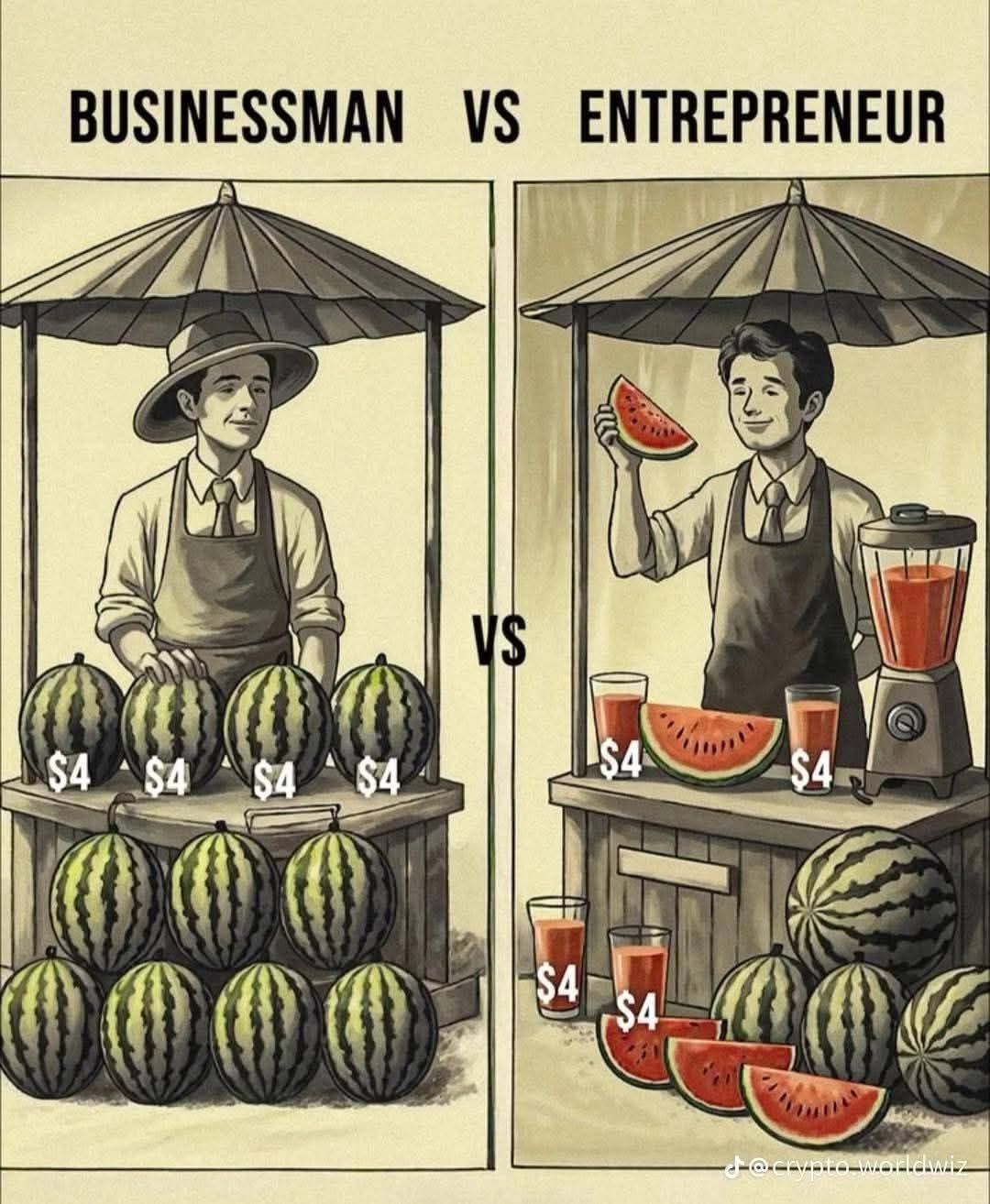
A popular visual graphic titled “BUSINESSMAN VS ENTREPRENEUR” clearly illustrates this concept using a fruit stand comparison:
-
The Businessman (Left): Sells whole watermelons directly off the stand for $4 each.
-
The Entrepreneur (Right): Uses a blender to transform watermelons into fresh juice, selling individual glasses for $4 each, alongside fresh slices.
Below, we explore the strategic differences between these two models and how adding value transforms basic commodities into highly profitable offerings!
The Core Difference: Trading vs. Transforming
1. Traditional Businessman (Direct Selling)
-
Strategy: Buys a commodity and resells it with a standard markup.
-
Volume Dependence: Revenue is strictly capped by the number of units available. If he sells 10 watermelons at $4 each, total revenue is $40.
-
Customer Appeal: Appeals only to buyers who want a full, uncut watermelon to take home.
2. Entrepreneurial Mindset (Value Addition)
-
Strategy: Processes raw materials into ready-to-consume products that solve immediate customer needs (convenience, refreshing drink on the go).
-
Multiplied Returns: One whole watermelon can yield several glasses of juice or multiple slices. By selling each glass for $4, the total revenue generated per watermelon multiplies significantly.
-
Customer Appeal: Expands the customer base to passersby who want a quick, convenient drink without carrying a heavy, uncut fruit.
Comparison Matrix: Commodity vs. Value-Added Product
| Business Attribute | Traditional Businessman | Entrepreneur |
| Product Type | Raw Commodity (Whole Watermelon) | Processed / Value-Added (Juice & Slices) |
| Price Point | $4 per whole fruit | $4 per glass / slice |
| Revenue per Unit | Fixed ($4 max per fruit) | Multiplied ($12–$20+ per fruit) |
| Customer Need Served | Grocery purchasing | Immediate convenience & refreshment |
| Key Advantage | Lower effort, lower setup | Higher profit margins & market differentiation |
3 Key Takeaways for Aspiring Entrepreneurs
1. Identify Unmet Customer Needs
A customer walking down the street on a hot day might not want to carry a 10-pound watermelon, but they will gladly pay $4 for a cold glass of fresh juice. Innovation starts by understanding what makes life easier or more enjoyable for the consumer.
2. Focus on Value Addition Over Volume
Instead of competing purely on price or trying to sell more raw units, ask yourself: How can I transform my product to make it significantly more valuable to the buyer?
3. Reinvest in Tools and Systems
The entrepreneur invested in a blender, cups, and preparation tools to unlock a higher price point. Strategic investments in tools and processing systems are what enable scalable growth.
Conclusion
Both approaches have their place in the economy, but true entrepreneurial success comes from looking at standard resources through a lens of transformation. By turning simple watermelons into fresh, accessible juice, the entrepreneur shows that creativity and convenience will always command premium value!
Frequently Asked Questions (FAQ)
What is the definition of value addition in business?
Value addition refers to enhancing a raw product or service through processing, packaging, branding, or convenience, allowing a business to sell it at a higher profit margin.
Why do customers pay more per unit for processed goods?
Customers pay for convenience, time savings, and immediate utility. Purchasing a ready-to-drink beverage eliminates the labor of cutting, blending, and serving it themselves.