


Which Glass Has More? The Science Behind Volume Perception Riddles
Visual puzzles that compare liquid levels across differently shaped glasses are popular tools for testing critical thinking and spatial awareness. Our minds naturally judge liquid volume based on height, often overlooking how the width, taper, and tilt of a container alter internal capacity.
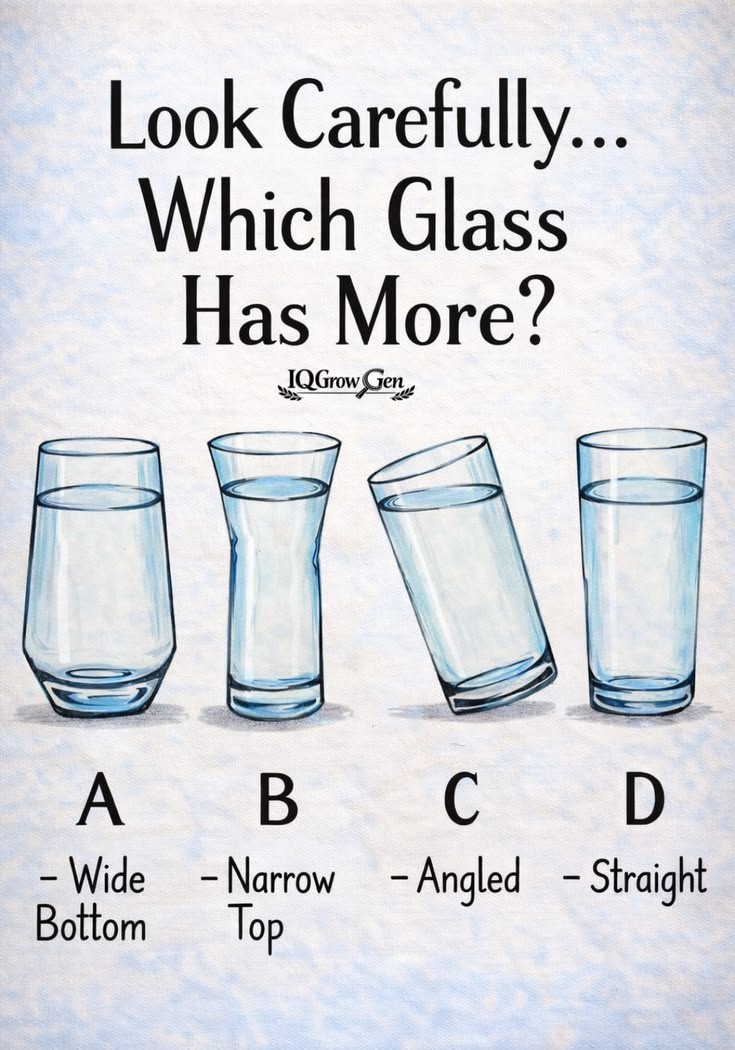
A widely shared visual puzzle asks a simple question:
“Look Carefully… Which Glass Has More?”
The graphic illustrates four distinct glasses filled with water, labeled A, B, C, and D:
-
Glass A (Wide Bottom): A bulbous glass that narrows significantly near the top rim, filled almost to the brim.
-
Glass B (Narrow Top/Middle): An hourglass-shaped glass with a wide base and flared rim, but a pinched, narrow middle section.
-
Glass C (Angled): A standard cylinder glass tilted at an angle, showing liquid settled horizontally.
-
Glass D (Straight): A classic, uniform cylindrical glass filled to a high water level.
Below, we analyze the geometric principles behind each container to determine which glass actually holds the greatest volume of liquid!
Geometric & Volume Analysis
To find out which glass contains the most liquid, we examine the cross-sectional area and fill height of each shape:
1. Glass A (Wide Bottom)
-
Shape Profile: Has a significantly wider base and midsection that holds a larger volume per unit of height.
-
Liquid Height: Filled very high near the narrow opening.
-
Volume Analysis: Because the vast majority of the glass’s height consists of its wide, expanded lower half, the overall displacement capacity is greater than that of uniform or pinched glasses filled to similar vertical heights.
2. Glass B (Narrow Top / Pinch)
-
Shape Profile: Features a pinched middle waist that drastically restricts internal volume.
-
Volume Analysis: Even though the top rim flares outward, the narrow central column removes a substantial amount of liquid capacity, making it hold less than a straight cylinder.
3. Glass C (Angled Cylinder)
-
Shape Profile: A standard cylindrical container resting on a tilted axis.
-
Volume Analysis: While tilting makes the water line appear high on one side, the effective average liquid level is lower than that of an upright glass filled near the top.
4. Glass D (Straight Cylinder)
-
Shape Profile: A uniform cylinder with constant cross-sectional area from top to bottom.
-
Volume Analysis: Provides a solid volume baseline ($V = \pi r^2 h$), but lacks the expanded belly capacity of Glass A.
Comparison Matrix: Glass Characteristics & Volume Capacity
| Glass | Geometry Type | Key Volumetric Feature | Relative Volume Rank |
| A | Wide Bottom / Bulbous | Expanded base stores maximum liquid volume | #1 (Highest Volume) |
| B | Hourglass / Pinched | Middle constriction reduces capacity | #4 (Lowest Volume) |
| C | Tilted Cylinder | Angled orientation lowers total fill level | #3 |
| D | Straight Cylinder | Uniform width from base to rim | #2 |
The Winner: Why Glass A Has the Most Water
Glass A holds the highest volume of liquid.
Because the entire lower two-thirds of Glass A expands outward into a wide bowl, its cross-sectional area is far larger than the standard straight walls of Glass D or the pinched waist of Glass B. Combined with a fill level that reaches near the top of the glass, the total liquid mass inside Glass A exceeds all other options.
Conclusion
Optical illusions often trick us into evaluating liquid volume solely by height rather than cross-sectional area. Understanding how shapes expand and constrict allows us to see past visual tricks and solve spatial riddles with ease!
Frequently Asked Questions (FAQ)
Why do wide-bottom glasses hold more liquid than straight ones?
A glass with an expanded lower half increases its internal radius ($r$). In volume formulas like $V = \pi r^2 h$, increasing the radius has a squared effect on total volume compared to height alone.
What optical illusion makes Glass A look smaller to some viewers?
The narrowing top rim of Glass A creates an illusion of compactness, leading viewers to focus on the pinched opening rather than the large, voluminous base beneath it.