


Word Search Personality Test: What Do the First 3 Colors You See Reveal?
Visual word search games and subconscious personality tests are some of the most shared content across social media platforms.
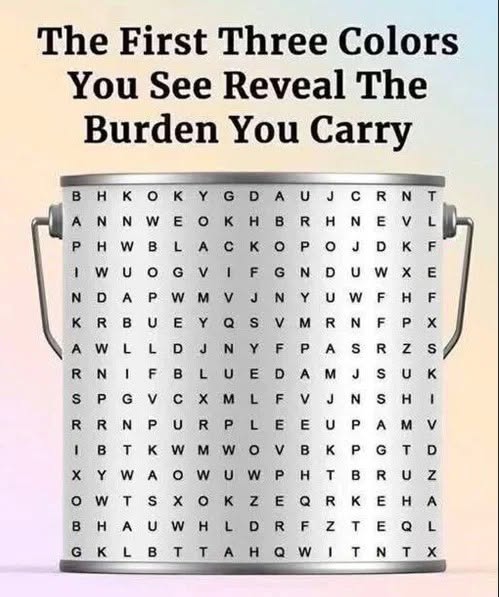
In this viral image challenge, a paint can is covered in a grid of random letters containing hidden color names, titled:
“The First Three Colors You See Reveal The Burden You Carry”
While these word search tests are meant for fun entertainment rather than clinical psychological diagnosis, the psychology of visual perception—specifically selective attention and color symbolism—explains why certain words instantly grab our attention over others!
Below, we break down the hidden colors in this puzzle and what color psychology says about each one.
Hidden Colors in the Word Search
If you look closely at the paint can letter grid, several horizontal and vertical color names are woven into the puzzle:
-
BLACK: Row 3 (Horizontal, columns 4–8)
-
BLUE: Row 8 (Horizontal, columns 6–9)
-
PURPLE: Row 10 (Horizontal, columns 4–9)
-
PINK: Column 1 (Vertical, rows 3–6)
-
RED: Column 1 (Vertical, rows 8–10)
-
YELLOW: Diagonal / Scattered patterns across rows
Color Psychology: What Your Selection Symbolizes
In psychological color theory, different colors trigger distinct subconscious associations and emotional responses:
1. Blue (Calmness & Overthinking)
If your eyes spot BLUE first, you may be carrying the weight of constant responsibility. Blue is associated with logic, structure, and peace, suggesting a desire for mental clarity amidst a busy schedule.
2. Black (Protection & Boundaries)
Spotting BLACK often highlights a need for privacy or self-protection. It symbolizes strength, mystery, and formal boundaries, indicating you might be holding back your true thoughts to avoid conflict.
3. Purple (Creativity & High Expectations)
Finding PURPLE points toward ambivalence between intuition and ambition. Historically tied to royalty and creativity, it often reflects internal pressure to achieve personal perfection or artistic vision.
4. Pink (Empathy & Emotional Caregiving)
Seeing PINK suggests your primary focus is on nurturing relationships. It represents compassion and warmth, meaning your burden might stem from putting others’ emotional needs ahead of your own.
5. Red (Urgency & Passion)
Detecting RED indicates high energy or immediate stress. Red triggers heightened alertness, signaling that you might be navigating high-stakes decisions or emotional intensity.
Color Symbolism Overview Table
| Color | Location in Grid | Subconscious Association | Common Emotional Focus |
| Blue | Row 8 (Horizontal) | Stability, peace, logic | Overthinking & responsibility |
| Black | Row 3 (Horizontal) | Boundaries, defense, strength | Privacy & emotional guarding |
| Purple | Row 10 (Horizontal) | Vision, wisdom, ambition | High self-expectations |
| Pink | Column 1 (Vertical) | Affection, care, sensitivity | Caregiver fatigue |
| Red | Column 1 (Vertical) | Intensity, passion, speed | Urgency & stress management |
Why Visual Word Search Tests Go Viral
-
Priming & Visual Scanning: Words near the top or written horizontally in standard reading order (like BLACK and BLUE) are naturally detected faster by our brain’s visual cortex.
-
Self-Reflection: Personality prompts give us a fun, low-stakes opportunity to reflect on our current mindset and mood.
-
Social Engagement: Comparing results with friends creates lively discussion around shared personality traits!
Conclusion
Whether you saw Blue, Black, Purple, or Pink first, these visual games offer a fun spark for self-reflection. While a word search can’t actually read your subconscious mind, exploring what colors resonate with you is a great way to check in on your mental well-being!
Frequently Asked Questions (FAQ)
Is there real science behind word search personality tests?
These specific puzzles are for entertainment, but the underlying mechanisms—selective attention and cognitive priming—are well-documented psychological phenomena.
Why do horizontal words stand out faster than vertical ones?
Because most languages are written horizontally from left to right, our visual system is naturally trained to scan horizontal letter patterns much faster than vertical ones