

Frog or Horse? The Rotating Optical Illusion Solved
Ambiguous figure illusions and orientation-dependent visual riddles are classic drivers of viral engagement across social media. They test how human perception changes based on spatial orientation by presenting a single artwork that reveals two completely different animals depending on the angle at which it is viewed.
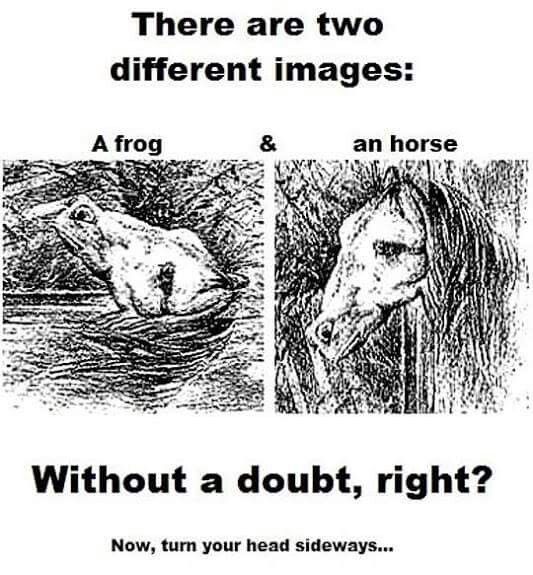
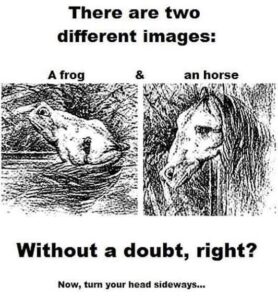
A widely shared visual challenge displays two side-by-side frames with the prompt:
“There are two different images:
A frog & an horse
Without a doubt, right?
Now, turn your head sideways…”
While the post presents them as two distinct side-by-side pictures, close inspection reveals a mind-bending visual trick: they are the exact same image, simply rotated by 90 degrees!
In this guide, we break down how the visual transformation works, compare the key features in both orientations, and explain the perceptual psychology behind ambiguous figures.
Deconstructing the Illusion: Frog vs. Horse
When viewed in its standard horizontal alignment, the image depicts a frog sitting near water. When rotated 90 degrees counterclockwise (or tilting your head to the right), the exact same lines transform into the head and mane of a horse.
                    [ ROTATION MAP & FEATURE MAPPING ]
                                     |
      --------------------------------------------------------------
     |                                                              |
 [ STANDARD ORIENTATION: FROG ]                  [ 90° ROTATED: HORSE ]
 • Frog's eye & nostril                         • Horse's eye & nostril
 • Frog's body & legs resting in water          • Horse's head & jawline
 • Water ripples / shading background           • Horse's flowing mane & background
Feature-by-Feature Mapping:
-
The Eye and Nostril: The dark circular spot forming the frog’s eye becomes the nostril/muzzle area of the horse when turned.
-
The Body to Head Transformation: The rounded, horizontal body of the frog sitting on a bank becomes the elongated face and forehead of the horse.
-
The Water Ripples to Horse Mane: The shadowed, textured lines under the frog representing lily pads or water ripples turn into the textured, flowing mane of the horse.
Visual Comparison Table
| Image Feature | Standard View (Left Frame) | 90° Rotated View (Right Frame) |
| Primary Subject | A Frog | A Horse Head |
| Central Focal Point | Frog’s head pointing left | Horse’s head pointing down/left |
| Textured Shading | Water ripples / ground leaves | Horse’s mane / hair texture |
| Dark Curved Accent | Frog’s rear leg & back fold | Horse’s jawline & ear contour |
The Answer
No, they are not two different drawings!
The image on the left and the image on the right are the exact same illustration. The right image is simply the left image rotated 90 degrees counterclockwise.
The Perception Science: Why Rotation Changes What We See
-
Orientation-Dependent Pattern Recognition: Human visual processing relies heavily on orientation relative to gravity. The brain groups lines and shadows into recognizable objects based on expected vertical/horizontal axes.
-
Mental Schema Priming: When text tells the viewer to look for a “frog,” the brain searches for horizontal frog features. When told to see a “horse,” rotating the image primes the visual cortex to recognize equine facial proportions.
Conclusion
The answer to “Without a doubt, right?” is that the two frames are identical artwork shown at different angles. Whether you see a frog or a horse depends entirely on how you orient your head!
Frequently Asked Questions (FAQ)
Are there two different drawings in this puzzle?
No, it is a single drawing shown in two different orientations (0° and 90° rotation).
What animal appears when you tilt your head?
When viewing the frog horizontally, tilting your head 90 degrees to the right reveals the face and mane of a horse.