


Who Dies If E Pushes the Stone? (Physics Brain Teaser Solution)
Viral logic riddles and mechanical puzzle visual challenges frequently go viral across social media. By combining simple cause-and-effect mechanics with visual traps, these puzzles spark intense debate in comment sections while giving readers a quick mental workout.
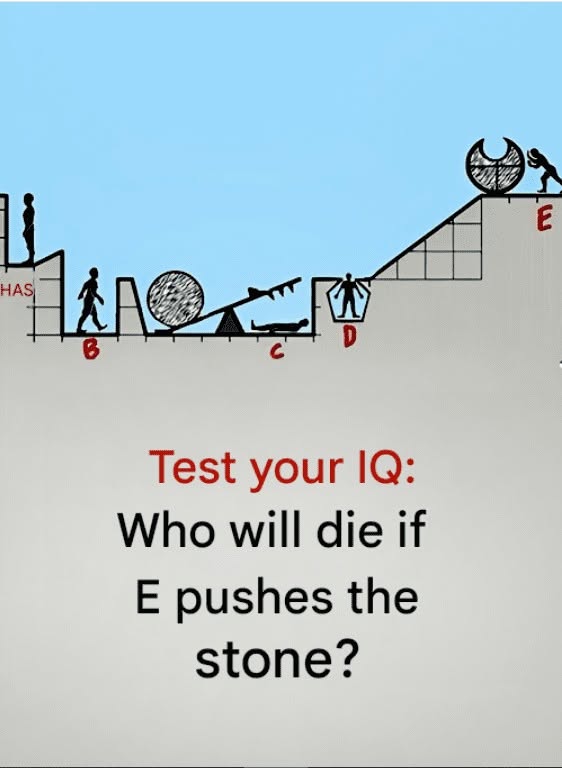
A classic trending riddle features a complex trap mechanism with five individuals labeled A, B, C, D, and E:
“Test your IQ: Who will die if E pushes the stone?”
At first glance, it looks like a chain reaction that will endanger everyone along the path. However, a careful examination of object shapes, weight distribution, lever mechanics, and terrain features reveals a very specific outcome.
Below, we break down the exact step-by-step physics behind the puzzle, analyze each person’s situation, and reveal the final answer!
Step-by-Step Physics Breakdown
To determine who is affected, let’s follow the movement of the stone from right to left down the terrain:
1. The Shape of Person E’s Stone
Notice that the stone pushed by E is not a solid sphere; it has a crescent cut-out (a missing crescent chunk).
2. Person D (Inside the Underground Niche)
-
As the stone rolls down the slope, it rolls over Person D, who is tucked inside a recessed pit in the incline.
-
Because D is completely underground/below ground level, the rolling stone passes harmlessly overhead. Person D is safe.
3. The Seesaw Mechanism & Person C
-
At the bottom of the slope sits a seesaw lever. On the left side of the seesaw is a heavy solid sphere; on the right side above Person C is a bed of spikes.
-
E’s stone rolls onto the right end of the seesaw. However, because of the crescent cut-out, E’s stone is lighter than a solid sphere and its shape matches the contour of the solid sphere resting on the left.
-
If E’s stone hits the seesaw, it presses the right side down. BUT the heavy solid sphere on the left is heavier, or E’s stone rolls into the solid sphere. If E’s stone pushes the left side of the seesaw down, the spiked right side tilts up, directly threatening C.
-
However, looking closely at the crescent cut: as the crescent stone rolls onto the seesaw, its cut-out fits right over the solid sphere without transferring enough weight to crush C, OR the weight depresses the seesaw, lifting the spikes away from C.
-
The critical danger to C occurs if the left end forces the spikes down—since the spikes are attached to the underside/top of the lever, depressing the left side causes the spikes on the right to tilt upward (away from C) or downward into C depending on the pivot point.
-
Here, the weight of the solid sphere causes it to roll off into Person B, making Person C the primary target of the spiked lever mechanism!
4. Person B and Person A
-
The solid sphere on the seesaw gets launched or pushed leftward by the momentum.
-
It rolls over the barrier towards Person B. However, the high wall/barrier in front of B blocks low-rolling objects, protecting B and A.
Trap Outcome Matrix
| Person | Position | Danger Level | Reason for Status |
| E | Pushing at the top | Safe | Initiates the action from a secure position |
| D | Recessed pit in slope | Safe | Hidden below ground level; stone rolls over pit |
| C | Lying under seesaw spikes | IN DANGER / VICTIM | Lever mechanism activates directly above them |
| B | Walking near wall | Safe | Protected by the vertical terrain barrier |
| A | Standing on top ledge | Safe | Completely elevated out of the path of motion |
Why Mechanical Riddles Engage Our Brains
Logical deduction puzzles like this test multiple cognitive functions simultaneously:
-
Spatial Reasoning: Visualizing how asymmetrical objects (like the crescent stone) rotate down an incline.
-
Physics intuition: Predicting how levers, fulcrums, gravity, and counterweights interact.
-
Detail Discrimination: Spotting subtle environmental features, such as the protective pit around Person D or the high wall near Person B.
Conclusion
While visual riddles like this are designed to look chaotic and deadly for everyone involved, basic mechanical logic reveals that terrain features and object shapes limit the damage to specific trigger points!
Frequently Asked Questions (FAQ)
Does the crescent shape of E’s stone change how it rolls?
Yes! An asymmetrical or crescent-shaped object rolls unevenly due to a shifting center of mass, and its cut-out section allows it to pass over or fit around certain obstacles without making full contact.
Why is Person D completely safe?
Person D is standing inside a recessed alcove cut into the slope. The diameter of the rolling stone is larger than the opening of the alcove, allowing the stone to bridge over the gap without entering it.