


Visual puzzles and brain teasers have taken the internet by storm, capturing the imagination of millions who love testing their observation skills. Among the most popular challenges online are optical illusions and hidden-object image tests featuring pets. At first glance, a simple graphic might appear straightforward, but closer inspection often reveals cleverly concealed details that trip up even the sharpest eyes.
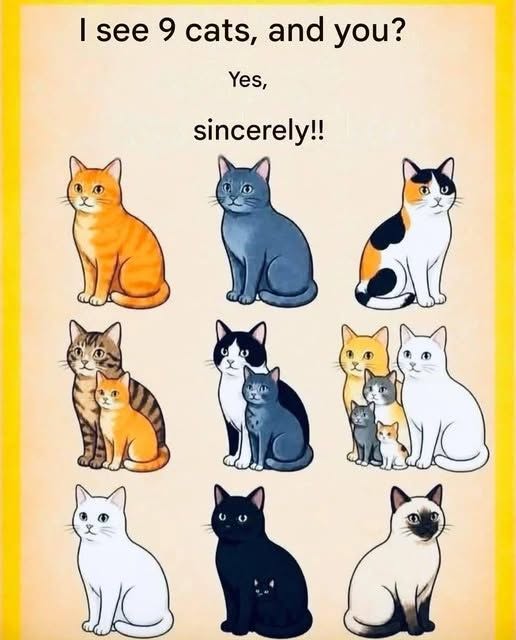
A recently viral image titled “I see 9 cats, and you?” has left pet lovers and puzzle enthusiasts debating the actual number of felines present in the graphic. While casual viewers quickly count nine primary cats standing in a neat grid, eagle-eyed observers notice smaller kittens nestled within the coats, shadows, and outlines of the larger figures.
In this comprehensive guide, we will break down the exact solution to this visual challenge, explore the cognitive science behind visual perception tests, discuss how optical illusions exercise your brain, and share expert insights on feline behavior and pet wellness.
Deconstructing the Puzzle: Row-by-Row Cat Breakdown
To arrive at the correct answer, you must look beyond the prominent figures standing in each row. The artist designed this puzzle by nesting smaller silhouettes and kittens against the fur patterns of larger cats. Let us inspect each row step-by-step.
The Top Row: Simple Direct Observations
The top row acts as a warm-up for your eyes, setting up a deceptive pattern that makes you expect single cats throughout the entire grid:
-
Top-Left Corner: A vibrant orange tabby cat sitting upright, looking toward the viewer.
-
Top-Middle Position: A smooth slate-gray cat seated quietly with a neutral expression.
-
Top-Right Corner: A distinct calico cat featuring black, orange, and white patches.
Count for Top Row: 3 Cats
The Middle Row: Hidden Kittens Revealed
This is where the optical trickery begins. Many viewers skim through these figures without noticing the smaller felines standing directly in front of or inside the larger outlines:
-
Middle-Left Position: A large brown tabby standing behind a smaller, bright orange kitten resting right against its chest. That makes 2 cats in this spot.
-
Middle-Center Position: A classic tuxedo cat (black and white) standing behind a smaller blue-gray kitten nestled in front. That makes 2 cats in this spot.
-
Middle-Right Position: A complex cluster consisting of an orange cat on the far left, a gray kitten in the center, a tiny gray kitten below it, a miniature white kitten at the base, and a larger sleek white cat framing the right side. That makes 5 cats grouped in this single tile.
Count for Middle Row: 9 Cats
The Bottom Row: Subtle Shadows and Silhouettes
The final row combines straightforward designs with subtle contrast tricks that test your contrast sensitivity:
-
Bottom-Left Corner: A sleek, solid white cat facing forward.
-
Bottom-Middle Position: A solid black cat that conceals a tiny black kitten silhouette right on its chest/belly area. Because the kitten matches the mother cat’s dark fur, it is extremely easy to miss unless your screen brightness is adjusted properly. That makes 2 cats in this spot.
-
Bottom-Right Corner: A classic Siamese cat with distinct dark points on its ears, face, paws, and tail.
Count for Bottom Row: 4 Cats
The Final Tally
When you add up every feline hidden across the nine main panels, the grand total is 16 cats!
If you initially counted only 9, do not feel discouraged—the puzzle was specifically styled with a grid layout to trick your brain into assuming one cat per box.
The Neuroscience of Optical Illusions and Brain Teasers
Why do so many people miss the hidden animals in visual challenges like this one? The answer lies in how the human visual cortex processes incoming graphics.
1. Pattern Recognition and Mental Shortcuts
The human brain relies heavily on heuristics, or mental shortcuts, to process vast amounts of visual information quickly. When you look at a 3×3 grid, your brain instinctively categorizes each frame as containing a single object. This visual expectation causes you to gloss over smaller details inside each box.
2. Contrast Sensitivity and Figure-Ground Segregation
Figure-ground segregation is the process by which our visual system separates an object (the figure) from its background. In the bottom-middle panel of the puzzle, the black kitten blends seamlessly into the black parent cat. Without high contrast, your visual processor groups both shapes into a single entity.
3. Cognitive Enhancement and Mental Agility
Regularly engaging with optical illusions, pattern identification games, and lateral thinking puzzles offers genuine cognitive benefits:
-
Enhanced Focus: Forces your visual attention to slow down and scan details systematically.
-
Improved Working Memory: Helps keep multiple pieces of visual information active in your short-term memory.
-
Neuroplasticity Support: Stimulates neural pathways associated with visual perception and problem-solving.
Fascinating Facts About Feline Sight and Behavior
While we test our human vision on cat graphics, it is equally intriguing to understand how cats view us and the world around them.
Did You Know? Cats have a visual field of approximately 200 degrees, compared to 180 degrees in humans. This wider peripheral vision helps them spot quick movements in their surroundings.
Night Vision Superpowers
Cats are crepuscular, meaning they are most active during dawn and dusk. Their eyes contain a high concentration of rod photoreceptors, allowing them to see in light levels six times lower than what humans require. Additionally, a reflective layer behind their retina called the tapetum lucidum acts like a mirror, reflecting light back through the retina to maximize night vision.
Color Perception in Cats
Contrary to popular belief, cats are not completely colorblind. However, their color vision is similar to a human with red-green color blindness. They primarily perceive shades of blue, green, and yellow, while red and pink hues appear washed out or gray to them.
Practical Pet Care: Ensuring Healthy Vision and Wellness for Your Cat
If you share your home with furry companions, keeping their health in top shape requires proactive attention to their physical, nutritional, and financial well-being.
+-------------------------------------------------------------------+
|                   ESSENTIAL CAT HEALTH CHECKLIST                  |
+-------------------------------------------------------------------+
| 1. Annual Veterinary Checkups & Vaccinations                      |
| 2. Balanced Nutrition & Fresh Water Access                        |
| 3. Regular Eye & Dental Examinations                              |
| 4. Comprehensive Pet Health Insurance Coverage                   |
| 5. Daily Mental & Physical Stimulation                            |
+-------------------------------------------------------------------+
Comprehensive Pet Insurance and Healthcare Management
Unexpected medical emergencies can arise at any point in a pet’s life. From accidental injuries to chronic conditions such as feline diabetes or eye infections, veterinary care costs can add up quickly.
Securing comprehensive pet health insurance early in your pet’s life helps safeguard your personal finance budget against unforeseen medical costs. Many modern insurance plans offer flexible options that cover diagnostic testing, emergency surgery, prescription medication, and routine wellness visits.
Financial Planning for Pet Owners
Managing long-term pet care costs involves incorporating veterinary expenses directly into your personal budgeting and investment strategy. Maintaining a dedicated emergency savings fund or line of credit specifically set aside for medical emergencies provides peace of mind and ensures your pets receive immediate treatment when needed.
Frequently Asked Questions (FAQ)
How many cats are actually in the image?
There are 16 cats in total scattered across the grid when you count all the small kittens and hidden silhouettes.
Why did I only see 9 cats at first glance?
The 3×3 grid layout creates a visual bias, leading your visual processing system to assume there is only one central subject per frame.
Are visual perception puzzles good for cognitive health?
Yes! Solving visual puzzles regularly helps sharpen attention to detail, enhances spatial reasoning, and promotes mental agility across all age groups.
Conclusion
Visual puzzles like this cat challenge offer a delightful way to test our observational skills, give our brains a mini-workout, and share fun moments with friends online. Whether you spotted all 16 cats right away or needed a quick hint, taking time to slow down and observe details is a rewarding mental exercise.
Share this article with fellow puzzle lovers and pet enthusiasts to see if they can beat the 9-cat visual trap!