

Can You Read This? Decoding the Human Typography Brain Teaser
Human typography—the art of arranging human bodies to form letters and words—has long been a favorite tool in visual advertising and brain teasers. By transforming organic shapes into structured lettering, these visual puzzles test our brain’s capacity for pattern recognition and letter form isolation.
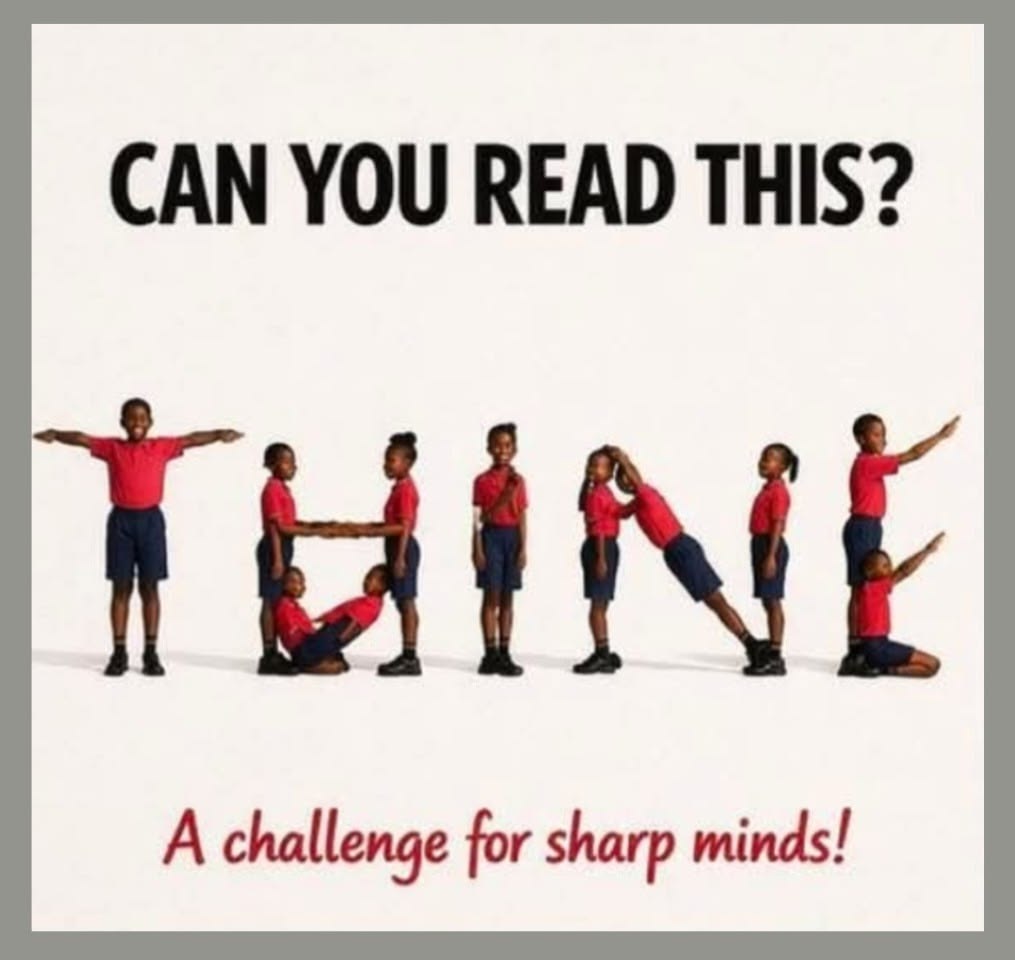
A viral brain teaser asking “CAN YOU READ THIS?” features a group of children wearing red shirts and dark shorts posing to spell out a word across a white background, accompanied by the caption:
“A challenge for sharp minds!”
At first glance, your mind tries to quickly piece together the letter forms. Depending on whether you read the literal body poses or mistake the second letter for an “H,” viewers often get caught between reading THINK or THINE.
In this guide, we visually break down each human letter posture, decode the intentional word, and explain why human typography puzzles generate so much engagement.
Deconstructing the Image: Letter-by-Letter Breakdown
By examining the poses of the kids from left to right, we can map each human configuration directly to its corresponding uppercase letter:
                    [ HUMAN TYPOGRAPHY STRUCTURE ]
                                  |
      -------------------------------------------------------------
     |          |             |              |                    |
 [ LETTER T ] [ LETTER H ] [ LETTER I ]  [ LETTER N ]        [ LETTER K ]
 • 1 child    • 4 children • 1 child     • 2 children        • 2 children
 • T-pose     • Frame pose • Standing    • Vertical + Slant  • Vertical + Arms
1. Letter “T” (First Position)
-
Configuration: 1 child standing straight with arms fully extended horizontally to the sides, forming a classic uppercase T.
2. Letter “H” (Second Position)
-
Configuration: 4 children working together. Two stand vertically as the outer pillars while holding hands across the top, and two crouch/lean together at the bottom to form the structural base of an uppercase H.
3. Letter “I” (Third Position)
-
Configuration: 1 child standing straight up with arms resting at their sides, forming a simple vertical line for the letter I.
4. Letter “N” (Fourth Position)
-
Configuration: 2 children. One child stands upright on the left forming the vertical stem, while the second child leans diagonally downward to the right to create the diagonal slash of an uppercase N.
5. Letter “K” (Fifth Position)
-
Configuration: 2 children. One child stands straight/kneels as the main vertical stem, while the other extends arms and legs upward and downward at diagonal angles to form the upper and lower arms of an uppercase K.
Comparative Matrix: “THINK” vs. Misread Variations
| Visual Position | Target Letter | Common Misread | Why It Happens |
| 1 | T | T | Unambiguous single-body T-pose |
| 2 | H | H | Clearly formed four-child rectangular frame |
| 3 | I | I | Straight vertical posture |
| 4 | N | N | Lean forms the diagonal stroke |
| 5 | K | E | Angled limbs can briefly look like horizontal bars of an E (leading to “THINE”) |
The Answer
The word spelled out in the picture is THINK.
The Science of Visual Pattern Recognition
Why do visual letter puzzles perform so effectively on social media platforms?
-
Pareidolia and Shape Recognition: The human brain is an efficient pattern-matching engine. When confronted with human figures arranged geometrically, the brain works rapidly to resolve the abstract shapes into familiar alphanumeric symbols.
-
Cognitive Delay (Stroop Effect Variation): Because human bodies aren’t rigid fonts, your eyes spend extra micro-seconds verifying the limbs and torso angles before confirming the final word, creating a rewarding “aha!” moment.
Conclusion
The answer to “Can You Read This?” is THINK. By combining creative human typography with high-contrast presentation, this teaser offers a fun, quick exercise in visual interpretation!
Frequently Asked Questions (FAQ)
What word is spelled out in the “Can You Read This?” puzzle?
The word is THINK.
Why do some people read “THINE” instead of “THINK”?
The final letter (K) uses angled arms and legs that, at a quick glance, can be misidentified as the three horizontal bars of an E.