

The Japanese Legend of the Train: Why Delaying Bad Decisions Costs You More
Inspirational proverbs and life metaphors paired with clean illustrations consistently spark reflection and high engagement across social media. By framing life choices through the universal experience of train travel, this wisdom image delivers a practical lesson on personal accountability, decision-making, and sunk cost fallacy.
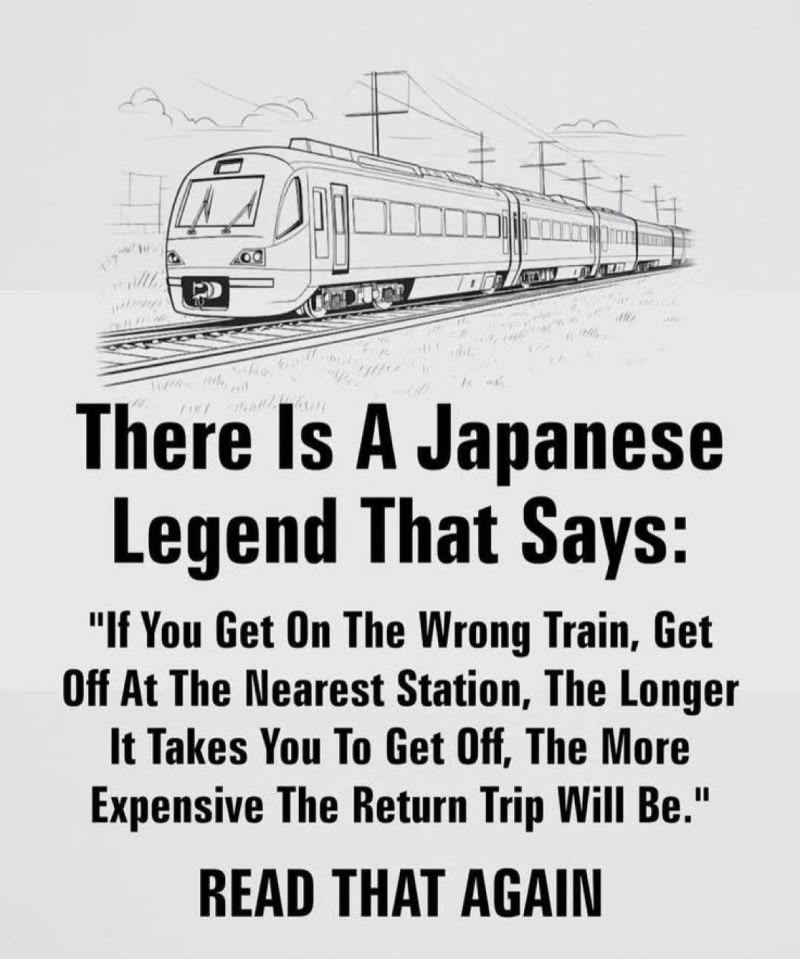
An illustration of a modern passenger train traveling along tracks displays the quote:
There Is A Japanese Legend That Says:
“If You Get On The Wrong Train, Get Off At The Nearest Station, The Longer It Takes You To Get Off, The More Expensive The Return Trip Will Be.”
READ THAT AGAIN
While presented as an ancient proverb or legend, this quote serves as a modern metaphor for human behavior. The core message is straightforward: recognizing a mistake early and correcting course immediately saves time, effort, emotional energy, and resources.
In this guide, we break down the deeper psychological meaning of this quote, examine the “sunk cost fallacy,” and share practical strategies for making timely course corrections in life.
Breakdown of the Metaphor & Key Concepts
The image uses train travel as a direct analogy for personal decisions and commitments:
                      [ METAPHOR ANALYSIS OVERVIEW ]
                                    |
      --------------------------------------------------------------
     |                              |                               |
  [ THE WRONG TRAIN ]        [ THE NEAREST STATION ]      [ THE EXPENSIVE RETURN ]
 • Symbolizes a bad path,     • Represents immediate       • Symbolizes the growing cost
   misaligned goal, or habit    realization & action         of delaying a necessary exit
Key Symbolic Elements:
-
The Wrong Train: Represents taking a job, entering a relationship, pursuing a goal, or adopting a habit that does not align with your true values or destination.
-
The Nearest Station: Represents the present moment and the first available opportunity to stop, reassess, and make a change.
-
The Return Trip: Represents the effort, time, financial cost, or emotional toll required to rebuild, reverse damage, and get back on the correct path.
The Psychology: Overcoming the Sunk Cost Fallacy
The main reason people stay on the “wrong train” is the sunk cost fallacy—the belief that because you have already invested time, money, or effort into something, you must continue down that path.
| Reaction Strategy | Behavior on the “Wrong Train” | Real-World Outcome |
| Sunk Cost Trap | Staying on the train because you already paid for the ticket | You travel further off course, increasing future return costs |
| Immediate Exit | Getting off at the very next station upon realization | Minimizes wasted time and allows an immediate turn-around |
| Course Correction | Boarding the correct train back toward your true target | Restores alignment and focus on long-term goals |
How to Apply This Wisdom to Daily Life
1. Conduct Regular Life Audits
Periodically check in with your goals, relationships, and daily routines. Ask yourself: “If I were starting fresh today, would I still choose to board this train?”
2. Normalize Making Mid-Course Corrections
Changing your mind or changing directions when presented with new information is a sign of wisdom, not failure. Leaving a bad situation quickly preserves your energy for better opportunities.
3. Accept Short-Term Losses to Avoid Long-Term Ruin
Getting off at the next station might feel inconvenient or painful in the moment, but it is far cheaper than riding the wrong train to the final terminal.
Conclusion
The message “If you get on the wrong train, get off at the nearest station” reminds us that the best time to fix a wrong decision is the moment you realize it. By cutting your losses early, you save valuable time, energy, and resources to build the path you truly want.
Frequently Asked Questions (FAQ)
Is this an authentic traditional Japanese legend?
While often shared on social media as “Japanese wisdom” or an “ancient legend,” the quote is a modern parable designed to illustrate decision theory, risk management, and the sunk cost fallacy using train mechanics.
How do I know if I’m on the wrong train in life?
Signs include persistent dissatisfaction, misalignment with your core values, constant anxiety about the future of the commitment, and staying involved solely out of fear of wasted effort.