
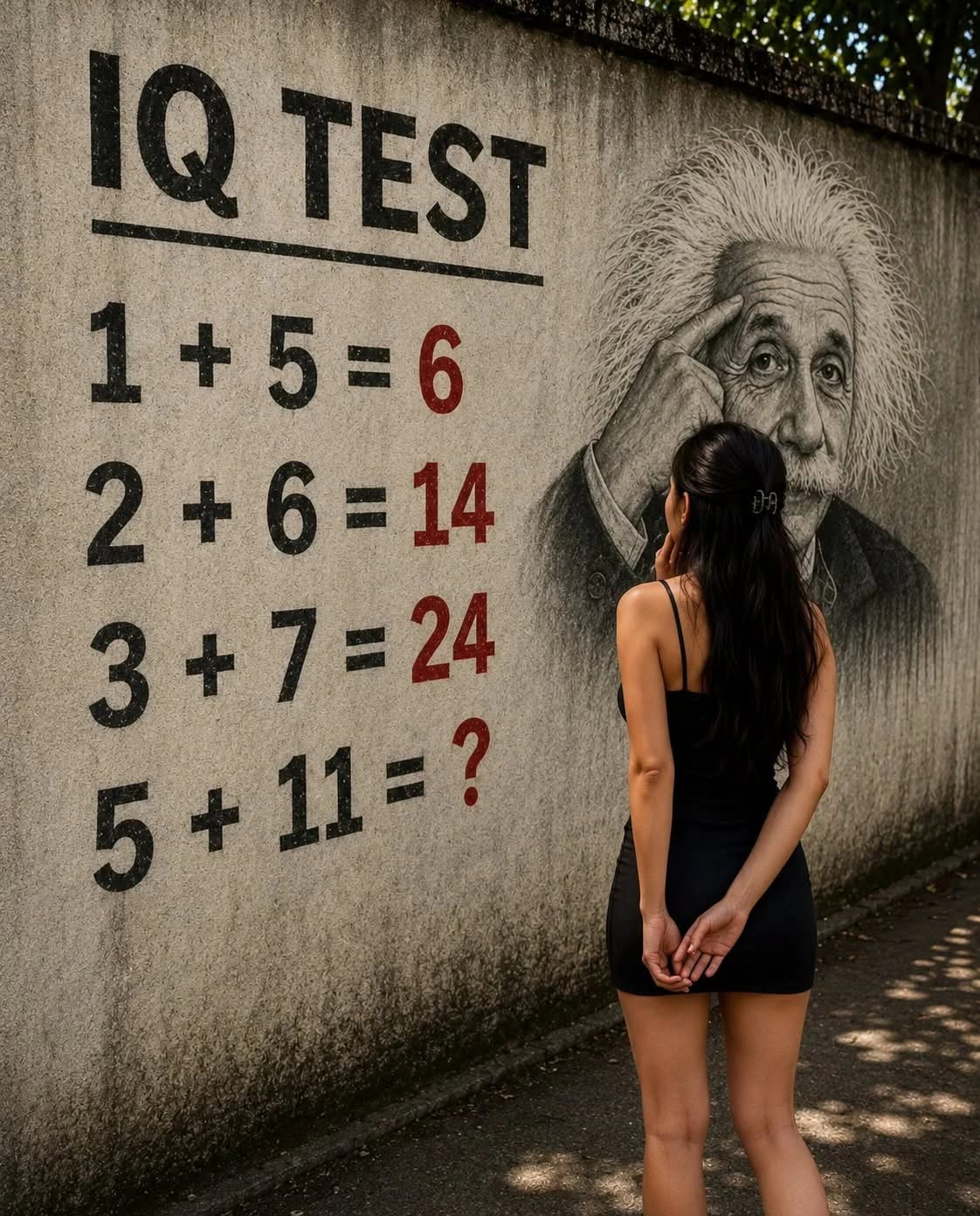


Math riddles and viral IQ puzzles have taken social media by storm, sparking heated debates in comment sections worldwide. These visual number games seem simple on the surface, but they are specially crafted to test pattern recognition, lateral thinking, and mathematical flexibility. A prominent example currently trending online presents a sequence of equations that clearly defy standard arithmetic:
-
$1 + 5 = 6$
-
$2 + 6 = 14$
-
$3 + 7 = 24$
-
$5 + 11 = ?$
While standard math tells us that $5 + 11 = 16$, logic puzzles operate under non-standard operator rules. To arrive at the correct answer, you must uncover the hidden mathematical function connecting the numbers.
Below, we reveal the complete step-by-step logic breakdown to solve this puzzle, explore the cognitive psychology behind pattern recognition, and discuss how mental exercises support long-term brain health and analytical skills.
The Math Breakdown: Unlocking the Hidden Pattern
To solve this viral riddle, we must look at how the input numbers on the left produce the output numbers on the right. There are two common logical methods used to solve this puzzle type, both leading to the primary answer.
Method 1: The Multiplicative Formula ($A \times B + A$)
Let the equation be represented as $A + B = C$. If we look at the relationship between $A$, $B$, and the result:
-
Row 1: $1 + 5 \rightarrow (1 \times 5) + 1 = 5 + 1 = 6$
-
Row 2: $2 + 6 \rightarrow (2 \times 6) + 2 = 12 + 2 = 14$
-
Row 3: $3 + 7 \rightarrow (3 \times 7) + 3 = 21 + 3 = 24$
Notice the consistent pattern: multiply the two numbers together, then add the first number ($A$) back to the product.
Applying this exact rule to the final line:
Alternatively, this can be factored algebraically as $A \times (B + 1)$:
-
$1 \times (5 + 1) = 6$
-
$2 \times (6 + 1) = 14$
-
$3 \times (7 + 1) = 24$
-
$5 \times (11 + 1) = 5 \times 12 = 60$
Method 2: The Cumulative Addition Sequence
Another common perspective viewers take with number puzzles involves adding the result of the previous line to the sum of the current line.
-
Row 1: $1 + 5 = 6$
-
Row 2: $2 + 6 + 6 \text{ (previous total)} = 14$
-
Row 3: $3 + 7 + 14 \text{ (previous total)} = 24$
However, notice that the sequence skips numbers! The first numbers jump from 1, 2, 3 directly to 5 (skipping 4). If we fill in the missing sequence row:
-
Missing Row ($4 + 8$): $4 + 8 + 24 \text{ (previous total)} = 36$
-
Final Row ($5 + 11$… wait, notice $B$ jumps from 5, 6, 7 to 11):
Because the jump between rows 3 and 4 skips intermediate steps, Method 1 ($A \times B + A$) remains the most mathematically sound and direct solution for isolated equations, yielding 60.
Why Pattern Recognition Matters in Cognitive Psychology
Pattern recognition is one of the foundational pillars of human intelligence. It allows our brains to make sense of complex data, predict outcomes, and adapt to unfamiliar environments.
Abstract Reasoning and Problem-Solving
When presented with non-traditional equations, your brain must suppress standard mathematical rules (where $1 + 5 = 6$ is the only acceptable output) and engage in abstract reasoning. This cognitive shift requires:
-
Rule Induction: Identifying underlying structures from limited examples.
-
Working Memory: Holding multiple potential formulas in mind while testing them against new data points.
-
Cognitive Flexibility: Abandoning incorrect hypotheses quickly when a formula fails on subsequent lines.
Practical Benefits of Daily Brain Teasers and Logic Games
Regularly challenging your mind with math puzzles, crosswords, and logic riddles offers tangible mental and lifestyle benefits.
1. Building Cognitive Reserve
Engaging in mentally stimulating activities builds cognitive reserve—the brain’s resilience and capability to improvise and find alternate ways of getting a job done when faced with challenges or age-related changes.
2. Enhancing Focus and Analytical Skills
Working through logic problems trains your brain to pay closer attention to detail, a skill that translates directly into professional environments, data analysis, and critical decision-making.
Real-World Applications: Analytical Thinking in Life Planning
The analytical skills used to solve logic riddles play a major role in navigating everyday adult responsibilities, financial decisions, and long-term security.
-
Financial Planning and Investment Strategy: Analyzing numerical patterns helps when reviewing interest rates, managing debt consolidation, evaluating mortgage terms, and projecting retirement growth over decades.
-
Legal and Contractual Review: Catching subtle details in contracts, insurance policies, and estate planning documents requires the same methodical, line-by-line scrutiny used in logic puzzles.
-
Professional Growth and Education: Developing strong problem-solving capabilities enhances performance across high-demand fields like software development, engineering, finance, and healthcare administration.
Practical Tips for Improving Your Problem-Solving Ability
If you want to sharpen your mental math and problem-solving speed, try incorporating these practical habits into your daily routine:
-
Test Multiple Hypotheses: Don’t settle on the first pattern you notice. Test your formula against every given example before reaching a conclusion.
-
Break Complex Problems Down: Divide large or overwhelming tasks into smaller, manageable equations or steps.
-
Practice Mental Math Daily: Calculate tips, discounts, or simple arithmetic in your head rather than immediately reaching for a calculator.
-
Prioritize Brain Health: Quality sleep, physical exercise, and proper hydration are essential for optimal neural processing speed and memory retention.
Fascinating Facts About Albert Einstein and Intelligence
-
Visual Thinking: Albert Einstein famously stated that he rarely thought in words, but rather in visual images, spatial concepts, and thought experiments (Gedankenexperimente).
-
Brain Structure: Post-mortem studies of Einstein’s brain revealed an unusually dense parietal lobe—the region responsible for spatial reasoning and mathematical thought.
-
The Concept of IQ: Modern IQ tests measure various domains, including verbal comprehension, perceptual reasoning, working memory, and processing speed, rather than raw accumulated knowledge.
Conclusion
While the equation $5 + 11 = 16$ holds true in basic arithmetic, the hidden rule of this viral IQ test—$A \times B + A$—reveals that the logical answer is 60. Engaging with these fun, thought-provoking riddles is a fantastic way to stretch your cognitive abilities, practice critical thinking, and keep your mind active and sharp.
Frequently Asked Questions (FAQ)
What is the final answer to the 5 + 11 IQ riddle?
The most widely accepted logical answer is 60, derived from the formula $A \times B + A$ (where $5 \times 11 + 5 = 60$).
Can 56 or 96 also be considered answers?
Depending on how missing sequence rows are interpreted in alternative cumulative addition methods, some solvers arrive at different numbers, but 60 is the cleanest solution for the individual equations.
Do online IQ tests accurately measure real intelligence?
Social media math riddles are fun brain teasers designed for engagement and cognitive exercise, whereas formal clinical IQ tests are comprehensive psychological evaluations administered by certified professionals.