
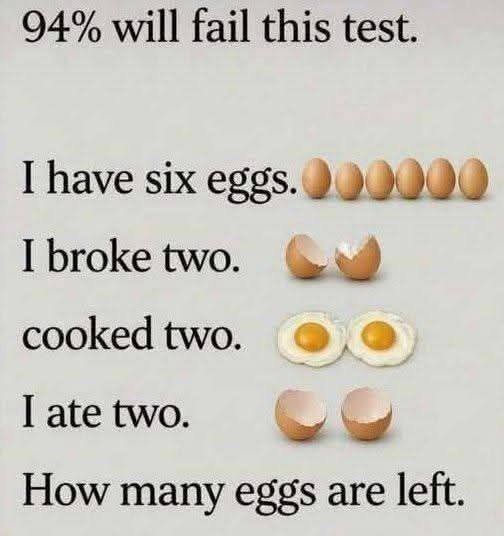


Riddles involving simple numbers and everyday tasks are a fantastic way to test attention to detail, linguistic interpretation, and sequential logic. The “Six Eggs” riddle is a classic viral brain teaser that frequently sparks lively debates across social media comments sections.
At first glance, your brain might naturally assume every verb describes a separate set of two eggs. However, looking closely at how we prepare food in real life reveals the clever wordplay behind the puzzle!
Below, we break down the logic step-by-step to explain the correct answer.
Breaking Down the Sequence
Let’s evaluate the actions described in the riddle:
1. The Starting Count
“I have six eggs.”
You start with a total pool of 6 whole eggs.
2. The Cooking Process
“I broke two, cooked two, ate two.”
Think about how you prepare fried or scrambled eggs:
-
You broke 2 eggs to open them into the pan.
-
You cooked those same 2 eggs in the pan.
-
You ate those same 2 cooked eggs for breakfast!
Instead of describing 6 individual eggs being acted on in pairs of two ($2 + 2 + 2 = 6$), the riddle describes a single pair of 2 eggs going through three sequential steps: crack $\rightarrow$ cook $\rightarrow$ eat.
Tallying the Remaining Eggs
-
Starting eggs: 6 whole eggs
-
Eggs used (cracked, cooked, and eaten): 2 eggs
-
Eggs remaining untouched: $6 – 2 =$ 4 eggs
The Correct Answer
4 eggs are left!
(You still have 4 whole, unbroken eggs remaining from your original six).
Alternative Wordplay Interpretations
Part of what makes this riddle viral is that subtle tweaks in grammar or tense lead to different playful answers:
-
The Literal Past Tense Angle (6 Eggs Left): Notice the shift in tense! “I have six eggs” is present tense. “I broke two, cooked two, ate two” is past tense. If those past actions occurred yesterday, you still currently have 6 fresh eggs today!
-
The “No Whole Eggs” Angle (0 Eggs Left): If you interpret each action as applying to distinct pairs ($2 + 2 + 2$), all 6 eggs were processed, leaving 0 whole eggs remaining.
However, in standard riddle logic, 4 eggs is universally accepted as the primary solution!
Conclusion
Linguistic riddles show how easily our minds jump to math addition when context and tense dictate the true logic. Did you solve it right away as 4, or did the word order catch you off guard? Share this riddle with friends and see how quickly they figure it out!
Frequently Asked Questions (FAQ)
Why do so many people answer 0?
People who answer 0 treat “broke,” “cooked,” and “ate” as three completely separate events involving 2 distinct eggs each ($2 \times 3 = 6$), assuming all original eggs were consumed.
Is this considered a math puzzle or a word puzzle?
It is primarily a wordplay and logic riddle! The math is basic arithmetic ($6 – 2 = 4$), but reading the narrative context correctly provides the challenge.