

Share When You See The Horse: The Rotating Frog Optical Illusion Solved
Rotating drawing illusions and ambiguous figure teasers are massive viral hits on social media platforms. They challenge visual processing by presenting a single artwork that completely changes identity when viewed from a different angle.
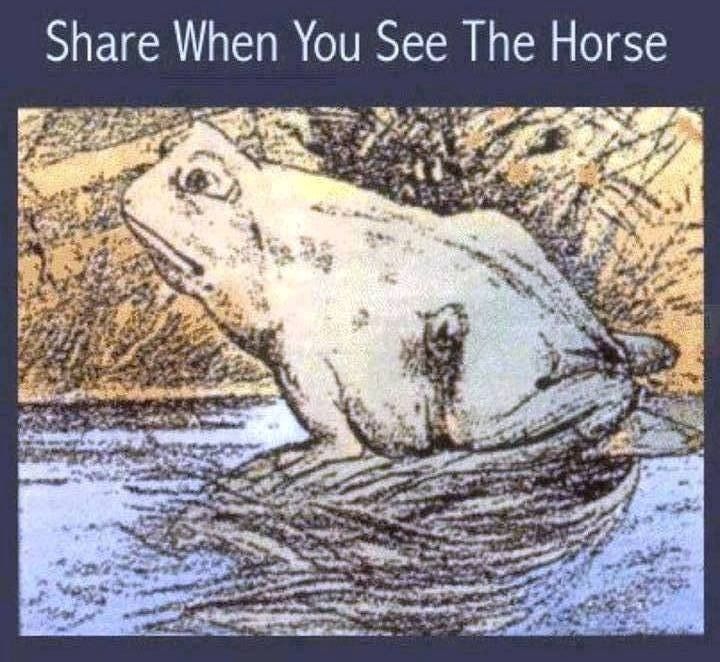
A widely shared classic optical teaser shows a realistic drawing of a frog sitting by a lily pad or water bank, framed by a simple prompt:
“Share When You See The Horse”
At initial viewing angle, the human brain easily identifies the central subject as a frog facing toward the upper-left corner. However, when the orientation is shifted, the exact same lines and shading reveal the head and mane of a horse.
In this guide, we break down how the visual rotation works, trace how each frog feature maps to the horse, and explain the visual psychology behind ambiguous visual puzzles.
Deconstructing the Illusion: How to Spot the Horse
To reveal the hidden horse, simply rotate the image 90 degrees counterclockwise (or tilt your head to the right):
                   [ ROTATION & FEATURE MAPPING ]
                                  |
      ----------------------------------------------------------
     |                                                          |
 [ STANDARD ORIENTATION: FROG ]              [ 90° ROTATED: HORSE ]
 • Frog's eye & head (top-left)             • Horse's nostril / muzzle area
 • Frog's body & back leg                   • Horse's face, jawline & cheek
 • Water ripples / base beneath frog        • Horse's flowing mane & neck
Feature-by-Feature Transformation:
-
Frog’s Eye $\rightarrow$ Horse’s Nostril: The dark circular eye of the frog becomes the horse’s nostril area near its muzzle.
-
Frog’s Head $\rightarrow$ Horse’s Muzzle: The rounded snout of the frog forms the front tip of the horse’s nose and upper lip.
-
Frog’s Body $\rightarrow$ Horse’s Face: The main white body and torso of the frog transform into the flat forehead, cheek, and bridge of the horse’s head.
-
Water Ripples $\rightarrow$ Horse’s Mane: The dark, textured linear strokes beneath the frog (representing water ripples or leaves) become the thick, flowing mane of the horse.
Visual Feature Mapping Table
| Image Feature | Frog Orientation (0°) | Horse Orientation (90° Counterclockwise) |
| Primary Subject | Frog sitting on a bank | Head and neck of a Horse |
| Top-Left Curve | Frog’s head & eye | Horse’s muzzle & nostril |
| Central White Area | Frog’s torso and hindquarters | Horse’s face and cheek structure |
| Bottom Textured Lines | Water ripples / ground leaves | Horse’s mane hair |
The Answer
The horse is not a tiny hidden detail in the background—the frog itself IS the horse! Rotating the image 90 degrees counterclockwise turns the frog’s head into the horse’s muzzle, its body into the horse’s head, and the water texture into the horse’s mane.
Why Rotating the Picture Tricks the Brain
-
Orientation Bias: Human object recognition relies heavily on horizontal and vertical visual cues. The brain defaults to interpreting shapes based on standard gravity alignment.
-
Mental Priming: When viewers expect to see a frog, the visual cortex prioritizes grouping the curved lines into an amphibian silhouette, obscuring the alternative equine shape until the viewing angle changes.
Conclusion
The key to “Share When You See The Horse” is simply rotating the drawing sideways! Once you view the image at a 90-degree angle, the horse’s face becomes impossible to miss.
Frequently Asked Questions (FAQ)
Where is the horse hidden in the frog picture?
The entire frog drawing forms the horse when turned sideways. Rotating the image 90 degrees counterclockwise reveals a horse’s head facing downward to the left.
How do you see the horse?
Tilt your head 90 degrees to the right or rotate your phone 90 degrees counterclockwise.