

If you’ve spent any time online lately, you’ve probably seen quick visual puzzles asking you to identify the “odd one out.” At first glance, they seem like simple children’s games—but according to psychologists, the way we analyze images, categorize objects, and justify our choices can reveal fascinating clues about our thinking style.
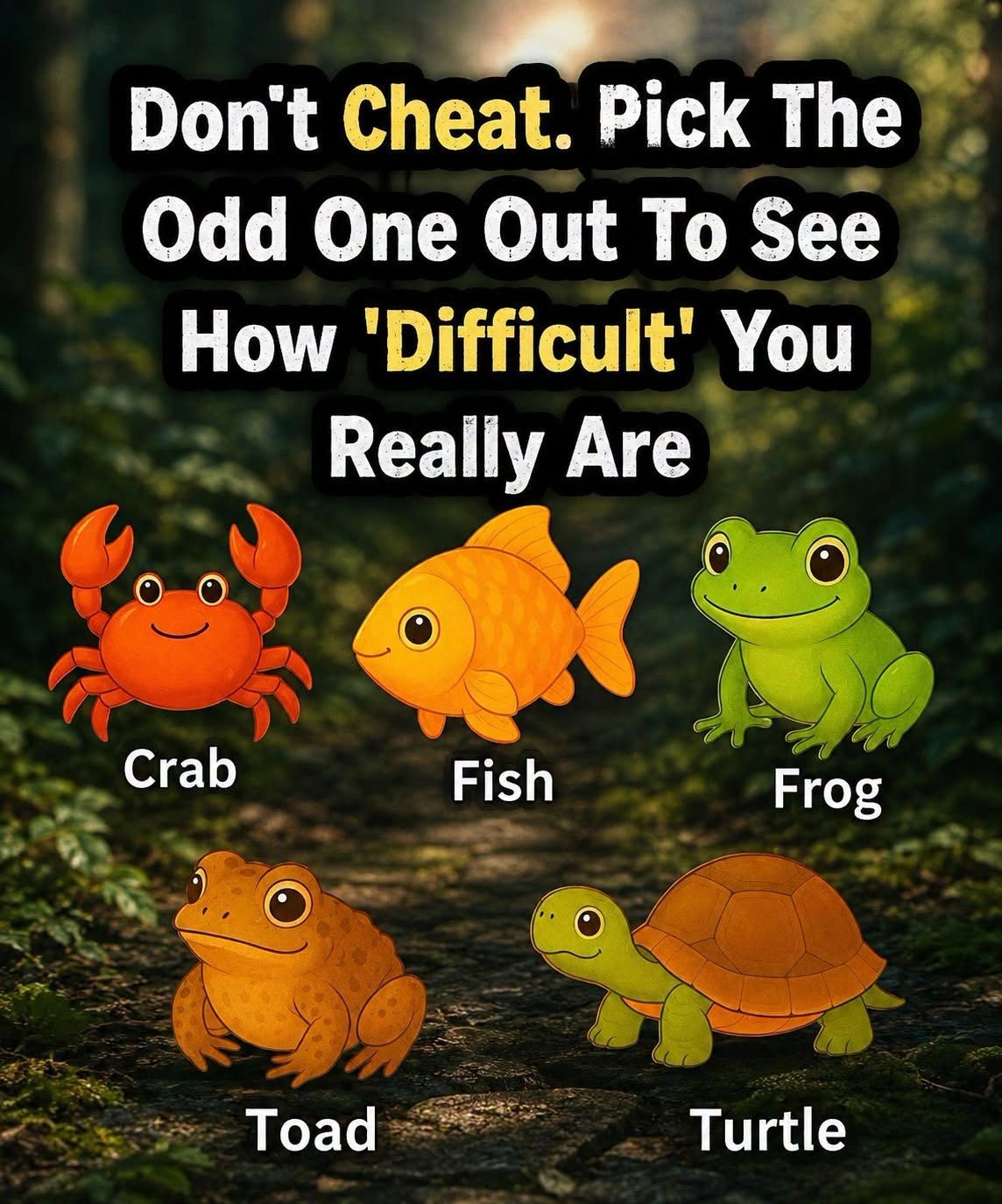
Today’s challenge is no different. In the image above, you’ll see five cute cartoon animals:
a Crab,
a Fish,
a Frog,
a Toad, and
a Turtle.
Your task seems easy: Pick the odd one out.
But depending on which one you choose, you may actually reveal how your mind processes information, solves problems, and approaches complexity.
So take a moment. Look at the animals. Don’t overthink it—just pick the one that immediately feels “different.”
Ready? Let’s dive into what your choice might say about you.
1. If You Chose the Crab
Continued on next page:
You’re the type of person who notices structural differences first. The crab stands out because it has claws, extra legs, and a completely different body shape from the others. Unlike frogs, turtles, toads, and fish, which all have bilateral, elongated bodies, the crab looks almost circular.
This means you’re grea
Many people confuse frogs and toads, but you spotted a difference. Toads have rough skin, prefer dry environments, and behave differently.
Selecting the toad means you observe subtle features and don’t fall for surface-level similarities. You likely have a sharp eye, excellent attention to detail, and a personality that appreciates nuance. You’re the friend who notices the smallest thing others overlook.
5. If You Chose the Turtle
You’re someone who categorizes based on biology and anatomy. The turtle is the only reptile among the group. It also has a shell—an obvious but important distinction.
Your brain tends to classify, analyze, and categorize things scientifically. You value accuracy, structure, and order. You might excel in fields where precision matters, like math, engineering, or data analysis
So, What Does This Really Mean?
Continued on next page: