


How to Solve (9 + 3) × 2 – 4 ÷ 2: The PEMDAS Order of Operations Explained
Math riddles and arithmetic order-of-operations puzzles consistently trend across social media platforms like Facebook. By adding playful challenges such as “90% fail,” these posts spark immediate engagement as users test their mental math against standard mathematical rules.
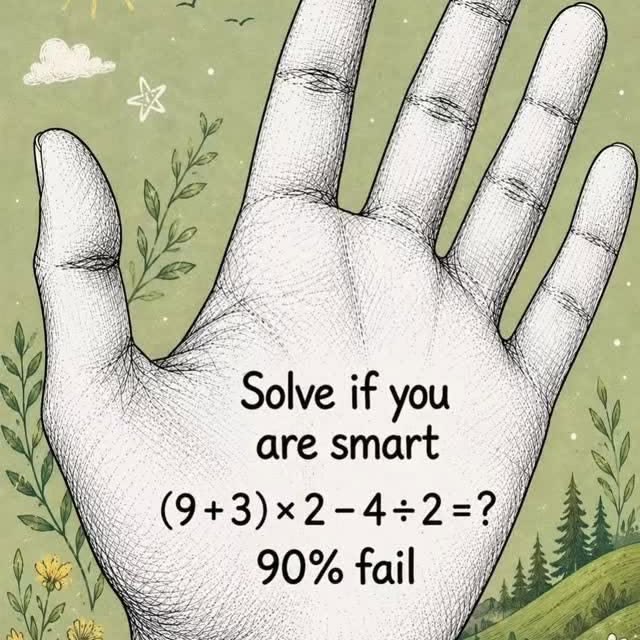
A popular viral graphic depicts an open hand drawn over a serene botanical background, holding a classic order-of-operations equation:
“Solve if you are smart”
“(9 + 3) × 2 – 4 ÷ 2 = ?”
“90% fail”
While the problem appears intimidating at first glance, following basic rules of arithmetic guarantees the correct answer every time.
In this guide, we break down the step-by-step solution using the standard PEMDAS/BODMAS rule, highlight common mistakes, and explain why math teasers generate high social engagement.
Step-by-Step Solution Guide
To solve $(9 + 3) \times 2 – 4 \div 2$, we apply the order of operations (PEMDAS: Parentheses, Exponents, Multiplication and Division from left to right, Addition and Subtraction from left to right).
                      [ STEP-BY-STEP CALCULATION ]
                                    |
      --------------------------------------------------------------
     |                              |                               |
 [ STEP 1: PARENTHESES ]     [ STEP 2: MULTIPLY & DIVIDE ]   [ STEP 3: SUBTRACT ]
 • (9 + 3) = 12              • 12 × 2 = 24                   • 24 - 2 = 22
                             • 4 ÷ 2 = 2
1. Solve Inside Parentheses First
First, evaluate the addition inside the brackets:
Now substitute $12$ back into the original expression:
2. Perform Multiplication and Division (Left to Right)
Next, perform all multiplication and division operations from left to right.
-
First, multiply:
$$12 \times 2 = 24$$ -
Next, divide:
$$4 \div 2 = 2$$
Substitute these simplified values back into the equation:
3. Perform Subtraction
Finally, perform the remaining subtraction:
The correct final answer is 22.
Order of Operations Breakdown
| Step Number | Operation Category | Part of Equation | Calculation Result | Intermediate Expression |
| Step 1 | Parentheses | $(9 + 3)$ | $12$ | $12 \times 2 – 4 \div 2$ |
| Step 2a | Multiplication | $12 \times 2$ | $24$ | $24 – 4 \div 2$ |
| Step 2b | Division | $4 \div 2$ | $2$ | $24 – 2$ |
| Step 3 | Subtraction | $24 – 2$ | $22$ | 22 |
Common Misconceptions & Wrong Answers
-
Ignoring Parentheses First: Some users try to multiply $3 \times 2$ before adding $9$, which violates the rule that expressions inside parentheses must always be evaluated first.
-
Strict Left-to-Right Execution Without Order Rules: Calculating strictly from left to right without respecting division priority leads to errors:
-
$(9 + 3) = 12$
-
$12 \times 2 = 24$
-
$24 – 4 = 20$
-
$20 \div 2 = 10$ (Incorrect result: 10)
-
Remember that multiplication and division take priority over addition and subtraction!
Conclusion
The equation $(9 + 3) \times 2 – 4 \div 2$ is a straightforward test of elementary algebra rules. By prioritizing parentheses, executing multiplication and division, and finishing with subtraction, we arrive at the exact solution: 22.
Frequently Asked Questions (FAQ)
What does PEMDAS / BODMAS stand for?
-
PEMDAS: Parentheses, Exponents, Multiplication, Division, Addition, Subtraction.
-
BODMAS: Brackets, Orders (exponents), Division, Multiplication, Addition, Subtraction.
Both rules follow the same mathematical hierarchy.
Why do division and multiplication have the same priority level?
In modern arithmetic conventions, multiplication and division are co-equal in priority and are evaluated in sequential order from left to right as they appear in the problem.