

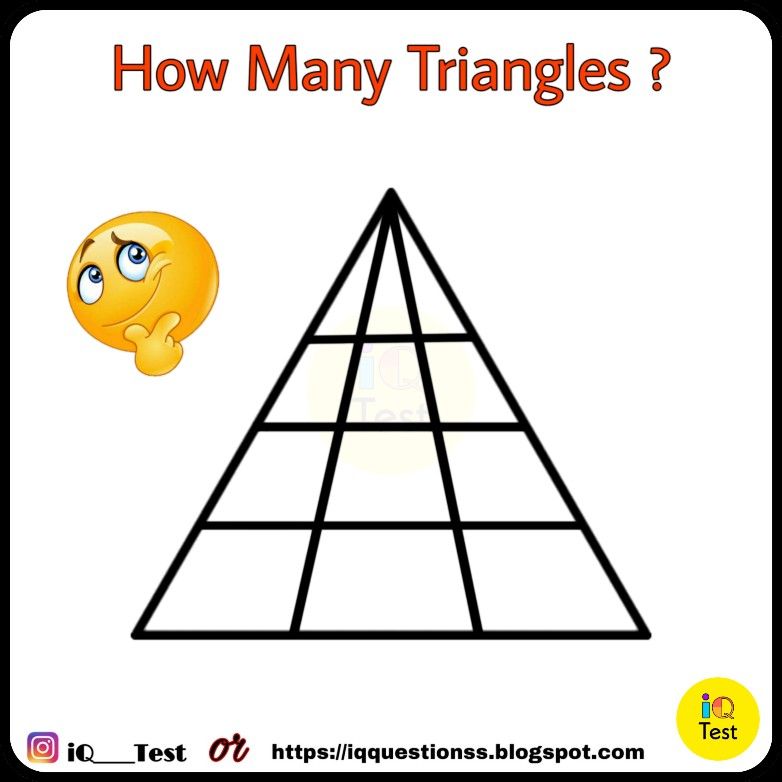


How Many Triangles Are There? The Triangle Grid Puzzle Solved
Triangle counting puzzles are among the most popular geometry teasers shared on social media. They test your visual spatial reasoning and systematic counting skills by stacking smaller triangles inside larger ones using horizontal and vertical divisions.
A widely shared visual puzzle asks a direct question above a large divided triangle:
“How Many Triangles?”
At first glance, many people simply count the individual small triangular spaces near the apex or only look at the main outer frame. However, by systematically calculating the combinations formed by the vertical divisions across every horizontal level, you can find the precise total mathematically without missing a single one.
In this guide, we break down the geometric structure of this puzzle, explain the combinatorial formula used to solve it, and reveal the exact answer.
Deconstructing the Geometry: Horizontal & Vertical Divisions
To calculate the total count accurately, we analyze the two structural components of the main triangle:
                  [ TRIANGLE GRID STRUCTURE ]
                               |
      --------------------------------------------------
     |                                                  |
 [ VERTICAL SECTORS ]                        [ HORIZONTAL LEVELS ]
 • 3 vertical columns formed by              • 4 horizontal lines (including base)
   2 lines radiating from top vertex         • Creates 4 distinct stacked horizontal
 • Total base combinations: 6                   sub-triangles (levels 1, 2, 3, 4)
1. The Vertical Section Breakdown (Combinations)
From the top apex vertex, 2 interior lines extend down to the base, dividing the triangle into 3 smaller adjacent columns/vertical sectors:
-
1-column triangles: 3 small single sectors
-
2-column triangles: 2 combined adjacent sectors
-
3-column triangles: 1 complete full-width sector
For any single horizontal base line, the number of triangles formed by 3 base divisions is:
Or using the standard formula for $n$ base divisions:
2. The Horizontal Levels Breakdown (Layers)
The main structure contains 4 horizontal lines (3 inner horizontal bars plus the bottom base line). Each horizontal line acts as the base for a set of triangles sharing the same top apex:
-
Level 1 (Top Level): Smallest top triangle (6 triangles)
-
Level 2 (Second Level Down): Upper medium triangle (6 triangles)
-
Level 3 (Third Level Down): Lower medium triangle (6 triangles)
-
Level 4 (Bottom Base): Full main outer triangle (6 triangles)
Step-by-Step Calculation Matrix
To find the grand total, we multiply the triangles formed per level by the total number of horizontal levels ($6 \times 4$):
| Level / Layer | Vertical Sectors Used | Calculation | Number of Triangles |
| Top Level (1) | 1-sector (3), 2-sector (2), 3-sector (1) | $3 + 2 + 1$ | 6 |
| Level 2 | 1-sector (3), 2-sector (2), 3-sector (1) | $3 + 2 + 1$ | 6 |
| Level 3 | 1-sector (3), 2-sector (2), 3-sector (1) | $3 + 2 + 1$ | 6 |
| Bottom Base (4) | 1-sector (3), 2-sector (2), 3-sector (1) | $3 + 2 + 1$ | 6 |
| GRAND TOTAL | 4 Levels $\times$ 6 Triangles | $6 \times 4$ | 24 |
The Answer
The total number of triangles in the image is 24.
Why Most People Get It Wrong
-
Ignoring Combined Sectors: Many viewers only count the 3 individual narrow triangles at each level ($3 \times 4 = 12$), forgetting that combining 2 adjacent sectors or all 3 sectors forms additional valid triangles.
-
Stopping at the Top Level: Some count all 6 triangles in the top section but fail to recognize that each horizontal bar creates a whole new baseline for 6 larger triangles.
-
Random Manual Counting: Trying to point and count without a systematic top-to-bottom formula often leads to double-counting or skipping combined shapes.
Conclusion
The complete solution to “How Many Triangles?” is 24. By applying simple combinatorics ($\text{Base Combinations} \times \text{Horizontal Levels}$), you can solve any triangle counting puzzle in seconds!
Frequently Asked Questions (FAQ)
What is the formula for counting triangles in a divided triangle?
The standard formula for a triangle with $n$ vertical columns and $h$ horizontal levels is:
For this puzzle ($n=3$ columns and $h=4$ horizontal levels):
Does the side contour count as a triangle?
Yes, the full main outer shape and all its sub-divided upper portions resting on each horizontal line meet the mathematical definition of a 3-sided polygon (triangle).