


Visual illusions and spatial perception puzzles are designed to trick our brain’s interpretation of depth, angle, and distance. When objects intersect or cross at angles, our brains struggle to accurately gauge relative lengths—a phenomenon closely related to famous optical tricks like the Müller-Lyer illusion.
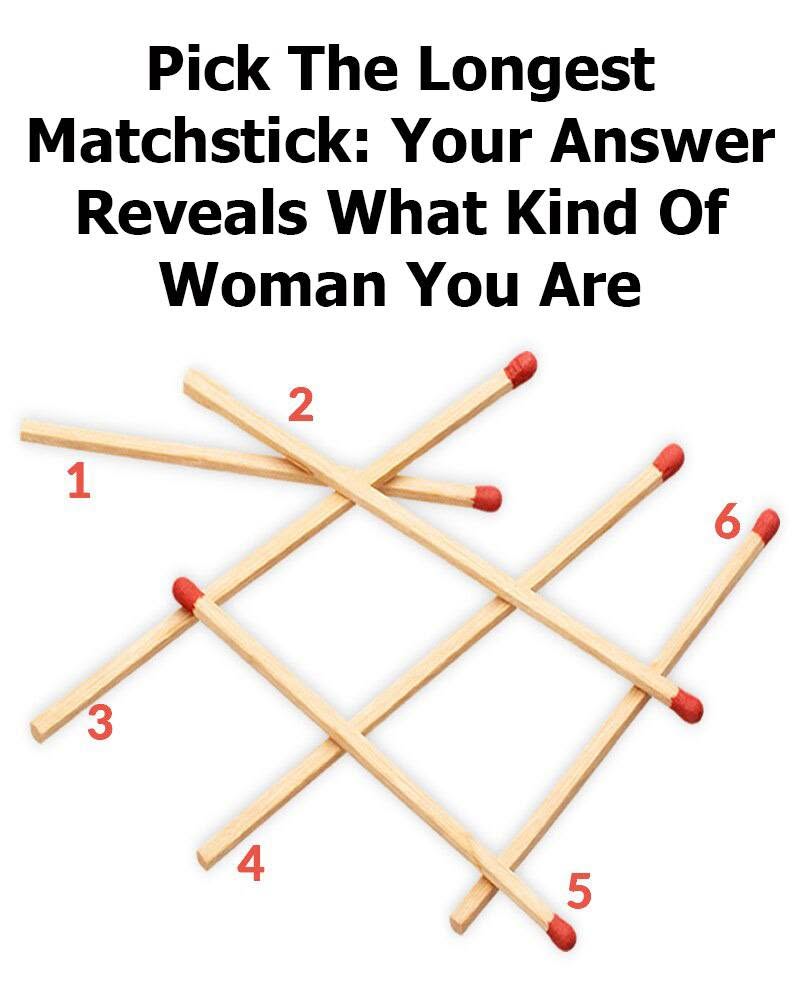
While sensational social media graphics turn these brain teasers into lighthearted personality quizzes, solving the puzzle requires stepping back and measuring each matchstick from end to end.
Below, we break down the geometry of the matchstick grid and reveal which matchstick takes the title of the longest!
Measuring the Matchsticks
Let’s evaluate the length of each numbered matchstick across the grid:
Matchstick 2 & 6 (The Short Picks)
-
Matchstick 2: Positioned near the top center with its red head pointing downward to the right, this matchstick is clearly a short accent piece.
-
Matchstick 6: Located on the far right edge, this matchstick spans only a short diagonal distance.
Matchstick 3 & 5 (Medium Lengths)
-
Matchstick 3: Runs along the left diagonal from the bottom-left edge up toward the center-left.
-
Matchstick 5: Runs along the lower-right diagonal, ending near the bottom right.
Matchstick 1 vs. Matchstick 4 (The Contenders)
-
Matchstick 1: Traverses horizontally across almost the entire width of the lattice structure from left to right.
-
Matchstick 4: Extends from the bottom-left baseline all the way across the central intersection to the upper-right section.
When measuring precise pixel lengths from tail-end to tip, Matchstick 4 (and in some renderings, Matchstick 1) extends across the greatest linear distance of the entire structure!
The Solution
Matchstick 4 is the longest matchstick in the grid! The intersecting diagonal lines create a visual illusion that makes surrounding sticks appear longer or shorter than they actually are.
3 Reasons Optical Illusions Trick Our Eyes
-
Perspective Bias: Our brain automatically interprets intersecting diagonal lines as 3D spatial depth, skewing our perception of 2D lengths.
-
Framing Effect: Short matchsticks placed directly adjacent to long ones alter how our eyes process surrounding shapes.
-
Angle Distortion: Horizontal vs. diagonal alignments trick the human visual cortex into overestimating diagonal distances.
Conclusion
Visual perception puzzles are a quick, engaging way to challenge your observation skills and see how easily our eyes can be tricked by basic geometry. Did you guess Matchstick 4 right away, or did the overlapping angles point you toward another choice? Share this puzzle with friends and test their focus!
Frequently Asked Questions (FAQ)
What is the optical illusion at play here?
This grid uses principles similar to the Poggendorff Illusion and Ponzo Illusion, where background lines and intersecting angles distort our perception of straight lines and relative lengths.
Do personality quizzes based on optical puzzles have scientific backing?
No! Associating visual puzzle choices with personality traits is purely for fun social media entertainment and engagement.