
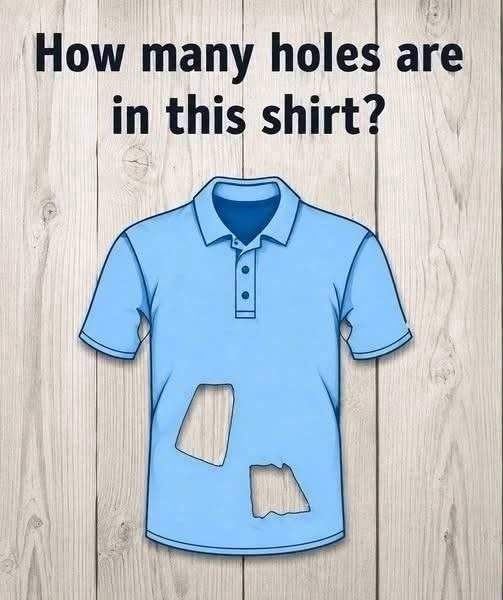


Social media is no stranger to visual brain teasers, mind-bending riddles, and viral perception tests that divide comment sections into passionate debates. One classic puzzle that consistently resurfaces and sparks massive engagement involves a simple light blue polo shirt with visible torn holes across the front. The prompt asks a seemingly straightforward question: “How many holes are in this shirt?”
While most people quickly blurt out an answer based on a two-second glance, this classic riddle is designed to trick our immediate visual assumptions. The real answer requires a combination of spatial reasoning, observation, basic geometry, and logical deduction. Let’s break down the hidden complexity behind this famous puzzle, examine why our brains get tricked, and explore the cognitive science that makes visual riddles so addictive.
Deconstructing the T-Shirt Riddle: Step-by-Step Logic
To determine the accurate count, you have to look beyond the obvious torn fabric on the front and consider the entire physical geometry of a three-dimensional shirt.
+------------------------------------------------------------------------+
|                          HOLE COUNT BREAKDOWN                          |
|                                                                        |
|   Standard Openings (Every Shirt Has These):                          |
|   * 1 Neck Hole (Collar opening)                                       |
|   * 2 Arm Holes (Sleeves)                                              |
|   * 1 Main Waist Opening (Bottom hem)                                  |
|   Subtotal: 4 Standard Holes                                           |
|                                                                        |
|   Torn/Damaged Openings (The Trick):                                   |
|   * 2 Torn Holes on the Front Layer                                    |
|   * 2 Matching Holes on the Back Layer (See-through to background)     |
|   Subtotal: 4 Torn Holes                                               |
|                                                                        |
|   GRAND TOTAL: 8 HOLES                                                 |
+------------------------------------------------------------------------+
1. The Standard Structural Openings (4 Holes)
Before considering any damage or tears, every wearable polo shirt naturally possesses four essential functional openings so that a human body can wear it:
-
One main neck hole at the top collar.
-
Two arm holes at the end of each sleeve.
-
One large bottom waist opening at the hem.
Without these initial four structural openings, the garment would simply be a sealed fabric pouch, rendering it completely unwearable.
2. The Torn Openings on the Front (2 Visible Openings)
When looking directly at the image, your eyes instantly spot two large, irregular ripped sections in the midsection of the blue polo. Most casual observers count these two rips, add them to the four standard openings, and prematurely guess six. However, that assumption ignores an essential visual detail.
3. The See-Through Back Layer (2 Additional Openings)
Look closely at the background showing through the torn holes in the shirt. You can clearly see the underlying light wood grain paneling directly through the ripped fabric.
If the back of the shirt were intact, you would see the solid blue inner fabric of the back layer inside those openings rather than the wooden wall background. Because the background wood pattern is visible straight through both rips, the tears must go completely through both the front and the back layers of the shirt.
This means there are two torn holes in the front fabric and two matching torn holes in the back fabric, adding four total damaged openings to the shirt.
The Final Calculation
Adding both structural openings and ripped openings together reveals the true total:
Why Our Brains Get Tricked by Visual Puzzles
Why do so many viewers fail to arrive at the number eight on their first attempt? The answer lies in how human visual processing handles two-dimensional images representing three-dimensional objects.
Visual Shortcuts and Automatic Thinking
Psychologists often divide human cognitive thinking into two main modes: System 1 (fast, automatic, and intuitive) and System 2 (slow, analytical, and deliberate).
When presented with a viral picture on a fast-moving social feed, our brain defaults to System 1. It scans the image instantly, registers the two obvious rips, remembers that shirts have openings, and generates a quick guess without analyzing spatial depth or background transparency. Only when forced to reflect—or prompted by an opposing comment—does System 2 kick in to evaluate the background texture and 3D garment structure.
Selective Attention and Cognitive Blindness
Our visual cortex prioritizes high-contrast focal points. The bold, dark outlines of the torn sections draw our primary focus, creating a form of selective attention. Because our focus is anchored on the shape of the tears, we naturally overlook subtle background clues, such as the continuity of the wooden panel lines passing uninterrupted through the garment.
The Cognitive and Health Benefits of Brain Teasers
Consistently challenging your mind with visual logic tests, lateral thinking problems, and spatial reasoning tasks offers significant long-term cognitive health benefits.
1. Strengthening Spatial Awareness
Spatial reasoning is the mental ability to visualize objects in three dimensions and understand how different perspectives alter their appearance. Practicing spatial puzzles regularly exercises the parietal lobes of the brain, improving map reading, physical navigation, and architectural comprehension.
2. Improving Memory and Mental Agility
Engaging in problem-solving activities stimulates synaptogenesis—the creation of new synaptic connections between neurons. Keeping your mind active through educational games, reading, analytical problem-solving, and continuous learning helps build a strong cognitive reserve.
3. Enhancing Focus in a Digital Age
With rapid content consumption becoming the norm, taking time to deliberately analyze a complex visual puzzle trains your brain to maintain sustained attention, boosting overall focus in daily tasks, work, and education.
The Broader Impact: Lifelong Learning, Technology, and Wellness
In an increasingly complex world, analytical thinking and attention to detail extend far beyond solving fun social media riddles. They form the bedrock of critical life decisions across education, professional careers, and long-term personal planning.
Education and Technology Innovation
Modern education systems and distance learning technology increasingly incorporate gamified logic challenges into early computer science, engineering, and mathematics courses. By teaching students to analyze problems systematically—just like deconstructing the layers of a visual riddle—educators foster critical thinking skills essential for software technology development, legal reasoning, and scientific discovery.
Long-Term Security and Financial Health
Cultivating a sharp, analytical mindset plays a vital role when making complex real-world decisions. Whether you are reviewing contract details with an attorney, evaluating mortgage and real estate investment options, analyzing business loans, or planning your retirement portfolio with a financial advisor, paying close attention to hidden details ensures long-term security.
Just as purchasing comprehensive health or life insurance protects your family’s physical well-being, keeping your mind active protects your intellectual independence throughout every stage of life.
Quick Tips to Excel at Visual Logic Riddles
If you want to solve viral image puzzles accurately every time, keep these simple diagnostic strategies in mind:
-
Identify the Hidden Assumptions: Ask yourself what the image is implicitly asking versus what it literally shows.
-
Examine Backgrounds and Shadows: Look at lighting cues, background continuity, and overlapping textures through openings.
-
Convert 2D to 3D: Imagine holding the real object in your hands. Does it have depth, hidden sides, or internal layers?
-
Slow Down System 1 Thinking: Resist the urge to comment with your immediate knee-jerk count; take ten seconds to re-verify every detail.
Fascinating Facts About Textiles, Perception, and Riddles
-
The Psychology of Blue: Light blue—the color used in this classic shirt puzzle—is scientifically shown to induce feelings of calm and focus, making viewers feel comfortable while contemplating a challenge.
-
The Origin of the Word “Riddle”: The word riddle stems from the Old English word rædels, which means “opinion,” “conjecture,” or “guidance.”
-
Background Continuity: The human eye uses “figure-ground organization” to distinguish objects from their backgrounds, a key mechanism that optical illusions exploit to trick our depth perception.
Conclusion
The classic t-shirt riddle is a perfect example of how a simple image can spark endless debate through clever visual presentation. What starts as a quick glance at two torn holes evolves into a fascinating lesson in 3D spatial thinking, depth perception, and background analysis. By taking a closer look, we discover that the true total of eight holes requires us to synthesize standard garment construction with transparent visual cues. The next time you come across a brain teaser online, slow down, look through the layers, and see if you can spot the hidden logic before everyone else!
Frequently Asked Questions (FAQ)
What is the final correct answer to the t-shirt riddle?
The widely accepted logical answer is 8 holes. This includes 4 natural openings (neck, waist, two sleeves) and 4 torn openings (2 on the front and 2 matching tears on the back showing the wooden background).
Why do some people insist the answer is 6?
People who answer 6 correctly identify the 4 standard garment openings and count the 2 visible front rips, but they fail to realize that seeing the wooden background through the shirt means the back layer must also be torn.
Is there a trick interpretation where the answer is 4?
If someone strictly defines “holes” as accidental damage or structural defects, they might count only the 4 torn openings (2 front, 2 back) and exclude the standard, intended openings for the neck, sleeves, and waist.
How do visual brain teasers help improve cognitive function?
Visual brain teasers force the brain to switch from automatic visual processing to active, analytical reasoning. This mental exercise sharpens spatial awareness, enhances visual discrimination, and supports long-term mental agility.