

Can You Spot Batman? The Visual Science Behind Hidden-Object Puzzles
Hidden-object teasers and search-and-find brain games are a great way to test visual acuity, attention to detail, and pattern recognition. By crowding an image with dozens of similar shapes and line art, these visual puzzles challenge your visual system to filter out repetitive background noise and spot subtle anomalies.
A viral brain teaser presents a straightforward challenge:
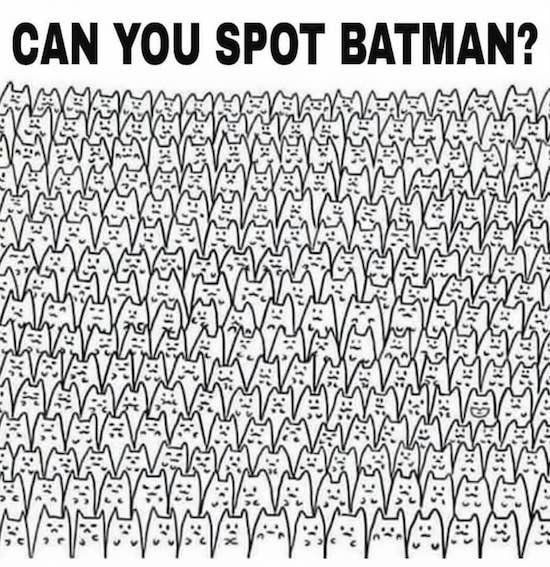
“CAN YOU SPOT BATMAN?”
The illustration is packed with an extensive crowd of simple, white line-art cats with pointed ears. But hidden among the feline faces is none other than Gotham’s Caped Crusader himself!
Below, we reveal the exact location of Batman and explain the cognitive mechanisms that make this puzzle so effective!
Step-by-Step Breakdown: Where Is Batman Hidden?
To find Batman quickly, scan the image systematically rather than looking at the entire field at once:
1. Key Visual Clues
-
Ears vs. Cowl: All the cats feature pointed ears that closely mimic the shape of Batman’s bat ears.
-
The Mask: While the cats have standard dot eyes, tiny mouths, or whisker lines, Batman wears his signature black cowl mask around his eyes!
2. Exact Location Reveal
-
Quadrant: Look toward the lower right quadrant of the illustration.
-
Position: About three rows up from the bottom edge and slightly to the right of the center-right area, you will see a figure whose face features a dark, black bat mask across his eyes instead of a cat’s simple facial features.
Puzzle Breakdown & Visual Comparison
| Feature | The Cats | Hidden Batman |
| Ear Shape | Pointed cat ears | Pointed cowl ears (identical profile) |
| Eye & Face Details | Simple dots, lines, and cat expressions | Dark cowl mask covering the eye area |
| Body / Outline | White line-art silhouette | Matching white line-art silhouette |
| Location | Spread across the entire image | Lower-right section |
The Science of Visual Search & Similarity Camouflage
Why does it take most viewers a few moments to spot Batman in this image?
1. Similarity Camouflage
When an imposter character shares key outline features with the background elements (in this case, pointed ears and a simple head shape), your visual cortex treats the entire visual field as a uniform texture.
2. Visual Search & Target Detection
Because Batman matches the background color, line weight, and head shape of the surrounding cats, your brain cannot rely on instant feature detection (like spotting a red object in a blue grid). Instead, it must engage in a serial visual search—examining individual faces line by line until it recognizes the dark eye mask.
Conclusion
Puzzles like this demonstrate how easily our visual perception can be misled by shared shapes and minimal contrast. If you managed to spot Batman in under 10 seconds, your detail recognition and visual scanning speed are top-tier!
Frequently Asked Questions (FAQ)
Where is Batman located in the image?
Batman is located in the lower-right section of the illustration, approximately 3 to 4 rows from the bottom, distinguished by the black cowl mask over his eyes.
What makes visual search puzzles beneficial for focus?
Engaging in targeted visual search activities exercises executive function, sharpens visual processing speed, and trains the brain to ignore visual distractions.