


This Is a Still Image. Nothing Is Moving: The Peripheral Drift Illusion Explained
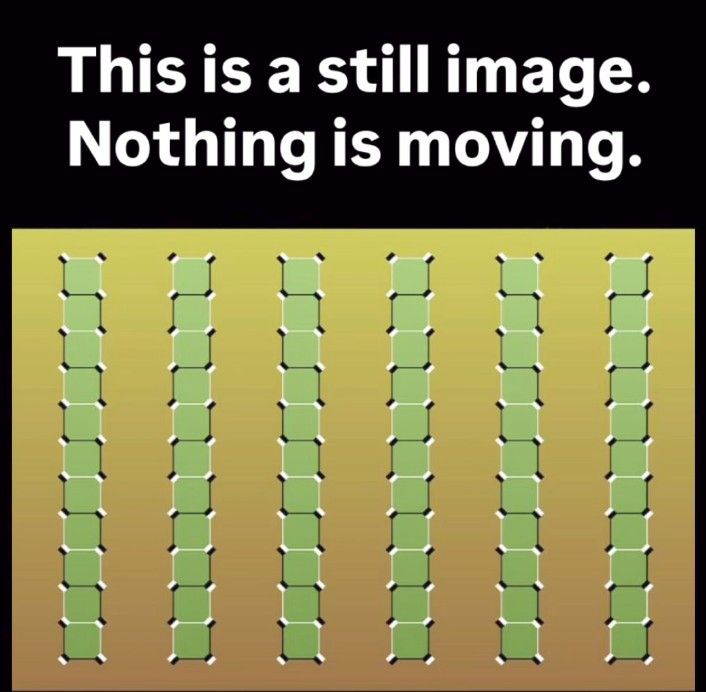
Optical illusions that simulate motion are some of the most captivating and shareable visual phenomena across the internet. They make us double-check our screens, tilt our heads, and wonder how a completely static graphic can appear to shift, shimmer, or slide right before our eyes. One famous peripheral motion illusion features vertical columns of green squares set against a warm gradient background, topped by a simple statement:
“This is a still image. Nothing is moving.”
Despite knowing intellectually that the file is a completely stationary picture, your visual system creates the convincing sensation that the green columns are swaying, tilting, or undulating up and down as your eyes scan across the page.
In this full guide, we explain the scientific mechanics behind the Peripheral Drift Illusion, break down the visual elements of this classic graphic, explore cognitive visual processing, and share practical ways to test the illusion for yourself.
Deconstructing the Image: Why Your Eyes See Motion
The graphic features six vertical columns composed of stacked green squares against a yellow-to-orange background gradient. Although every line is straight and frozen in place, specific visual design triggers cause your visual cortex to misinterpret the static data as motion.
Key Visual Triggers
-
Asymmetrical Micro-Pointers at the Corners: Notice the small black-and-white accents placed at the corners of each green square. These tiny high-contrast visual cues alternate orientation and luminance across neighboring columns.
-
High Luminance Contrast: The sharp contrast between pure white, deep black, and vibrant green creates micro-delays in how your visual neurons process light signals.
-
Background Gradient: The subtle shift in background color from bright yellow at the top to warm orange at the bottom enhances the depth illusion, making the columns seem floaty and dynamic.
The Neuroscience Behind the Peripheral Drift Illusion
Why does a completely static picture appear to move? The phenomenon is known as a Peripheral Drift Illusion, and it relies on how our visual system processes light signals at different speeds.
1. Luminance Processing Speed Delays
Neurons in your retina and visual cortex register high-contrast signals (white against black) slightly faster than mid-contrast signals (green against yellow). When your eyes scan across high-contrast contrast patches, your brain receives light signals at micro-fraction-of-a-second delays. The visual brain interprets this tiny millisecond discrepancy in neural response timing as continuous motion!
2. Rapid Eye Movements (Saccades)
Even when you feel your gaze is totally still, your eyes make tiny, subconscious movements several times per second called saccades and micro-saccades. Every time your gaze shifts, the visual cortex recalculates the position of the black-and-white corner accents, refreshing the perceived motion.
3. Peripheral Vision Dominance
Notice that the movement usually disappears on whichever specific square you stare at directly, while the surrounding columns continue to sway. Peripheral vision is optimized for motion detection rather than fine detail, making it particularly susceptible to contrast-driven optical tricks.
Comparing Visual Motion Illusions
Different optical illusions exploit distinct quirks of human sensory perception. The table below compares common visual illusion categories:
| Illusion Type | Primary Visual Driver | Typical Effect |
| Peripheral Drift (This Image) | Alternating contrast & luminance patterns | Swaying, rotating, or wave-like movement in peripheral vision |
| Scintillating Grid | Lateral inhibition in retinal ganglion cells | Dark spots appearing and disappearing rapidly at grid intersections |
| Geometric Orientation (Café Wall) | Offset parallel lines with contrasting borders | Straight parallel lines appearing slanted or tilted |
| Afterimage / Motion Aftereffect | Photoreceptor adaptation (fatigue) | Stationary objects appearing to drift after staring at continuous movement |
Practical Ways to Test and Prove the Image Is Still
If you want to prove to your brain that the picture is completely stationary, try these simple tests:
1. Fixate on a Single Point
Pick one single black-and-white corner mark and stare at it intently without moving your eyes. Within two to three seconds, the motion in that spot—and eventually across the immediate area—will come to a complete freeze.
2. Block the Peripheral View
Use your hand, a sheet of paper, or a card to cover up all columns except for one single column. Removing the repeating peripheral patterns eliminates the motion trigger completely.
3. Take a Screen Capture or Print It Out
Print the image on paper or take a screenshot on your device. Holding a physical printed sheet confirms that the movement is entirely created by your neural processing rather than digital animation!
Conclusion
The caption “This is a still image. Nothing is moving” is 100% accurate. The sensation of movement is a fascinating brain-trick produced by high-contrast corner elements, luminance processing delays, and micro-saccadic eye movements working together.
Taking a moment for visual optical puzzles like this is a fun, mind-bending way to appreciate the incredible complexity of human visual perception!
Frequently Asked Questions (FAQ)
Is this image actually a GIF or video?
No, it is a static, non-animated image file (such as a standard PNG or JPEG).
What is the name of this optical illusion?
This effect is known as the Peripheral Drift Illusion, a subclass of motion illusions driven by high-contrast patterns and saccadic eye movements.
Why does the motion stop when I stare directly at one spot?
Foveal vision (the center of your visual focus) processes fine spatial detail accurately, suppressing the luminance speed delays that cause peripheral vision to register false movement.