
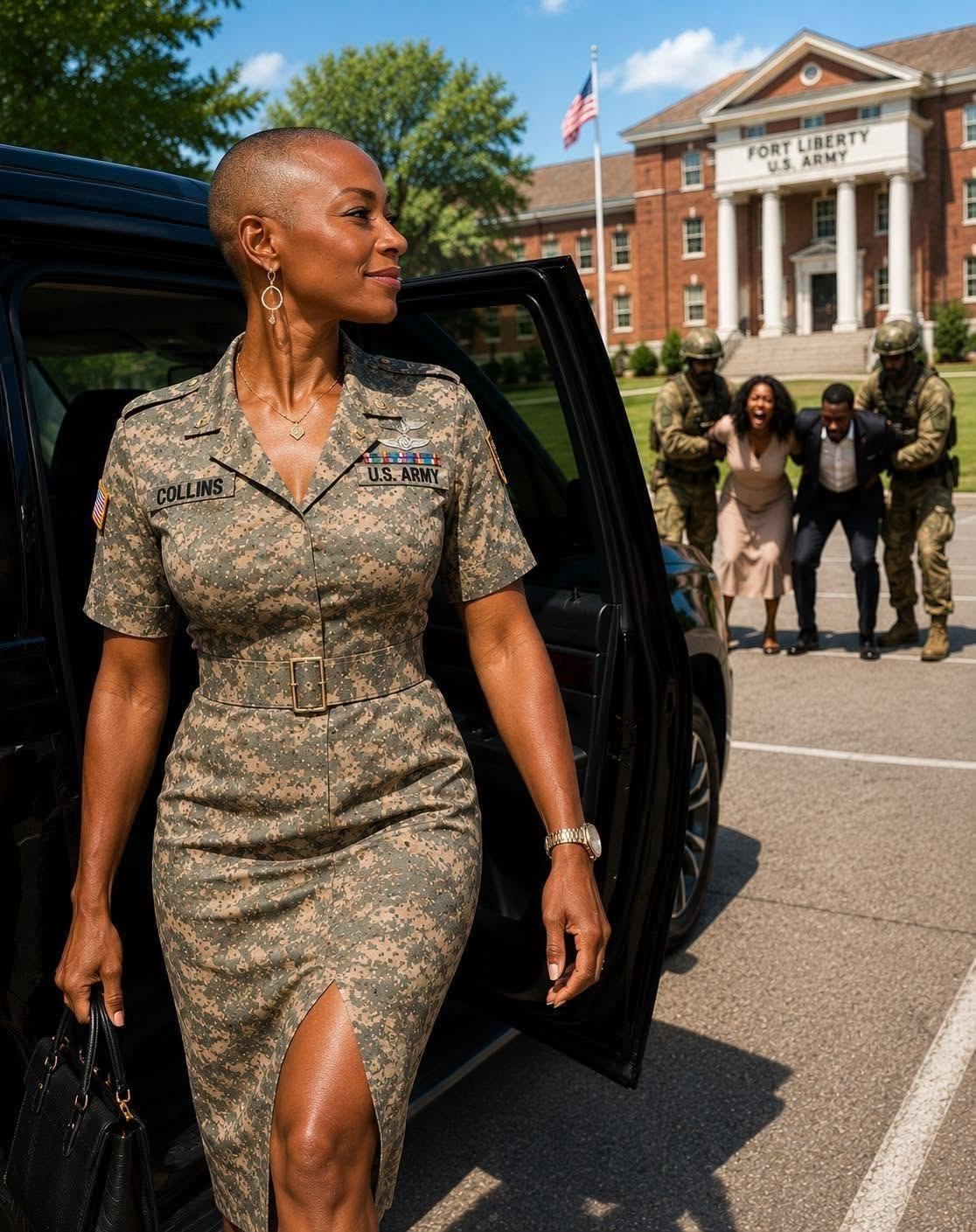


In the age of generative artificial intelligence, realistic synthetic images often circulate widely across social media feeds. A notable recent example features a woman in a camouflage dress with “U.S. ARMY” and “COLLINS” patches exiting an SUV, while armed soldiers restrain two individuals in front of a building labeled “FORT LIBERTY U.S. ARMY.”
While designed to look like a dramatic real-life photograph or movie screenshot, a visual audit quickly reveals that this image is 100% AI-generated.
Visual Deconstruction: Key AI Artifacts and Giveaways
Generative AI models struggle with specific real-world details, particularly military regulations, anatomical proportions, and typography. Here is a breakdown of why this image is synthetic:
                    [ Visual AI Audit Breakdown ]
                                  |
     +----------------------------+----------------------------+
     |                                                         |
[ Non-Regulation Uniforms ]                          [ Visual Artifacts ]
 - Camouflage dress/skirt with high slit              - Glitched building text ("FORT LIBERTY")
 - Gold jewelry, open collar, hoop earrings           - Distorted soldier features & hands
 - Mismatched patches & non-standard insignia        - Floating background elements
1. Military Uniform Violations
-
Fashion-Style Cut: The U.S. Military does not issue or permit camouflage pencil dresses with high thigh slits or belted hourglass fits. Operational Camouflage Pattern (OCP) utility uniforms consist of standard trousers and button-up coats.
-
Jewelry & Grooming: Strict military dress codes (AR 670-1) prohibit visible gold chain necklaces, large drop earrings, and unbuttoned low-cut collars while in uniform.
-
Insignia Discrepancy: The placement of ribbons directly onto a combat camouflage pattern—along with non-standard chest badges—is an amalgamation typical of AI text-to-image prompts.
2. Anatomical and Rendering Glitches
-
Soldiers in Background: The figures in combat gear in the background exhibit classic AI distortion: blurred limbs, unnatural posture, and merged fingers holding non-existent equipment.
-
Car Door Geometry: The vehicle’s open door and frame do not connect realistically to the interior cabin.
3. Background Text Rendering
-
Distorted Lettering: While the sign says “FORT LIBERTY U.S. ARMY,” close inspection shows uneven alignment, slightly warped letter geometry, and inconsistent shadows characteristic of AI text rendering.
AI Image Markers vs. Real-World Standards
| Feature Category | Image Representation (AI) | Actual Military / Real-World Standard |
| Camouflage Attire | Fitted dress with thigh slit & belt | Loose-fitting utility coat & trousers |
| Accessories | Drop earrings, gold watch, necklace | Minimalist stud earrings, no visible necklaces |
| Background Action | Dramatic, film-like arrest scenario | Unrealistic staging without standard MP gear |
| Text & Signage | Floating, slightly irregular font geometry | Solid engraved or mounted physical signage |
Why Fake AI Images Spread So Fast
Synthetic imagery engineered to evoke strong emotional reactions—such as shock, admiration, or political drama—achieves high engagement rates on social platforms. AI generators blend dramatic lighting, high contrast, and cinematic composition to capture visual attention, prompting users to like and share before checking for authenticity.
Key Takeaways and Conclusion
When scrolling through social media, always look beyond the initial visual splash:
-
Inspect Text and Hands: AI frequently struggles with fine details like text alignment, hands, and uniform patches.
-
Verify Regulations: Authentic military personnel follow strict uniform guidelines that contrast sharply with stylized AI depictions.
Frequently Asked Questions (FAQ)
Is the woman in the image a real U.S. Army officer?
No. The entire image—including the person, uniform, background soldiers, and building—is artificially generated by an AI model.
How can I spot AI-generated military images?
Look for non-regulation uniform styles (such as dresses made of camouflage material), improper placement of ribbons or name tapes, distorted hands/fingers, and exaggerated cinematic lighting.