

Mind Test: How Your Brain Decodes Hidden Hand-Gesture Text
Word puzzles and typography illusions are a fascinating demonstration of how the brain processes language, visual shapes, and pattern recognition. By shaping everyday objects—such as hands and fingers—into letter-like forms, our minds seamlessly fill in the blanks to decode hidden messages.
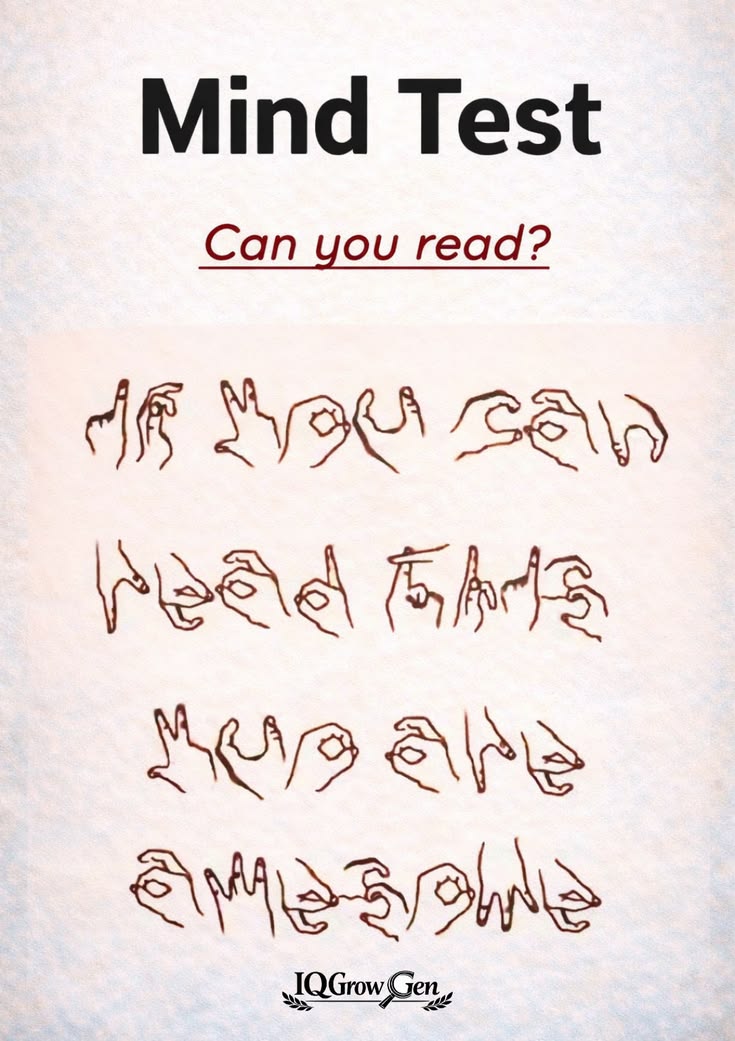
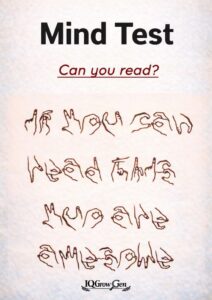
A viral cognitive riddle titled “Mind Test: Can you read?” presents four lines of hand gestures that spell out a hidden phrase:
“IF YOU CAN READ THIS YOU ARE AWESOME”
Below, we break down the secret message line-by-line and explore the psychological science behind how our brains decode complex visual typography!
Line-by-Line Breakdown of the Hidden Message
The graphic uses various hand positions and finger outlines to form each English alphabet letter:
Line 1: “IF YOU CAN”
-
IF: Formed by two hand outlines shaped like the letters I and F.
-
YOU: Created using finger configurations that form Y, O, and U.
-
CAN: Illustrated with hand positions outlining C, A, and N.
Line 2: “READ THIS”
-
READ: Formed by hand silhouettes spelling out R, E, A, and D.
-
THIS: Outlined using finger movements representing T, H, I, and S.
Line 3: “YOU ARE”
-
YOU: Repeating the finger shapes for Y, O, and U.
-
ARE: Three hand positions spelling A, R, and E.
Line 4: “AWESOME”
-
AWESOME: The longest word in the puzzle, skillfully outlined with hand shapes forming A, W, E, S, O, M, and E.
Visual Decoding Matrix: Letters to Hand Gestures
| Word | Letter Count | Key Visual Trick | Brain Processing Speed |
| IF | 2 | Simple vertical & horizontal finger alignments | Fast |
| YOU | 3 | Rounded hand shape for ‘O’ anchors the word | Fast |
| CAN | 3 | Open hand curve forms the ‘C’ and ‘A’ | Moderate |
| READ | 4 | ‘E’ and ‘D’ formed by overlapping fingers | Moderate |
| THIS | 4 | Vertical ‘T’ and ‘I’ gestures frame the word | Moderate |
| ARE | 3 | Classic letter outlines made via hand contours | Fast |
| AWESOME | 7 | Complex multi-finger positions forming ‘W’ and ‘M’ | Advanced |
The Science of Brain Decoding: Typoglycemia & Gestalt Psychology
Why can most people read this sentence effortlessly despite the letters being drawn as hands?
1. Pattern Recognition & Context
When reading, the human mind does not process letters individually; instead, it recognizes entire word structures and sentence contexts. Once your brain recognizes the opening words “IF YOU CAN…”, it automatically anticipates the likely structure of the remaining sentence.
2. Gestalt Principle of Closure
The Gestalt principle of closure states that when visual elements are incomplete or unconventional, the brain automatically completes the image to form a familiar, recognized shape (in this case, standard Latin alphabet characters).
Conclusion
Puzzles like this prove that reading isn’t just about recognizing clean fonts—it’s an active, creative process of pattern recognition and visual interpretation. If you were able to read the hidden text smoothly, your brain’s decoding pathways are sharp and firing on all cylinders!
Frequently Asked Questions (FAQ)
Is this actual sign language?
No, these hand outlines are stylized visual typography designed to look like Latin alphabet letters, rather than standard sign language alphabets such as ASL (American Sign Language).
Why do some people read visual text illusions faster than others?
Speed depends on individual cognitive processing, pattern-recognition skills, and how strongly a person relies on global vs. local visual analysis when perceiving images.