

“Admit It, You Checked” Meme Solved: Why Fingers Appear Equal When Bent
Observational hand-anatomy memes are among the most relatable and engaging classic rage comic formats on social media. By pointing out a simple physical illusion using everyday human anatomy, they prompt readers to pause, test the observation on their own hands, and laugh in the comments.
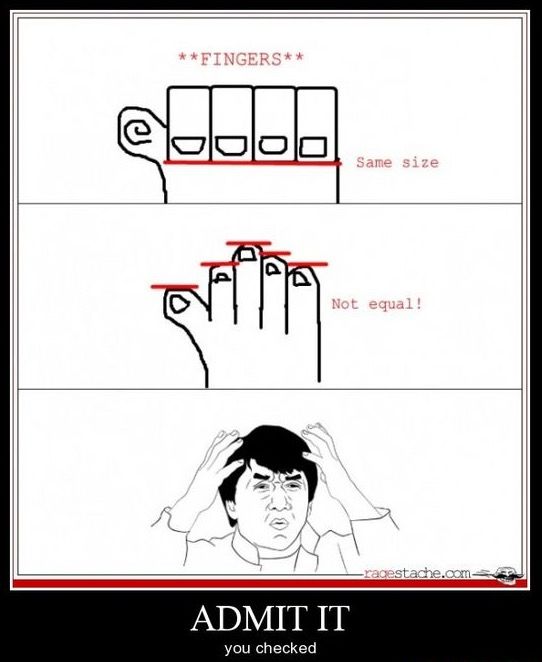
A classic 3-panel rage comic graphic presents a universal observation:
Panel 1: Displays a hand with bent fingers aligned along a horizontal red line labeled “**FINGERS** Same size”.
Panel 2: Displays a hand with fully extended fingers showing different heights labeled “Not equal!”.
Panel 3: Displays the iconic Jackie Chan “My Mind is Blown / What?” reaction face with the main caption:
“ADMIT IT — you checked”
While it appears as if your fingers magically change length depending on how you fold them, this visual phenomenon is actually caused by basic joint mechanics and palm alignment.
In this guide, we break down the meme panel-by-panel, explain the biomechanics of hand anatomy, and analyze why this classic meme format drives high engagement.
Deconstructing the Hand Visual Phenomenon
To understand why your fingers look equal when bent but unequal when straight, consider the placement of your knuckles:
                   [ HAND BIOMECHANICS BREAKDOWN ]
                                  |
      -----------------------------------------------------------
     |                                                           |
 [ 1. BENT FINGERS (PANEL 1) ]               [ 2. STRAIGHT FINGERS (PANEL 2) ]
 • Knuckles flex at different base heights    • Metacarpal bones are different lengths
 • Tips align flush along a flat surface      • Fingers extend fully, revealing natural
 • Creates the illusion of equal length         height variation
1. Panel 1: Bent Fingers (The Illusion)
When you bend your fingers inward into a flat-top fist or rest your folded knuckles against a flat surface, the fingertips align in a neat horizontal line. This happens because the metacarpophalangeal (MCP) joints—the base knuckles—are positioned at varying staggered heights along the curved arch of your palm to compensate for differing finger lengths.
2. Panel 2: Extended Fingers (The Reality)
When you straighten your fingers fully out, you reveal the true relative lengths of your digits:
-
Middle Finger (Longest): Extends furthest from the hand.
-
Index & Ring Fingers (Medium): Slightly shorter than the middle finger.
-
Pinky & Thumb (Shortest): Positioned significantly lower on the hand structure.
Anatomy vs. Illusion Summary Table
| Hand Position | Fingertip Alignment | Underlying Anatomical Reason | Illusion Effect |
| Folded / Bent | Horizontal Straight Line | Staggered MCP knuckles flex at offset angles | Fingers appear equal in size |
| Fully Extended | Curved Arch (Not Equal) | Metacarpal bones and phalanges have different lengths | True digit length variance visible |
Why “Admit It, You Checked” Memes Go Viral
-
Involuntary Physical Response: The meme relies on a universal physical trigger. Almost every person reading the image instinctively looks down at their own hand to curl and uncurl their fingers.
-
Relatable Humor & Reaction Face: Featuring the famous Jackie Chan confused reaction image amplifies the comedic realization that millions of people fall for the exact same subconscious urge.
Conclusion
The “Admit It, You Checked” meme turns human anatomy into a classic internet joke. While folding your fingers creates a straight edge due to offset knuckle joint flexing, extending your hand clearly shows that your fingers are indeed unequal in length!
Frequently Asked Questions (FAQ)
Are human fingers all the same length when bent?
No, human fingers are not the same length. They only appear aligned when bent because the base knuckle joints (MCP joints) are offset along the curved palm structure, allowing the tips to meet along a flat plane.
Why do people instinctively check their hands when seeing this meme?
The prompt creates a subtle psychological trigger called an “action imperative”—viewers test the physical claim immediately on their own body before continuing to read.