


Brain teasers, word puzzles, and math riddles frequently go viral across social media feeds. They test our lateral thinking, linguistic interpretation, and basic arithmetic while driving massive user debate in comment sections.
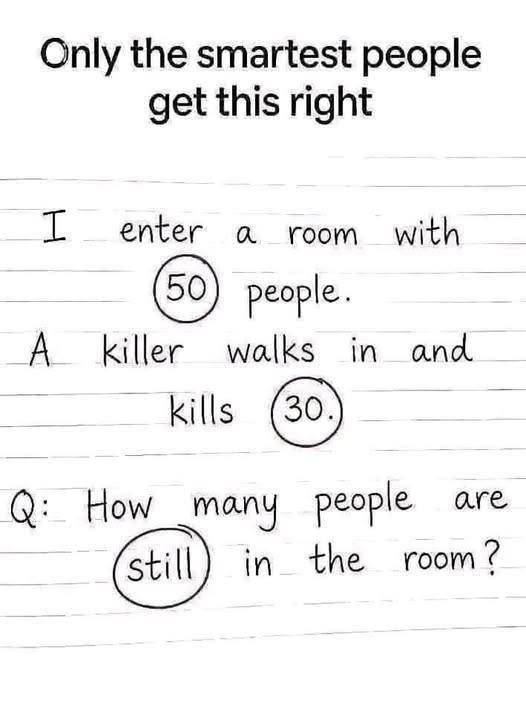
One riddle that continuously circulates with bold claims like “Only the smartest people get this right” states:
“I enter a room with 50 people. A killer walks in and kills 30. Q: How many people are STILL in the room?”
Below, we break down the exact answer, analyze why so many people guess incorrectly, and explore the subtle wording tricks that make logic puzzles so engaging.
The Correct Answer: 52 People
At first glance, many readers instantly subtract $30$ from $50$ and answer $20$. However, closer inspection of the riddle’s exact phrasing reveals why the true answer is 52:
1. Counting Everyone in the Room
-
Initial occupants: The room starts with 50 people.
-
You (“I”): You enter the room, bringing the total count to 51 people ($50 + 1$).
-
The Killer: A killer enters the room, bringing the total headcount to 52 people ($51 + 1$).
2. The Meaning of “People STILL in the Room”
The key to the riddle lies in the word “STILL”:
-
The riddle asks how many people are still in the room, not how many people are alive.
-
Deceased individuals remain physical people inside the space unless explicitly stated that they were removed or fled.
-
Neither the survivors, the narrator, nor the killer are mentioned leaving the room.
Therefore, all 52 individuals (living and deceased) remain in the room!
Alternative Logical Interpretations (The “Living” Perspective)
Because riddles often play on semantic ambiguity, commenters frequently argue for alternative interpretations based on wording assumptions:
-
51 Living People (If the 30 killed were outside): The sentence reads “A killer walks in and kills 30.” It does not explicitly state that the 30 people killed were inside the room. If the killer entered after committing the crime outside, $50 + 1\text{ (you)} = 51$ living people remain inside.
-
21 Living People (If “I” is included in the initial 50): If you subtract the 30 victims from 50 inside, 20 living occupants remain, plus yourself ($20 + 1 = 21$).
Why Brain Teasers Go Viral on Social Media
Riddles like this are designed to maximize user interaction and viral traffic for several reasons:
1. Cognitive Misdirection
Our brains naturally focus on basic arithmetic ($50 – 30 = 20$) while ignoring extra nouns (“I”, “killer”) and semantic details (“still”). Realizing the trick creates a satisfying “Aha!” moment.
2. Debatable Semantics
Because words like “people” can refer to living bodies or physical corpses, the ambiguity inspires friendly debates in the comments, dramatically increasing social engagement metrics.
Conclusion
The “50 People in a Room” riddle is a classic example of how subtle word choices turn simple math into a fun brain teaser. Whether you counted 52 total people or focused strictly on survivors, taking a second look at the details is what makes visual logic games so entertaining!
Frequently Asked Questions (FAQ)
What is the trick to solving logic riddles?
Always read every sentence literally! Pay close attention to pronouns (like “I” or “me”), total counts, location changes, and specific wordings (such as “alive” versus “in the room”).
Are deceased bodies still counted as “people” in logic puzzles?
In lateral thinking riddles, physical bodies remain in the setting unless the text explicitly states that someone left, escaped, or was removed.