
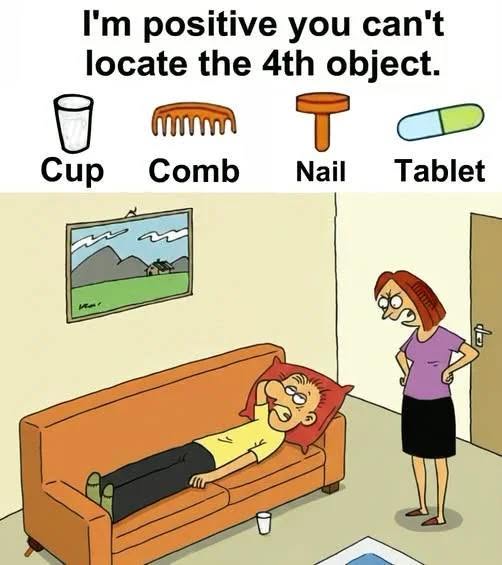


Hidden object puzzles, brain teasers, and visual perception tests have long been a favorite pastime across social media. These engaging mental challenges look simple at a glance, but they are specially designed to test our visual search efficiency, spatial awareness, and attention to micro-details. A classic example is the viral “lazy man on the couch” puzzle, which challenges viewers to spot four specific objects cleverly disguised within the cartoon drawing: a cup, a comb, a nail, and a pill/tablet.
While most people locate the first two or three items within seconds, finding the fourth object—the pill or tablet—proved tricky for thousands of viewers. The secret to solving these visual riddles lies in understanding how the human brain processes shapes, outlines, and figure-ground relationships.
Below, we reveal the exact location of all four hidden items, explore the cognitive science behind visual search puzzles, and share practical tips for keeping your mind sharp.
Complete Solution: Where to Find All 4 Hidden Objects
If you spent minutes scanning the room, the couch, and the characters, here is the step-by-step breakdown of where each hidden item is located within the cartoon illustration:
1. The Cup (Located)
-
Location: Resting on the floor right under the middle section of the orange couch, near the man’s shoes.
-
Visual Marker: The white cup stands out clearly against the grey floor surface.
2. The Comb (Located)
-
Location: Positioned right in the man’s hair on top of his head.
-
Visual Marker: The orange comb blends seamlessly into the outline and texture of his spiky brown/orange hair.
3. The Nail (Located)
-
Location: Hanging on the wall above the picture frame on the left.
-
Visual Marker: The T-shaped brown nail holds the string supporting the framed landscape painting.
4. The Tablet / Pill (The Hardest Item!)
-
Location: Look closely at the woman standing on the right! The two-tone blue and green capsule tablet forms her right eye (the eye on the left side of her face from the viewer’s perspective).
-
Visual Marker: The outline of her eye and eyelid perfectly matches the pill capsule’s shape, splitting into two distinct halves that blend into her facial expression.
The Psychology of Visual Search: Why the Brain Misses Hidden Items
Why is the 4th item so difficult for most people to spot? Cognitive psychologists refer to this phenomenon as change blindness and inattentional blindness.
Contextual Expectation and Schema
When our brains search for a “tablet” or “pill,” we instinctively search surfaces where a pill would realistically be placed: on a table, on the floor, on the couch cushions, or near the picture frame. Because our brain builds a visual expectation (a mental “schema”) of a living room scene, it completely ignores facial features like eyes or ears when searching for household objects.
Visual camouflage and Integration
Puzzle artists use visual camouflage by making an object double as a key structural line in another entity. By turning the capsule pill into a character’s eye, the illustrator cleverly hides the item in plain sight by tricking your visual cortex into registering it purely as part of a human face.
Mental Benefits of Visual Puzzles and Brain Training
Consistently engaging with visual perception tests, lateral thinking riddles, and hidden object games offers tangible cognitive advantages across all ages.
1. Strengthening Selective Attention
Selective attention is the brain’s ability to focus on specific visual inputs while filtering out irrelevant background distractions. Practicing visual search tasks trains your eyes to methodically scan environments, a skill that enhances reading speed, spatial orientation, and driving awareness.
2. Enhancing Pattern Recognition and Brain Plasticity
Searching for disguised shapes forces your brain to build new neural pathways and practice flexible thinking. Breaking through visual tricks builds cognitive flexibility, allowing you to approach problem-solving from fresh perspectives.
Real-World Applications: Precision and Attention to Detail
The ability to look beyond initial assumptions and spot subtle details is a vital skill that translates directly into professional success, personal security, and household management.
-
Professional and Technical Precision: High-detail visual analysis is essential in fields such as medical imaging, legal document auditing, software quality assurance, and architecture engineering.
-
Financial and Household Management: Scrutinizing the fine print in loan agreements, insurance policies, tax filings, and household utility bills ensures you protect your family’s budget and catch discrepancies early.
-
Property Care and Preventative Maintenance: Routine home inspections—checking roof tiles, plumbing lines, or electrical fixtures for subtle signs of wear—helps prevent costly structural repairs down the road.
Practical Tips for Solving Hidden Object Puzzles Quickly
If you want to master visual riddles and spot hidden items with ease, use these proven scanning strategies:
-
Break the Image into Quadrants: Instead of letting your eyes wander randomly across the picture, divide the image into a grid (top-left, top-right, bottom-left, bottom-right) and scan each square systematically.
-
Scan Character Outlines and Features: Illustrators frequently hide items within clothing folds, hair textures, shoes, or facial features (eyes, ears, noses).
-
Invert or Blur Your Focus: Soften your gaze or look at the negative space around objects. This breaks the brain’s automatic context recognition and reveals hidden outlines.
-
Take Short Breaks: If you get stuck on a puzzle, look away for 10 seconds and return with fresh eyes. This resets your brain’s visual search pattern.
Fascinating Facts About Human Vision and Perception
-
Saccadic Eye Movements: Human eyes do not move smoothly across a static image; instead, they make rapid, jerky movements called “saccades” 3 to 4 times per second, gathering snapshots that the brain stitches together.
-
The Fovea’s Role: High-detail color vision relies entirely on the fovea—a tiny area in the center of the retina that covers only about 2 degrees of your total visual field (roughly the width of your thumbnail held at arm’s length!).
-
Pill Color Psychology: In pharmaceutical design, capsule colors are intentionally chosen to evoke emotional responses; cool blues and greens are widely associated with calming, pain-relieving effects.
Conclusion
The viral “lazy man” puzzle is a brilliant demonstration of how clever visual design can trick human perception. While finding the cup, comb, and nail comes naturally, locating the tablet hidden inside the woman’s eye requires breaking out of conventional visual expectations. Practicing these fun mental workouts keeps your observation skills sharp, your mind curious, and your brain ready for life’s everyday details!
Frequently Asked Questions (FAQ)
Where is the tablet hidden in this cartoon image?
The tablet (pill) is cleverly disguised as the woman’s right eye (the eye on the left side of her face from the viewer’s perspective).
Why do most people miss the 4th hidden item?
Most people miss the tablet because the brain expects pills to be on flat surfaces like tables or floors, so it automatically filters out the woman’s facial features during the visual search.
Can practicing hidden object games improve cognitive focus?
Yes! Visual search games and hidden object puzzles actively train selective attention, working memory, and visual discrimination skills.