
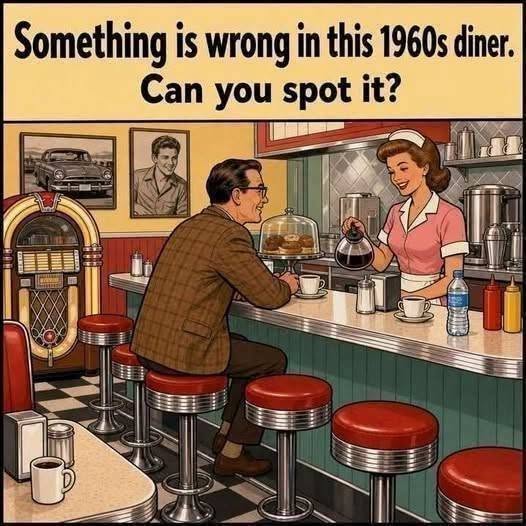


Visual puzzles that feature historical settings alongside a subtle out-of-place object—known as an anachronism—are popular online brain teasers. Captions like “Something is wrong in this 1960s diner. Can you spot it?” challenge our knowledge of historical eras, material culture, and everyday items.
Understanding how historical context clues work, why anachronisms catch our attention, and the history behind everyday consumer goods makes solving these visual riddles a fun learning exercise.
Uncovering the Solution: The Out-of-Place Object
When auditing a scene set in the mid-20th century, look for items that utilize modern materials, packaging, or design technologies that were not available during that era.
                    [ Visual Scene Inspection ]
                                 |
     +---------------------------+---------------------------+
     |                                                       |
[ Authentic 1960s Elements ]                       [ The Anachronism ]
 - Classic Jukebox & Chrome Stools                   - Modern Clear Plastic Water Bottle
 - Glass Coffee Decanter & Mugs                      - Features clear PET plastic & blue cap
 - Diner Counter, Mustard & Ketchup                  - Disposable PET bottles emerged in the late 1970s/80s
The Answer
-
The Modern Plastic Water Bottle: On the diner counter (just to the right of the coffee cup and to the left of the ketchup and mustard dispensers), sitting prominently is a modern disposable plastic water bottle with a blue cap and blue label. Single-use clear plastic (PET) water bottles were not used or sold in American diners during the 1960s—water in that era was served in glass tumblers straight from the tap!
Historical Context: A Timeline of Everyday Diner Items
To spot historical inconsistencies in retro illustrations, it helps to understand when everyday kitchen and dining items were actually introduced:
| Item / Feature | Historical Era Introduced | Era Realism in the Picture |
| Glass Coffee Decanter | 1930s–1940s (Pyrex / Bunn) | Historically Accurate: Very common in 1960s diners. |
| Chrome-Base Counter Stools | 1930s–1950s | Historically Accurate: A signature staple of mid-century American diners. |
| Wurlitzer-Style Jukebox | 1940s–1950s | Historically Accurate: Central feature of rock-and-roll diner culture. |
| Disposable PET Water Bottle | Late 1970s (Patented 1973) | Anachronism: Widespread commercial distribution only took off in the late 1980s and 1990s. |
Why Anachronism Puzzles Engage Our Brains
-
Test of Observational Skills: Searching for anachronisms forces you to look beyond the overall aesthetic and inspect small object features.
-
Nostalgia & Historical Awareness: Puzzles featuring retro diners, vintage cars, and classic fashion evoke nostalgia while testing our memory of cultural history.
-
Pattern Disruption: Seeing a familiar modern object in an unexpected historical setting creates a psychological “wait a minute” reaction that makes the puzzle satisfying to solve.
Key Takeaways and Conclusion
While the illustration captures the nostalgic charm of a 1960s American diner—complete with jukebox music, fresh coffee, and classic diner counter stools—the presence of a modern disposable plastic water bottle gives away the hidden trick. Keep an eye out for material details whenever solving historical visual teasers!
Frequently Asked Questions (FAQ)
Where is the mistake in the image?
The mistake is the modern plastic water bottle sitting on the counter to the right of the waitress and coffee cup.
When did disposable plastic water bottles become common?
Polyethylene terephthalate (PET) plastic bottles were patented in 1973. Commercially sold, mass-market bottled water in single-use plastic bottles did not become mainstream until the late 1980s and 1990s.