

Small Keys Open Big Doors: How Thoughtful Solutions Solve Major Problems
Inspirational quotes, wisdom graphics, and conceptual life-lesson posts perform exceptionally well across social media platforms like Facebook. By linking physical, everyday objects to deep psychological principles, these visuals prompt readers to reflect on personal growth, problem-solving techniques, and emotional clarity.
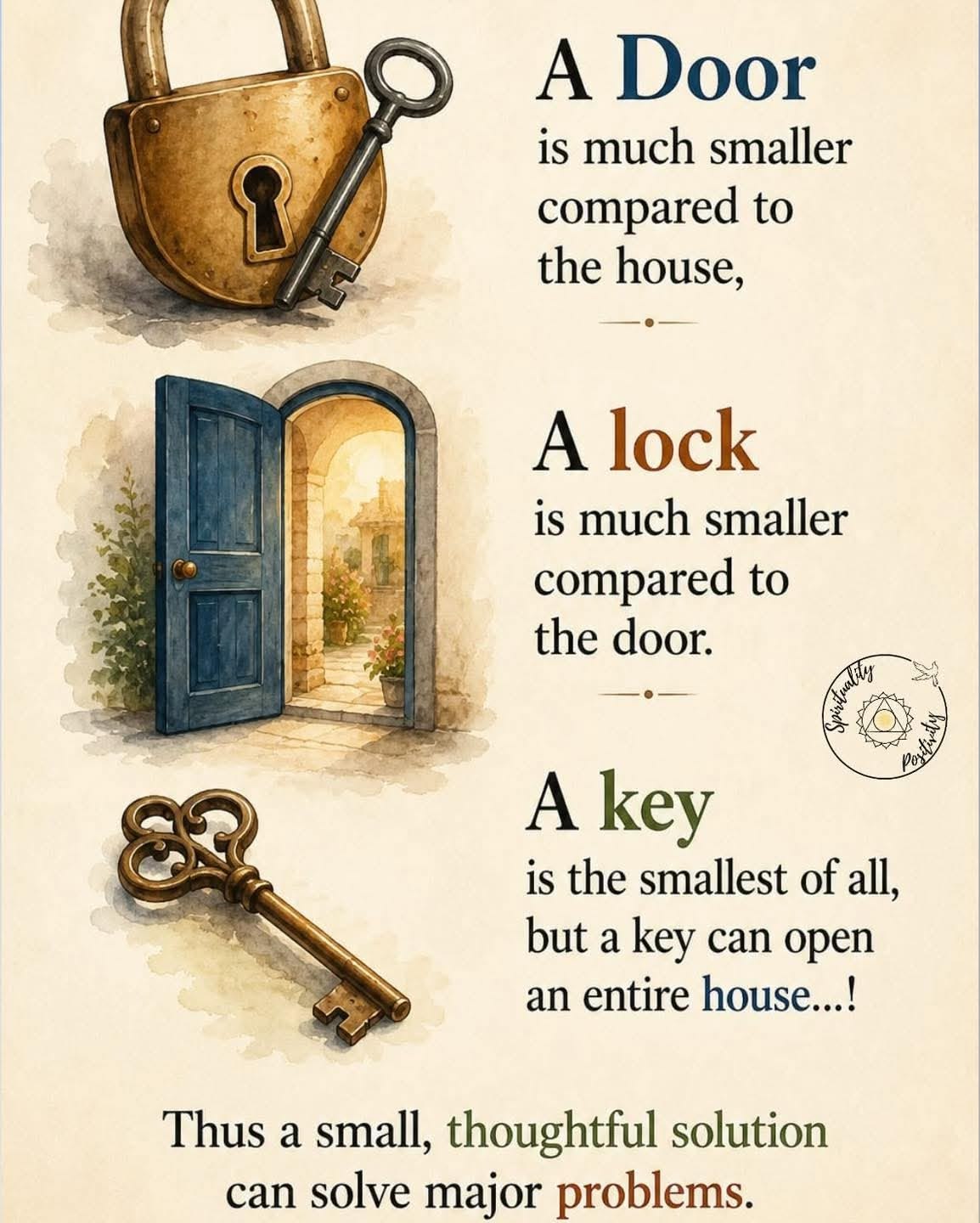
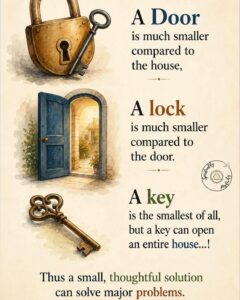
A classic watercolor-style infographic displays three distinct illustrations alongside structured wisdom text:
-
A brass lock and key next to the text: “A Door is much smaller compared to the house,”
-
An open archway door next to the text: “A lock is much smaller compared to the door.”
-
An ornate vintage key next to the text: “A key is the smallest of all, but a key can open an entire house…!”
The bottom of the graphic summarizes the core takeaway:
“Thus a small, thoughtful solution can solve major problems.”
In this guide, we break down the visual metaphor of the key, examine the principle of leverage in problem-solving, and share actionable ways to find small solutions for life’s biggest challenges.
Visual Metaphor Breakdown
The graphic illustrates scale, proportion, and leverage through a logical hierarchy:
                      [ THE PROPORTIONAL HIERARCHY OF LEVERAGE ]
                                         |
      --------------------------------------------------------------
     |                                   |                          |
  [ THE HOUSE ]                    [ THE DOOR & LOCK ]         [ THE KEY ]
 • Represents the entire problem  • Represents access points  • The smallest element
 • Appears huge & overwhelming    • Middle components         • Unlocks the entire system
1. The House vs. The Key
When facing a massive obstacle—whether in career, relationships, or personal finances—it often feels as large and immovable as a house. However, brute force isn’t required to navigate a house; you only need to turn the key in the lock.
2. The Power of Leverage
A key works through precise alignment, not massive force. In practical life, the “key” represents leverage: a small, smart adjustment in mindset, communication, or strategy that effortlessly removes a giant barrier.
Brute Force vs. Strategic Key Alignment
Understanding the difference between overwhelming effort and precise problem-solving helps save time and energy:
| Aspect | Brute Force (Trying to Kick Down the Door) | Strategic Thinking (Finding the Key) |
| Approach | Applying maximum physical or mental force | Finding the specific root cause or mechanism |
| Resource Cost | High stress, high fatigue, risk of damage | Low friction, high efficiency, smooth transition |
| Long-Term Result | Exhaustion and broken barriers | Easy, repeatable access to solutions |
3 Ways to Find the “Small Key” for Large Problems
-
Identify the Root Cause: Instead of battling the entire problem at once, break it down to find the single bottleneck (the “lock”) holding back progress.
-
Focus on Micro-Habits: Massive life goals are achieved through tiny daily routines. A 15-minute daily habit is a small key that unlocks massive long-term transformation.
-
Change the Perspective: If pushing hard against a problem isn’t working, step back. A small shift in perspective often reveals an obvious solution that was previously hidden.
Conclusion
The lesson “A small, thoughtful solution can solve major problems” is a powerful reminder that scale does not equal difficulty. By focusing on precision, leverage, and smart habits, you can unlock even the most daunting challenges with ease.
Frequently Asked Questions (FAQ)
What does “a small key opens a big door” mean metaphorically?
It means that complex or massive problems often have simple, targeted solutions if you focus on finding the right approach rather than using raw force.
How can I apply the “key” principle to stress management?
Instead of trying to overhaul your entire life when overwhelmed, identify one small trigger (like screen time or lack of sleep) and make a minor adjustment to unlock significant mental peace.