

Which One Shows the Correct Equilibrium Position? Physics Pulley Puzzle Explained
Physics puzzles and mechanics brain teasers generate strong engagement across social media platforms like Facebook. By testing intuitive physics concepts against real mechanical laws, these posts challenge readers to apply fundamentals of static equilibrium and tension.
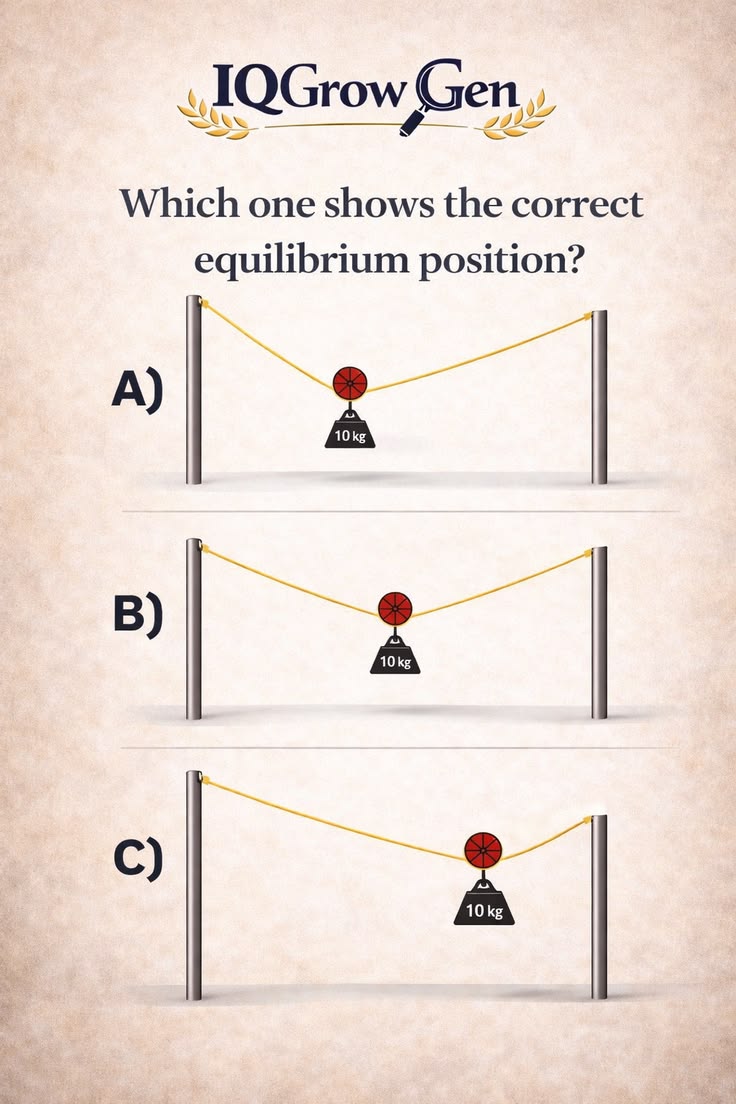
A popular physics puzzle presents a $10\text{ kg}$ weight suspended on a pulley along a rope stretched between two vertical poles of equal height, asking:
“Which one shows the correct equilibrium position?”
While options A and C show the pulley offset to the left or right, basic static equilibrium and symmetry principles dictate that option B is the correct answer.
In this guide, we break down the mechanics behind the puzzle, derive the tension equations, and explain why the pulley naturally settles directly in the center.
Detailed Physics Breakdown
To determine where the pulley comes to rest, we analyze the forces acting on the frictionless wheel:
                         [ FORCE EQUILIBRIUM DIAGRAM ]
                                      |
      -----------------------------------------------------------------
     |                                |                                |
 [ GRAVITATIONAL FORCE ]      [ ROPE TENSION (T) ]           [ SYMMETRY REQUIREMENT ]
 • Pulls 10 kg weight downward • Tension is uniform along     • Equal pole heights require
 • F_g = m * g                 ideal frictionless rope        equal angles (θ_1 = θ_2)
1. Frictionless Pulley Dynamics
-
A continuous, frictionless rope passes around the pulley wheel.
-
Because the rope and pulley are assumed to be ideal and frictionless, tension $T$ must be equal on both sides of the rope segment.
2. Horizontal Force Balance ($\sum F_x = 0$)
-
Let $\theta_1$ be the angle of the left rope segment with the horizontal, and $\theta_2$ be the angle of the right rope segment.
-
For the pulley to remain stationary horizontally:
$$T \cos(\theta_1) = T \cos(\theta_2)$$ -
Dividing both sides by $T$ yields $\cos(\theta_1) = \cos(\theta_2)$, which means:
$$\theta_1 = \theta_2$$
3. Equal Height and Centering
-
Since the attachment points on both poles are at the exact same vertical height, having equal rope angles ($\theta_1 = \theta_2$) means the pulley must be positioned symmetrically at the exact horizontal midpoint between the two posts.
Analysis of the Options
| Option | Pulley Position | Static Forces Balanced? | Correct Equilibrium? |
| A | Offset to the left | No ($\sum F_x \neq 0$, horizontal net force pulls right) | Incorrect |
| B | Centered at midpoint | Yes ($\sum F_x = 0$ and $\sum F_y = 0$) | CORRECT |
| C | Offset to the right | No ($\sum F_x \neq 0$, horizontal net force pulls left) | Incorrect |
Minimal Potential Energy Principle
Another way to confirm option B is through classical mechanics and potential energy:
-
Lowest Point of Mass: A system in stable equilibrium minimizes its total gravitational potential energy ($E_p = mgh$).
-
Path of the Pulley: For a fixed length of rope anchored at two fixed points, the locus of points the pulley can reach forms an ellipse.
-
Lowest Altitude: The lowest geometric point on this elliptical path occurs precisely halfway between the two anchor posts. The $10\text{ kg}$ weight will naturally roll down to this lowest point at the center.
Conclusion
The correct answer is B. Because the posts are equal in height and the pulley is frictionless, horizontal force equilibrium and potential energy minimization both require the weight to rest at the exact geometric midpoint between the two posts.
Frequently Asked Questions (FAQ)
What would happen if one post was taller than the other?
If the anchor points were at different heights, the pulley would still settle at a position where the angles relative to the horizontal are equal ($\theta_1 = \theta_2$), shifting the equilibrium position toward the lower post horizontally relative to the midpoint.
Does the mass of the weight affect the equilibrium position?
No. The magnitude of the mass ($10\text{ kg}$) increases the total tension $T$ in the rope, but the geometric equilibrium position remains centered at the midpoint regardless of the weight value.