

How Many Balls Are in This Picture? The Viral Pyramid Puzzle Solved
Viral brain teasers and optical illusions flood social media daily, but few generate as much debate in comment sections as spatial reasoning puzzles. Puzzles that ask viewers to count stacked objects test our ability to visualize three-dimensional structures from a flat, two-dimensional image.
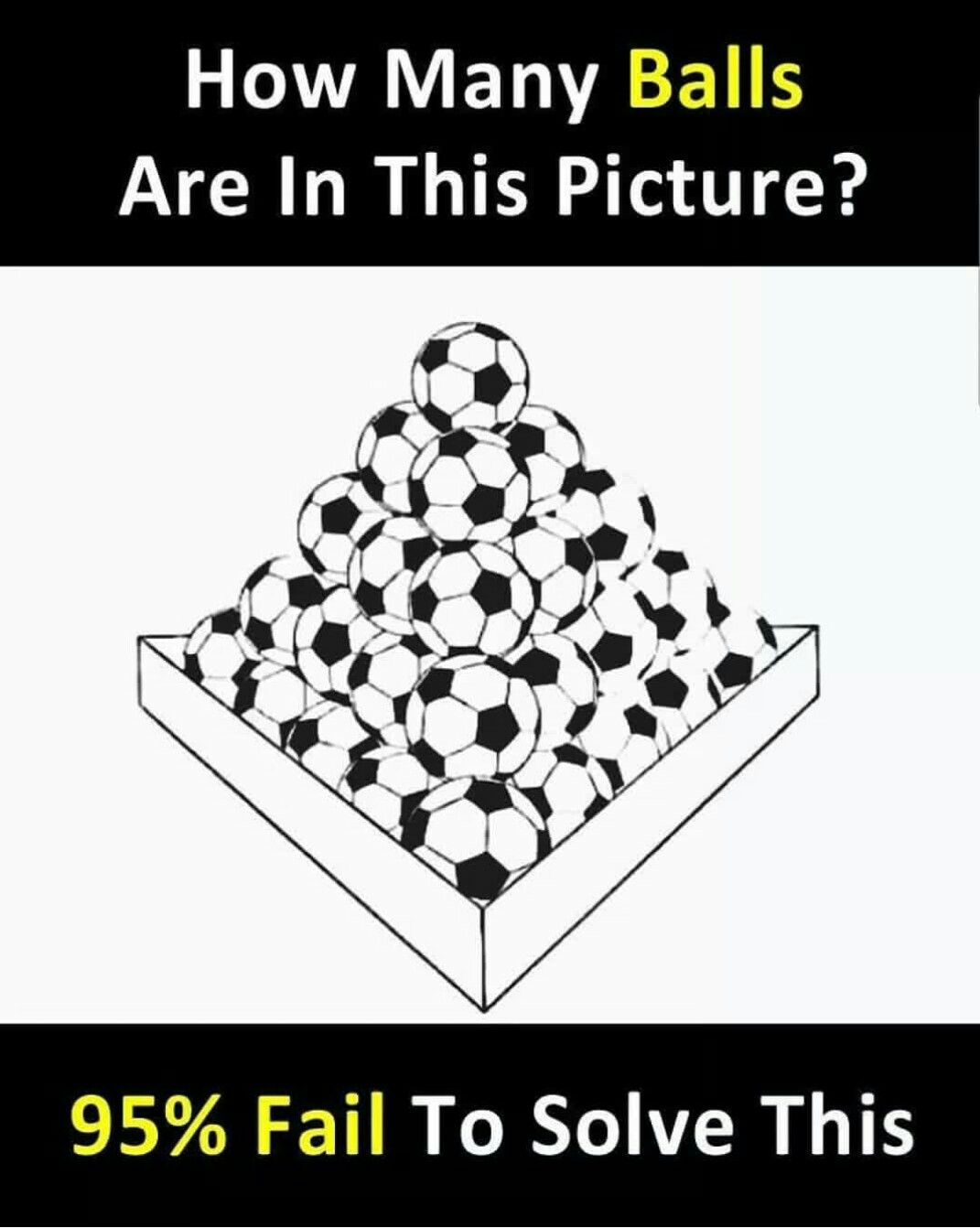
A classic viral puzzle featuring stacked soccer balls in a square tray challenges users with a bold claim:
“How Many Balls Are In This Picture?”
“95% Fail To Solve This”
At first glance, many viewers make the mistake of only counting the soccer balls that are visibly exposed on the front faces. However, to construct a stable, balanced pyramid structure like the one shown, there must be hidden balls supporting the upper levels underneath.
In this guide, we break down the simple mathematical formula to solve this pyramid puzzle step-by-step, explain why so many people get it wrong, and share the definitive final answer.
Deconstructing the Pyramid: Layer-by-Layer Breakdown
To solve any square pyramid counting puzzle, you must break the structure down into horizontal layers from top to bottom.
                   [ LAYER-BY-LAYER PYRAMID STRUCTURE ]
                                    |
      --------------------------------------------------------------
     |                |                    |                        |
 [ TOP LEVEL ]   [ LEVEL 2 ]          [ LEVEL 3 ]              [ BASE LEVEL ]
 • 1 x 1 grid    • 2 x 2 grid         • 3 x 3 grid             • 4 x 4 grid
 • 1 ball total  • 4 balls total      • 9 balls total          • 16 balls total
Layer 1 (The Top)
-
Dimensions: $1 \times 1$
-
Calculation: $1^2 = 1$
-
Count: 1 ball sitting right at the peak.
Layer 2 (Second from Top)
-
Dimensions: $2 \times 2$
-
Calculation: $2^2 = 4$
-
Count: 4 balls supporting the top ball.
Layer 3 (Third from Top)
-
Dimensions: $3 \times 3$
-
Calculation: $3^2 = 9$
-
Count: 9 balls arranged in a square grid.
Layer 4 (The Base)
-
Dimensions: $4 \times 4$
-
Calculation: $4^2 = 16$
-
Count: 16 balls forming the full base inside the tray.
The Mathematical Solution
To find the total number of balls in the pyramid, we simply sum the squares of each layer level ($n = 4$):
Comparative Breakdown: Common Errors vs. The Correct Approach
| Method | Approach Taken | Common Result | Why It’s Flawed / Correct |
| Surface Count | Counting only balls visible on front faces | 16–20 balls | Ignores hidden interior/rear support balls |
| Base-Only Count | Counting only the bottom row visible | 16 balls | Forgets all upper layers |
| 3D Layer Formula | Calculating square layers ($1^2 + 2^2 + 3^2 + 4^2$) | 30 balls | Accurately accounts for 3D physics & hidden supports |
Why Do 95% of People Get It Wrong?
The reason this puzzle tricks so many viewers comes down to cognitive psychology:
-
2D Visual Bias: Our eyes naturally gravitate toward what is directly visible in a two-dimensional image. People forget to project the image into 3D space in their minds.
-
Rushing the Calculation: Viewers often quickly tally the exposed pattern along the front edges without pausing to calculate the structural foundation underneath.
Conclusion
The definitive answer to “How Many Balls Are In This Picture?” is 30. By applying a simple layer-by-layer sum of squares, you can easily crack 3D stacking puzzles every single time!
Frequently Asked Questions (FAQ)
What is the correct answer to the soccer ball pyramid puzzle?
The correct answer is 30 balls (1 + 4 + 9 + 16).
What formula is used to solve square pyramid counting puzzles?
You use the sum of squares formula for $n$ layers:
For a 4-layer pyramid: $1^2 + 2^2 + 3^2 + 4^2 = 30$.