


What You See First Reveals How Your Brain Processes Visual Details
Ambiguous figures and Gestalt visual illusions are fascinating tools used in perceptual psychology. They test how our brains organize visual stimuli, specifically how we separate a primary subject (figure) from its background (ground).
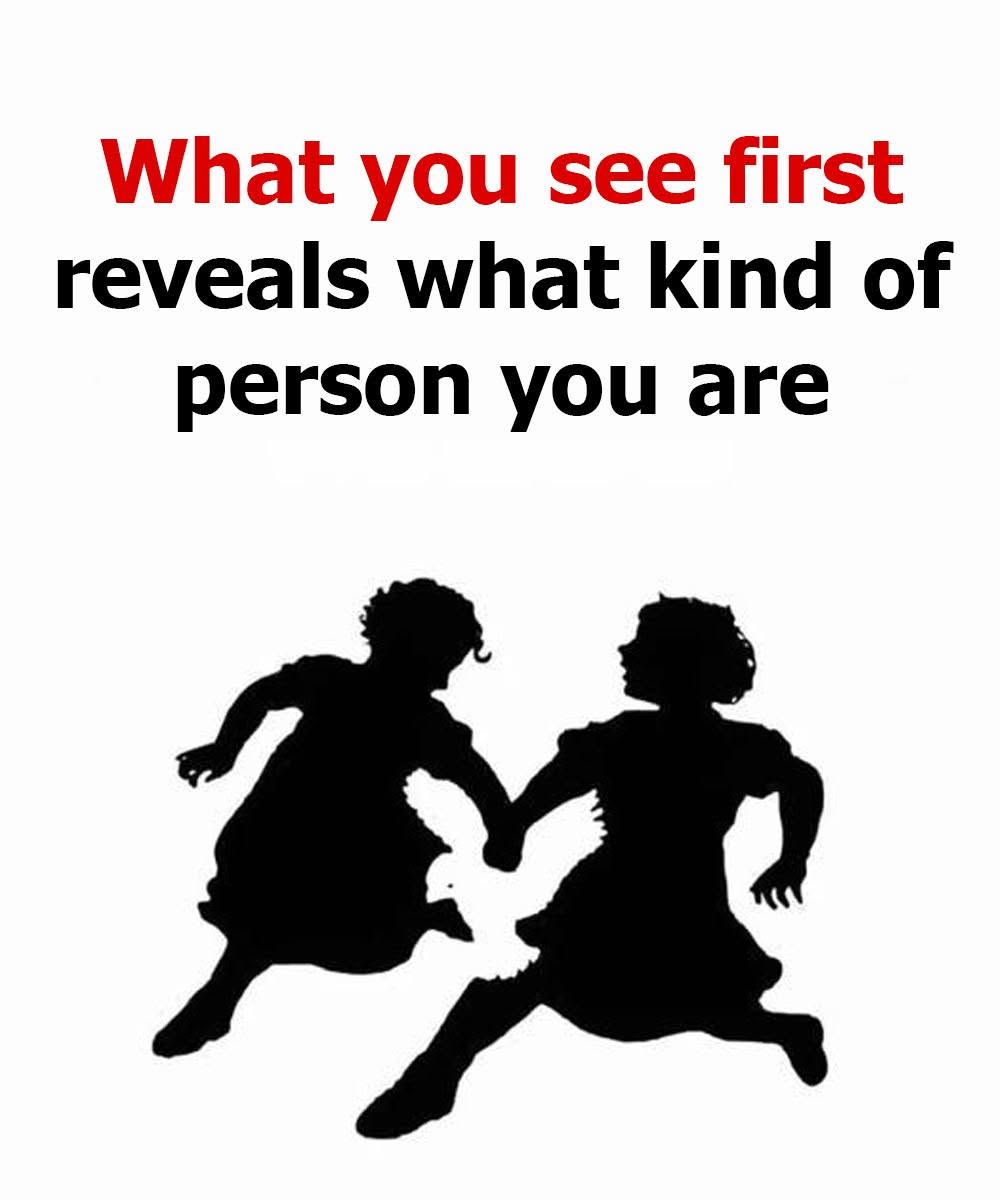
A viral visual personality test featuring a black-and-white silhouette poses a popular question:
“What you see first reveals what kind of person you are”
This image is a classic example of figure-ground reversal, where the positive space (the dark silhouette) and the negative space (the white area in between) form two entirely different recognizable images.
Below, we break down what each interpretation means and how visual perception shapes what we see first!
What Your First Impression Reveals
1. Two Girls Playing (The Positive Space)
-
Visual Focus: Your attention is naturally drawn to the solid black silhouettes of two young girls running or holding hands.
-
Psychological Interpretation: Seeing the figures first suggests an outward-focused, social, and observational mindset. You tend to notice immediate surroundings, human connections, and actionable details first before looking at hidden nuances.
2. A Flying Bird or Skull (The Negative Space)
-
Visual Focus: Your brain instantly highlights the white space formed between the legs and dresses of the two girls, revealing the shape of a white bird (like a dove) taking flight—or a stylized skull shape.
-
Psychological Interpretation: Spotting the negative space first indicates a high degree of lateral thinking and pattern recognition. You naturally look beyond the obvious, noticing subtle background details, underlying context, and non-conventional perspectives.
Visual Breakdown: Figure vs. Ground
| Visual Element | Graphic Component | Perceptual Focus | Personality Archetype |
| Two Girls | Positive Space (Black Silhouettes) | Direct, main subject recognition | Practical, socially observant, grounded |
| Bird / Dove | Negative Space (White Center) | Background contour recognition | Analytical, imaginative, detail-oriented |
The Science Behind Gestalt Illusions
Why do people see different images when looking at the exact same graphic?
-
Figure-Ground Organization: The visual cortex constantly decides which parts of an image are the foreground (objects of interest) and which are background space.
-
Contrast Priming: Depending on whether your eyes hit the dark tones or light center first, your brain “fills in the blanks” to construct a familiar object like a person or a bird before you even consciously register it.
Conclusion
Whether you saw the two girls playing or the white bird taking flight, this illusion shows just how remarkably adaptable human visual processing really is!
Frequently Asked Questions (FAQ)
Can visual illusion personality tests accurately diagnose personality traits?
While they are fun and engaging social media quizzes, visual perception tests primarily measure optical focus and cognitive visual processing rather than comprehensive psychological traits.
Why is negative space so powerful in visual design?
Artists and graphic designers use negative space to create dual-meaning logos and optical illusions because it forces the human brain to actively engage with the artwork to reveal hidden meanings!