

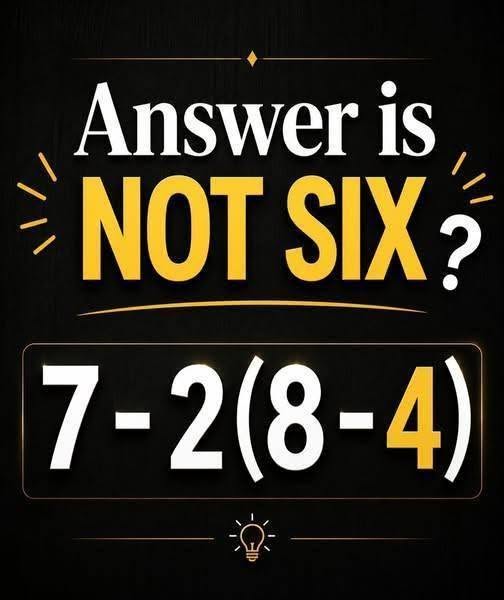


Math viral puzzles frequently go viral on social media, igniting heated debates in comment sections. One classic example is the expression $7 – 2(8 – 4)$. While many people quickly answer 6 or 20, mathematical rules follow a strict order of operations known worldwide as PEMDAS (or BODMAS).
Understanding how to evaluate mathematical expressions step-by-step clarifies why common mental shortcuts lead to incorrect results, and why order of operations is foundational to mathematics, science, engineering, and computer programming.
Step-by-Step Solution Breakdown
To solve $7 – 2(8 – 4)$, we follow the standard order of operations: Parentheses, Exponents, Multiplication and Division (left to right), and Addition and Subtraction (left to right).
         [ 7 - 2(8 - 4) ]
                 |
     (Step 1: Parentheses)
            8 - 4 = 4
                 |
         [ 7 - 2(4) ]
                 |
   (Step 2: Multiplication)
             2 * 4 = 8
                 |
          [ 7 - 8 ]
                 |
   (Step 3: Subtraction)
            7 - 8 = -1
Step 1: Solve Inside the Parentheses
Always evaluate terms inside parentheses first:
Substituting this back into the expression gives:
Step 2: Perform Multiplication Before Subtraction
A common mistake is subtracting $7 – 2$ first to get $5$, then multiplying by $4$ to get $20$, or incorrectly evaluating it to get $6$. However, multiplication takes precedence over subtraction:
Now the expression becomes:
Step 3: Perform Subtraction
Finally, subtract $8$ from $7$:
Correct Answer: -1 (Negative One)
Why Do People Get 6 or 20? Explaining the Common Errors
Understanding why people arrive at wrong answers helps highlight typical mathematical pitfalls:
| Result | Method Used | Why It Is Incorrect |
| -1 | Followed PEMDAS correctly: $7 – 2(4) = 7 – 8 = -1$ | Correct Answer |
| 20 | Performed subtraction first: $(7 – 2) \times (8 – 4) = 5 \times 4 = 20$ | Violated order of operations by subtracting before multiplying. |
| 6 | Calculated $(7 – 1) = 6$ or miscalculated $7 – (8 – 4) = 7 – 4 = 3$ / misplaced signs | Ignored the factor of $2$ multiplying the parenthesis or made sign distribution errors. |
PEMDAS vs. BODMAS: The Universal Standard
Regardless of where you learned mathematics, standard acronyms reinforce the same fundamental rules:
-
PEMDAS: Parentheses, Exponents, Multiplication & Division, Addition & Subtraction.
-
BODMAS: Brackets, Orders, Division & Multiplication, Addition & Subtraction.
Both conventions require evaluating grouping symbols first, followed by multiplication/division, and lastly addition/subtraction.
Real-World Applications: Why Order of Operations Matters
The strict rules of arithmetic order are essential across numerous industries:
-
Computer Programming & Software Engineering: Calculators, algorithms, and financial software rely on unambiguous math logic. An error in operation precedence can lead to catastrophic software bugs or incorrect accounting balances.
-
Engineering & Physics: Complex physics equations and structural engineering formulas require precise execution order to calculate force, stress, and electrical load safely.
-
Banking and Accounting: Computing compound interest, tax deductions, and depreciation schedules requires adherence to algebraic rules.
Practical Tips for Avoiding Order of Operations Errors
-
Work Left to Right Within Hierarchy: Remember that multiplication and division hold equal priority, as do addition and subtraction. Always execute them from left to right as they appear.
-
Never Subtract Before Multiplying: Unless subtraction is explicitly enclosed in parentheses (e.g., $(7 – 2)$), multiplication must always be performed first.
-
Rewrite Steps Line-by-Line: Avoid doing mental math shortcuts for multi-step expressions. Writing down each intermediate step prevents sign and distribution mistakes.
Key Takeaways and Conclusion
The expression $7 – 2(8 – 4)$ yields -1, proving that the headline claiming “Answer is NOT SIX” is entirely accurate! By sticking to the standard PEMDAS rules—resolving parentheses first, multiplying next, and subtracting last—you will reliably arrive at the correct answer every time.
Frequently Asked Questions (FAQ)
What is the correct answer to $7 – 2(8 – 4)$?
The correct answer is -1.
Why is the answer not 20?
Because $7 – 2$ cannot be evaluated first. Multiplication ($2 \times 4$) takes precedence over subtraction according to the order of operations.
What does PEMDAS stand for?
PEMDAS stands for Parentheses, Exponents, Multiplication, Division, Addition, and Subtraction.