

What Your Fingerprint Says About You: Loop, Arch, and Whorl Patterns Explained
Fingerprint personality tests and dermatoglyphic infographics generate huge engagement across social media platforms. They combine everyday self-examination with personality trait categories, inviting users to compare their thumbprints to illustrated diagrams.
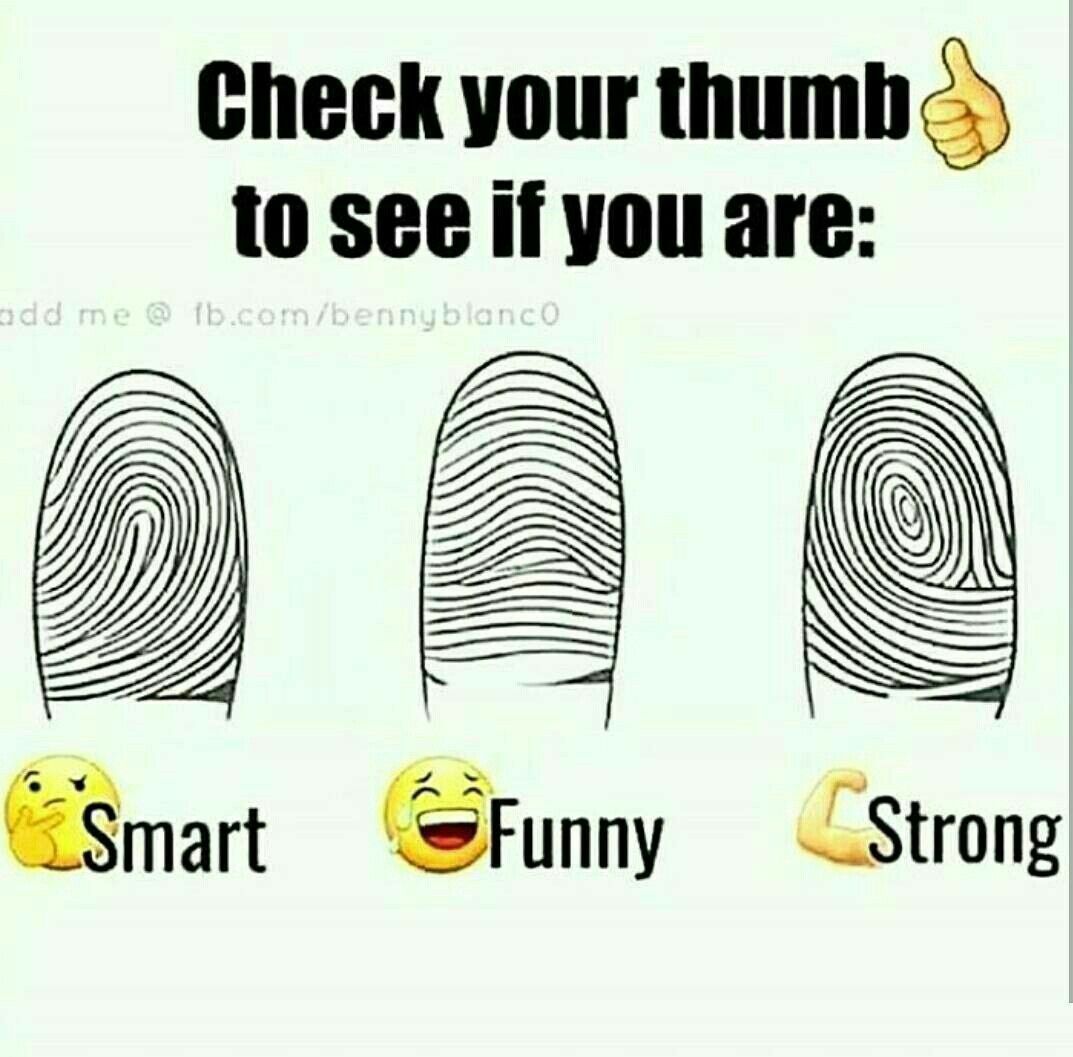
A popular viral post shows three distinct fingerprint patterns with a simple invitation:
“Check your thumb to see if you are:”
• Smart (Loop Pattern)
• Funny (Arch Pattern)
• Strong (Whorl Pattern)
While personality assignments in online quizzes are fun entertainment, fingerprint patterns—known scientifically as dermatoglyphics—are genuine unique biological markers formed before birth.
In this guide, we analyze the three primary types of fingerprint patterns shown in the graphic, explore their scientific classifications, and explain why personality tests featuring fingerprints are so popular online.
Deconstructing the Three Fingerprint Patterns
Dermatoglyphics classifies human friction ridge patterns on fingertips into three main categories: loops, arches, and whorls.
                    [ FINGERPRINT PATTERN CLASSIFICATION ]
                                       |
      ------------------------------------------------------------------
     |                                 |                                |
 [ LOOP PATTERN ]              [ ARCH PATTERN ]                 [ WHORL PATTERN ]
 • Slanted recurving lines     • Wave-like horizontal ridges     • Concentric circles/spirals
 • Labeled: **Smart**          • Labeled: **Funny**             • Labeled: **Strong**
 • ~60–65% of population       • ~5% of population              • ~30–35% of population
1. The Loop Pattern (“Smart”)
-
Visual Structure: Ridges enter from one side of the finger, curve upward around a central core, and exit or tend to exit on the same side.
-
Prevalence: Loops are the most common fingerprint pattern worldwide, occurring in roughly 60% to 65% of human fingers.
-
Subtypes: Can be classified as Ulnar loops (pointing toward the pinky) or Radial loops (pointing toward the thumb).
2. The Arch Pattern (“Funny”)
-
Visual Structure: Ridges enter continuously from one side, rise up in the center forming a wave or gentle tent-like peak, and flow out the opposite side without looping back.
-
Prevalence: Arches are the rarest primary pattern type, appearing in only about 5% of fingertips.
-
Subtypes: Includes Plain arches (gentle rise) and Tented arches (sharp upward point in the middle).
3. The Whorl Pattern (“Strong”)
-
Visual Structure: Ridges form circular, spiral, or bullseye-like patterns around a central point, completing at least one full circuit.
-
Prevalence: Whorls are the second most common pattern, found in approximately 30% to 35% of fingerprints.
-
Subtypes: Includes Plain whorls, Central pocket loops, Double loops, and Accidental whorls.
Pattern Comparison Table
| Pattern Type | Meme Trait Label | Ridge Formation Characteristics | Population Frequency |
| Loop | Smart | Ridges curve back on themselves around a core point | ~60% – 65% |
| Arch | Funny | Ridges flow continuously from left to right in a wave | ~5% |
| Whorl | Strong | Ridges form closed concentric circles or spiral loops | ~30% – 35% |
Do Fingerprints Determine Personality Traits?
While dermatoglyphic patterns are entirely unique to each person and determined during fetal development, there is no scientific evidence linking fingerprint ridge patterns to specific personality traits like being smart, funny, or strong.
Such online memes function as lighthearted entertainment and engagement prompts rather than psychological evaluations.
Why Fingerprint Personality Memes Go Viral
-
Self-Relevance & Curiosity: People naturally love quick self-assessments that require zero effort—simply looking down at a thumb.
-
Comment Drive: Asking users to identify their pattern naturally drives heavy engagement as people share their results in the comment section.
Conclusion
Whether your thumb features a loop, an arch, or a whorl, every single person possesses a completely unique arrangement of friction ridges! While the meme assigns fun traits like Smart, Funny, or Strong, the real marvel lies in the unique biological marker on your fingertips.
Frequently Asked Questions (FAQ)
What are the three main types of fingerprint patterns?
The three primary classifications in dermatoglyphics are Loops, Arches, and Whorls.
Which fingerprint pattern is the rarest?
The Arch pattern is the rarest, occurring in only about 5% of all fingertips.