
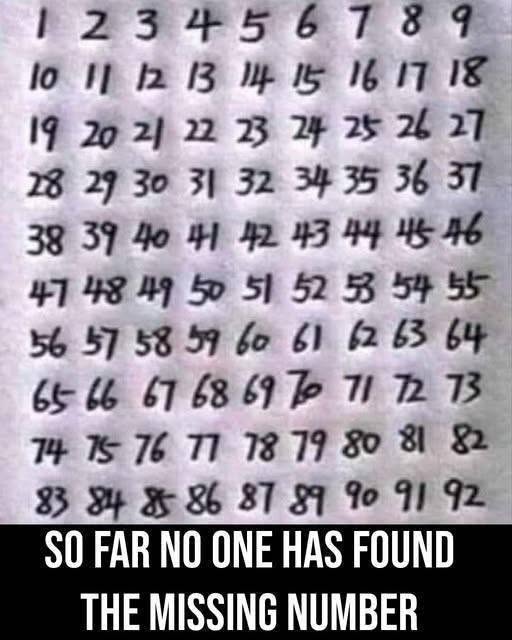


Number grids and sequential visual teasers are a staple of social media brain workouts. Prompts featuring rows of handwritten or printed digits—such as counting sequentially from 1 to 92—play on the human brain’s natural tendency to auto-correct missing information based on expectation. When scanning numbers in order, our brains often experience “expectation bias,” where the visual cortex fills in familiar sequences automatically, making subtle omissions surprisingly hard to spot.
Understanding how pattern recognition works, how visual auditing techniques improve cognitive accuracy, and why brain training games benefit mental sharpness offers fascinating insights into perception and focus.
Solving the Puzzle: Tracing the Grid Row by Row
To find all missing numbers in this visual sequence, we must systematically inspect each row from left to right rather than skim-reading the entire block.
Row 1-3:  1  to 27  ---> Complete
Row 4:   28, 29, 30, 31, 32, [??], 34, 35, 36, 37  ---> 33 IS MISSING!
Row 5-9: 38  to 82  ---> Complete
Row 10:  83, 84, 85, 86, 87, [??], 89, 90, 91, 92  ---> 88 IS MISSING!
1. Row-by-Row Breakdown
-
Rows 1 through 3 (1 to 27): Every sequential integer is present in exact numerical order.
-
Row 4 (28 to 37): Look closely between 32 and 34. The number 33 is completely skipped!
-
Rows 5 through 9 (38 to 82): All numbers run continuously without interruption.
-
Row 10 (83 to 92): Look between 87 and 89. The number 88 is missing as well!
The Trick Revealed
While the caption asks to find “the” missing number (singular), there are actually two missing numbers: 33 and 88. The prompt deliberately uses singular phrasing to trick viewers into stopping their search as soon as they discover the first missing digit (33), missing the second one at the very bottom!
Cognitive Psychology: Why We Overlook Repeated or Missing Digits
The reason these visual riddles spark so much debate comes down to how human vision processes structured information:
| Psychological Mechanism | How It Affects Reading Grids | Real-World Impact |
| Expectation Bias | The brain anticipates sequential order and mentally “inserts” missing numbers. | Leads to proofreading errors in editing and documentation. |
| Typoglycemia / Visual Filling-In | The mind focuses on overall pattern shape rather than granular individual items. | Helps rapid reading, but causes missed details during visual checks. |
| Satisficing | Stopping a search task as soon as a single solution (33) is found. | Causes incomplete auditing, code bugs, or overlooked data entry errors. |
Cognitive Benefits of Visual Audit Exercises
Regularly challenging your mind with visual search puzzles offers several cognitive benefits:
1. Strengthening Selective Attention
Filtering out noise to focus on sequential details trains selective attention, helping improve concentration in noisy work environments or during complex data analysis.
2. Enhancing Working Memory
Keeping track of where you are in a sequence while scanning across multi-line grids engages short-term working memory, maintaining cognitive flexibility as you age.
Practical Applications in Business, Finance, and Technology
The skill tested in visual search puzzles translates directly into critical professional disciplines:
-
Accounting and Financial Auditing: Financial analysts and accountants perform detailed line-item audits to spot missing entries, duplicate transactions, or numerical transpositions.
-
Software Testing & Quality Assurance (QA): Software engineers use structured line-by-line inspection to identify missing syntax or logical errors in computer code.
-
Data Verification: Healthcare billing specialists and legal researchers rely on systematic visual tracking to maintain error-free records and legal compliance.
Key Takeaways and Conclusion
Visual number puzzles like this grid test our focus, visual discipline, and patience. While many people glance at the grid and find 33, a thorough audit reveals that 88 is also missing. Taking your time and avoiding assumptions is the key to mastering optical and numerical challenges!
Frequently Asked Questions (FAQ)
What are the missing numbers in the grid?
There are two missing numbers: 33 (in the 4th row) and 88 (in the 10th row).
Why do most people only find one missing number?
Because of “satisficing”—the cognitive habit of stopping a search once an initial answer is found. The prompt also uses singular phrasing (“the missing number”) to distract from the second missing digit.
How can I improve my visual scanning speed?
Practice using a structured tracking method, such as moving your finger or pointer along each row line by line from top to bottom, rather than letting your eyes wander randomly across the image.