

Three or Four Bars? The Classic Optical Illusion Solved & Explained
Perspective puzzles, impossible objects, and visual paradoxes are timeless engagement drivers across social media. By presenting contradictory visual cues, these graphics provoke lively debate in comment sections while teaching us fascinating lessons about human perception.
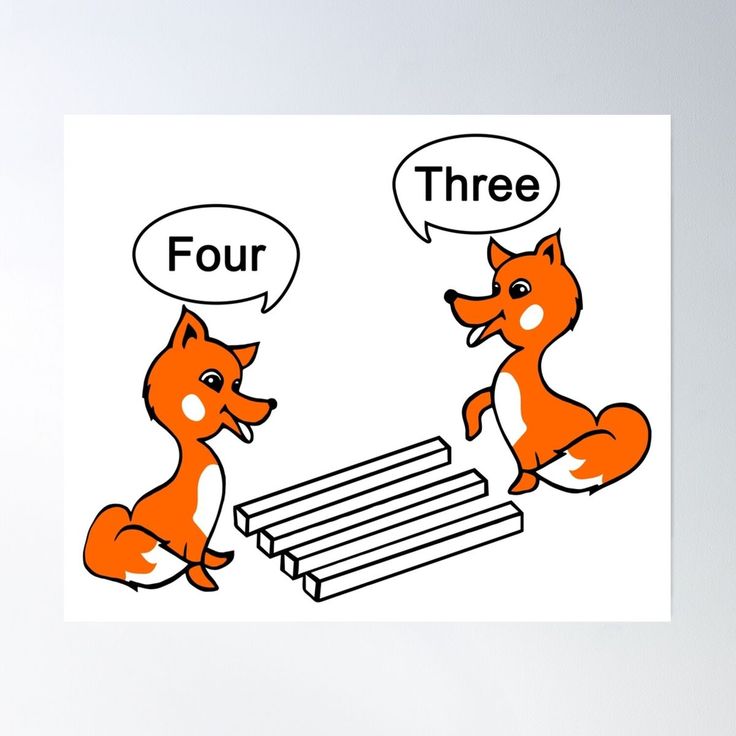
A popular illustration starring two cartoon foxes looking at a pile of wooden planks poses a classic visual debate:
-
The fox standing on the left looks down at the ends and says: “Four”
-
The fox standing on the right looks down at the top edges and says: “Three”
At first glance, both foxes seem utterly convinced of their answer. So who is actually right?
In this complete solution guide, we break down the famous “Impossible Trident” / Devil’s Fork illusion, explain how the drawing tricks your brain, and explore the science of visual perspective.
Deconstructing the Image: Where the Illusion Happens
The illustration is a variation of the famous impossible trident (also known as the blivet or Poiuyt), an impossible object that cannot exist as a solid 3D structure in real physical space.
                    [ IMPOSSIBLE PRISM ILLUSION ]
                                 |
      -------------------------------------------------------
     |                                                       |
 [ LEFT SIDE (BASE ENDS) ]                      [ RIGHT SIDE (FAR ENDS) ]
  • Features 4 distinct rectangular ends         • Features 3 complete rectangular beams
  • Grounded cut-off faces                        • Continuous solid bars
  • Result: Appears to be 4 bars                  • Result: Appears to be 3 bars
1. The Left Viewpoint (4 Ends)
If you focus on the bottom-left corner of the object:
-
Your eyes count 4 rectangular cut-off end faces facing toward the left fox.
-
Because each face represents the end of a block, the left observer naturally concludes there are 4 distinct bars.
2. The Right Viewpoint (3 Beams)
If you focus on the top-right corner of the object:
-
Your eyes count 3 distinct solid wooden beams extending toward the right fox.
-
The negative space between the ends on the left is cleverly blended into the surfaces of the beams on the right.
-
As a result, the right observer naturally concludes there are 3 distinct bars.
Comparative Breakdown of Perspective Views
| Viewing Angle | Focal Point | Count Observed | Visual Explanation |
| Left Perspective | Bottom-left cut-off faces | 4 | Counts the individual end-caps created by the artist. |
| Right Perspective | Top-right continuous beams | 3 | Counts the long rectangular solid bodies. |
| 3D Reality Check | Whole Object | Impossible | The 2D drawing uses contradictory depth cues that cannot exist in a 3D world. |
The Neuroscience and Psychology of Impossible Objects
Why does our brain struggle to make sense of this picture?
1. Depth Reconstruction Errors
The human visual cortex automatically attempts to translate 2D lines drawn on a flat surface into a 3D model in our minds. When looking at local parts of the drawing (just the left or just the right), the image makes mathematical sense. However, when trying to join both ends together, the spatial cues conflict, creating an impossible figure.
2. Contextual Bias & Perspective
This illustration is frequently used as a metaphor in cognitive psychology and communication training:
-
Both perspectives are valid based on local evidence.
-
It demonstrates how two people looking at the exact same situation from different viewpoints can reach opposite, yet logically sound, conclusions.
Practical Takeaways for Spotting Optical Paradoxes
-
Isolate the Sections: Cover the left half with your hand, and you clearly see 3 bars. Cover the right half, and you clearly see 4 block ends.
-
Trace the Edges: Try tracing a single line from the left end face to the right beam. You’ll notice that what starts as an outer edge transitions into negative space in the middle!
Conclusion
So, are there 3 or 4 bars?
Technically, both foxes are right relative to their viewing angle, but physically, it’s an impossible 2D drawing that cannot exist as a solid 3D object!
Frequently Asked Questions (FAQ)
What is the official name of this optical illusion?
This shape is based on the Impossible Trident, also known as the Devil’s Fork, Blivet, or Poiuyt.
Can this object be built in real life?
No. While physical models can be constructed as forced-perspective sculptures that look like the illusion from one specific angle, a true 3D version cannot exist.
What is the main lesson behind the 3 vs 4 bars meme?
Beyond being a fun visual paradox, it is often used as a lesson in perspective: two people can look at the same object from different angles and both be right based on what they see.