
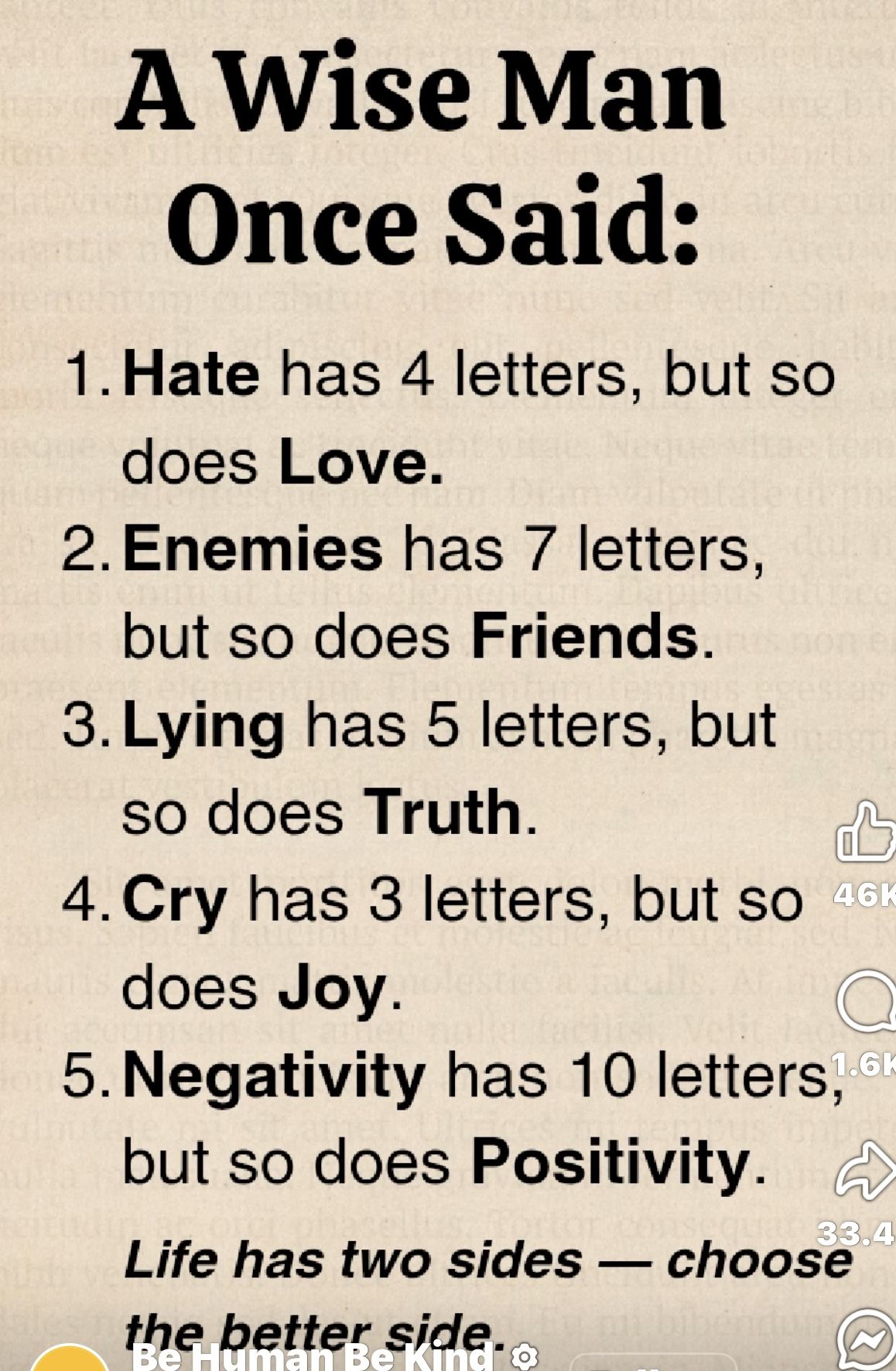

The Word-Length Equivalence Paradigm: Linguistic Symmetry, Cognitive Reframing, and Social Media AphorismsShort, list-based motivational graphics pointing out word length symmetries are widely shared engagement drivers on social media platforms. Featuring a high-contrast text overlay titled “A Wise Man Once Said”, listing five opposing word pairs (Hate/Love, Enemies/Friends, Lying/Truth, Cry/Joy, Negativity/Positivity) with equal letter counts, this post uses clever linguistic coincidence to deliver an uplifting message.While letter counts are purely an artifact of English orthography, using these linguistic parallels as a tool for cognitive reframing provides genuine psychological value.In this comprehensive guide, we examine the linguistic mechanics behind this viral post, analyze how word length symmetries influence cognitive processing, and explore the psychological benefits of conscious perspective-shifting.Deconstructing the Parallels: Linguistic Coincidence vs. Cognitive ReframingUnderstanding how the human brain processes textual symmetries clarifies why simple word games feel like profound philosophy: [ WORD-LENGTH PARALLELISM ]
[ ORTHOGRAPHIC COINCIDENCE ] [ COGNITIVE REFRAMING EFFECT ]
• Letter counts match purely by language evolution • Pairs negative concepts with positive counterparts
• Has no innate metaphysical meaning • Encourages intentional mental focus shift
• Creates a memorable, rhythmic linguistic structure • Promotes emotional resilience and optimistic bias
1. The Linguistic Reality of Word LengthsOrthographic Coincidence: The fact that “Love” and “Hate” both contain four letters is a result of Germanic and Old English linguistic development rather than an intentional philosophical design. In other languages, these opposing terms rarely match in letter count (e.g., in Spanish, amor has 4 letters while odio has 4, but amigos has 6 while enemigos has 8).Linguistic Symmetry as a Memory Device: Human brains naturally seek patterns. Pairing contrasting concepts with identical character lengths creates a rhythmic, memorable structure that makes the underlying message easier to digest and retain.2. The Psychology of Cognitive ReframingDichotomous Choices: The concluding message (“Life has two sides — choose the better side”) leverages cognitive reframing—a psychological technique used in cognitive behavioral therapy (CBT) to help individuals recognize alternative, positive perspectives when facing challenging or negative thoughts.Refocusing Mental Energy: While negative emotions (like fear, negativity, or sorrow) often trigger automatic survival responses, actively choosing to focus on positive equivalents (like joy, positivity, or truth) helps reduce stress and build emotional resilience.
1 2