

1. Left-to-Right Processing Bias
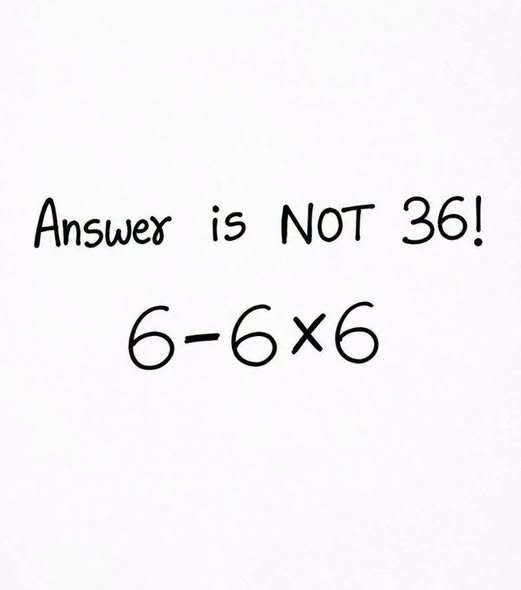
When we read text in English and many other languages, our brains naturally move from left to right. When faced with an equation like $6 – 6 \times 6$, the intuitive human inclination is to read it sequentially from left to right:
- First, subtract $6 – 6 = 0$.
- Next, multiply $0 \times 6 = 0$.
This left-to-right processing bias yields an incorrect answer of 0. While $0$ is a very common answer in comment sections, it violates the standard order of operations because subtraction was performed before multiplication.
2. Confusion Over Negative Numbers
Another common misconception involves signed numbers and multiplication. Some solvers attempt to group the middle numbers as $(-6) \times 6$, which gives $-36$, but then improperly handle the leading positive $6$, resulting in confusion about whether the final product should be positive or negative.
3. Misinterpreting the Warning
The viral graphic boldly states: “Answer is NOT 36!” This warning is included because some individuals multiply $6 \times 6$ to get $36$ and stop right there, completely ignoring the initial $6 -$. Seeing the bold warning often causes readers to second-guess basic arithmetic and guess zero or other positive whole numbers instead.
EducationalResources
The Real-World Importance of Mathematical Standards
While solving viral Facebook riddles might feel like a fun mental game, strict adherence to notation is essential across major global industries.
Technology and Software Engineering
Software developers, computational algorithms, and computer programming languages rely entirely on unambiguous execution rules. If a financial software script evaluated arithmetic operations sequentially rather than adhering to operator precedence, account balances and trading calculations would suffer catastrophic errors.
Finance and Investment Management
In banking, accounting, and investment portfolio analysis, formulas calculating compound interest, amortized loan payments, and mortgage schedules depend on precise algebraic hierarchy. A single misplaced operator precedence can miscalculate interest yields by thousands of dollars.
Insurance and Actuarial Science
Actuaries working in the insurance industry use complex mathematical models to assess risk factors, policy premiums, and liability coverage. These risk assessment equations require strict mathematical consistency to ensure financial stability for both insurance providers and policyholders.
Practical Tips for Improving Your Mental Math Skills
Keeping your brain active with mathematical challenges is an excellent way to maintain sharp problem-solving abilities throughout your life. Here are several practical strategies to refine your quantitative skills:
- Pause Before You Calculate: Resist the urge to evaluate equations instantly from left to right. Scan the entire expression first to identify higher-priority operations like multiplication, division, exponents, or parentheses.
- Master the Acronyms: Memorize PEMDAS or BODMAS so that checking operator precedence becomes second nature whenever you work with numbers.
- Practice Daily Logic : Engage with daily numerical teasers, Sudoku, or logic grids to build cognitive agility and spatial reasoning.
- Break Complex Problems Down: Write down intermediate steps rather than doing everything in your head. For instance, converting $6 – 6 \times 6$ into $6 – (6 \times 6)$ visually clarifies the priority.
Fascinating Facts About Math and Human Cognition
- Ancient Conventions: Early mathematicians did not always use parentheses. The explicit hierarchy favoring multiplication over addition evolved during the 16th and 17th centuries as modern algebraic notation standardized. EducationalResources
- The Brain’s Working Memory: Solving multi-step problems in your head exercises working memory, which is the mental workbench used to store and manipulate information over short periods.
- Global Consistency: Math is often referred to as the universal language because its operational rules remain identical regardless of native language, alphabet, or regional dialect.