
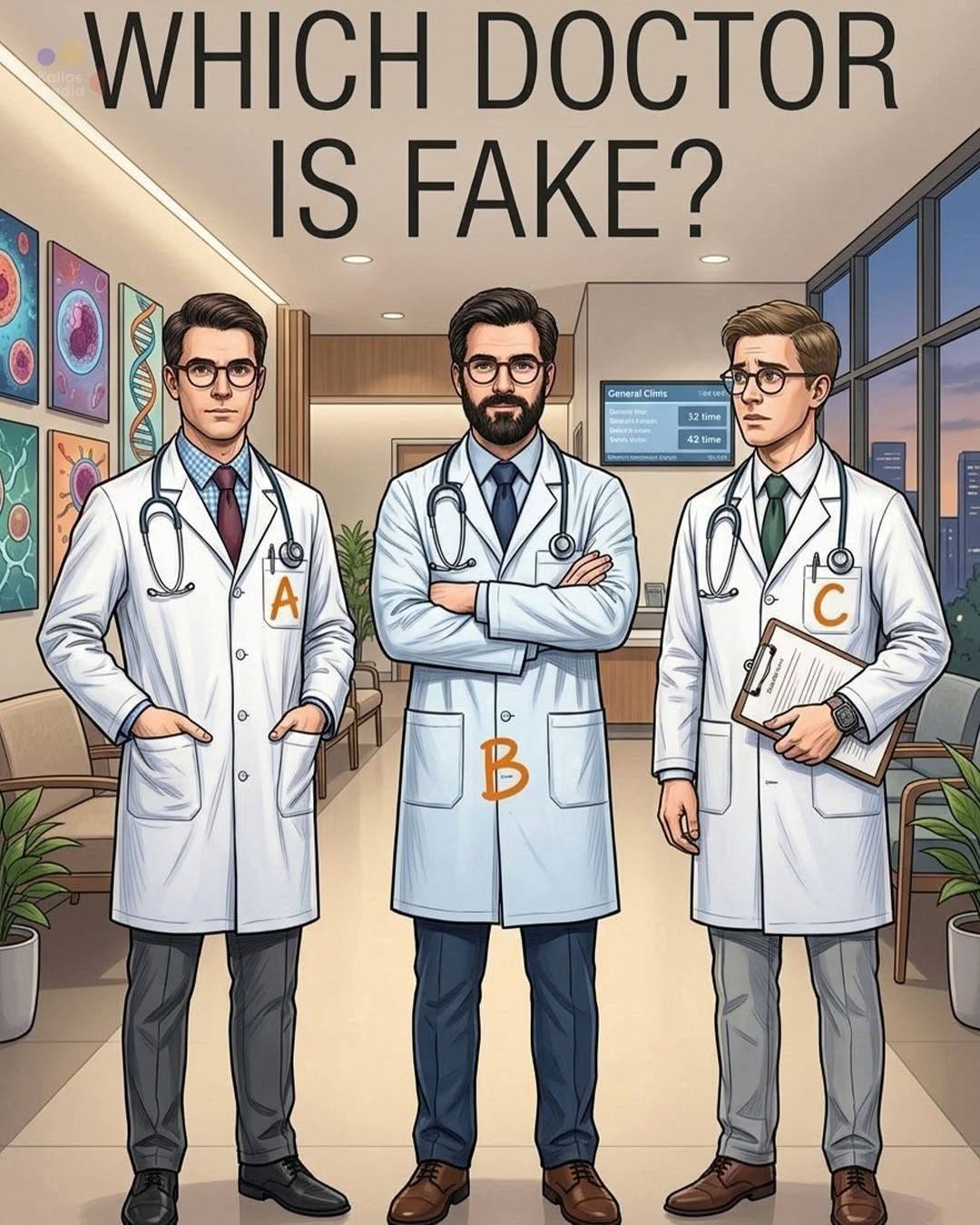


Visual brain teasers and detective riddles have become a massive hit across social media platforms, engaging millions of users daily. Among these popular challenges are spot-the-impostor puzzles, such as identifying the “fake doctor” among three candidates lined up in a clinic setting. While these puzzles serve as fun, quick visual workouts, they actually tap into deeply ingrained human observational psychology, attention to detail, and non-verbal communication cues.
Furthermore, in the real world, the topic of medical impersonation, healthcare provider verification, and legal credentialing carries significant weight. From medical liability insurance to healthcare fraud investigation, understanding how to spot anomalies—both in visual logic puzzles and real-world clinical environments—is essential for public safety and consumer protection.
Solving the Puzzle: Analyzing Doctors A, B, and C
To determine which doctor is fake in this visual puzzle, we must carefully observe the medical equipment, attire, posture, and physical details of each individual pictured.
                  [Examine Candidates]
                            |
     +----------------------+----------------------+
     |                      |                      |
 [Doctor A]             [Doctor B]             [Doctor C]
  Pockets hands          Crossed arms           Holding clipboard
  Proper stethoscope    Proper stethoscope     Incorrect stethoscope placement!
Analyzing Doctor A
-
Attire and Equipment: Doctor A is dressed professionally in a collared shirt, tie, and clean lab coat. His stethoscope is worn correctly around his neck, resting naturally over his shoulders with the earpieces ready for deployment.
-
Posture: Standing with hands in pockets, appearing relaxed and confident in a clinical setting.
Analyzing Doctor B
-
Attire and Equipment: Doctor B sports a full beard, tie, and lab coat. His stethoscope is draped appropriately across his chest and shoulders in a standard clinical manner.
-
Posture: Arms crossed with a steady, authoritative demeanor typical of a seasoned medical professional.
Analyzing Doctor C
-
Attire and Equipment: Doctor C is holding a clipboard, wearing glasses, and dressed in medical attire. However, a closer look at his chest pocket reveals a major clinical mistake: his stethoscope is stuffed inside his lab coat breast pocket with the heavy chestpiece pointing upward, completely unattached to a functional neck loop.
-
Behavioral Clue: Doctor C looks visibly nervous, sweating, and uncomfortable compared to Doctors A and B.
Conclusion: Doctor C is the fake doctor! A real healthcare professional knows how to properly wear and store a stethoscope around their neck, rather than tucking it uselessly into a shirt pocket like a pen while showing clear signs of distress.
Why Visual Impostor Puzzles Engage Our Brains
Human visual perception relies on pattern recognition. Puzzles that ask us to identify an impostor stimulate specific areas of the brain responsible for logical reasoning and critical analysis.
| Brain Function | Role in Solving Riddles | Real-World Benefit |
| Visual Scanning | Rapidly analyzing details across multiple focal points | Enhanced focus during driving, reading, and auditing |
| Anomaly Detection | Identifying subtle inconsistencies or misplaced items | Identifying compliance risks, security errors, or fraud |
| Deductive Logic | Ruling out plausible options based on physical evidence | Structured problem-solving in legal, financial, and tech fields |
Real-World Medical Credentialing, Legal Liability, and Insurance
While spotting a fake doctor in an online puzzle is a fun game, verifying medical credentials in real life is a critical process backed by strict laws and insurance standards:
Medical Licensing and Board Certification
In the healthcare industry, practicing medicine without a valid license is a serious felony. State medical boards enforce rigorous credentialing processes, requiring doctors to complete accredited medical education, residency training, and national board examinations before treating patients.
Healthcare Fraud and Legal Investigations
Medical impersonation and fraud carry severe criminal penalties and civil liability. Law enforcement agencies, attorney networks, and medical ethics boards work tirelessly to investigate fraudulent clinics, protect patient rights, and ensure public trust in healthcare systems.
Malpractice and Liability Insurance
Legitimate physicians must hold professional liability insurance (medical malpractice insurance) to protect patients and healthcare facilities against clinical errors or negligence. Insurance providers mandate thorough credential verification before underwriting any medical policy.
Practical Tips for Verifying Healthcare Providers
Whether you are seeking care at a new medical facility or verifying credentials, keep these practical steps in mind:
-
Check State Licensing Databases: Most government health departments offer free online search tools where patients can verify a doctor’s active medical license, board certifications, and disciplinary history.
-
Observe Clinical Habits: Real medical practitioners follow strict hygiene protocols, proper diagnostic equipment handling, and clear communication standards.
-
Verify Hospital Affiliations: Legitimate physicians are affiliated with recognized medical centers, clinics, or healthcare systems.
-
Trust Your Instincts: If a provider seems uncertain, lacks proper medical knowledge, or avoids answering basic health questions, seek a second opinion immediately.
Key Takeaways and Conclusion
Visual logic riddles like “Which Doctor Is Fake?” test our visual scrutiny and critical thinking in an entertaining way. By looking closely at the details, we see that Doctor C is the clear impostor due to his incorrectly worn stethoscope and anxious demeanor. Beyond the puzzle, maintaining high standards for medical credentialing, legal compliance, and healthcare verification keeps our real-world communities safe and informed.
Frequently Asked Questions (FAQ)
Which doctor is fake in the picture?
Doctor C is the fake doctor. He has his stethoscope awkwardly stuffed inside his breast pocket instead of properly draped around his neck, and he exhibits visible signs of nervousness and sweat.
Why do visual riddles go viral online?
Visual riddles encourage audience participation, spark friendly debate in comment sections, and offer a quick sense of intellectual accomplishment when solved.
How can you verify if a doctor is real in real life?
You can verify a healthcare provider’s credentials by searching your local state medical board’s official directory, checking hospital privileges, or looking up their board certification status online.
What are the legal penalties for practicing medicine without a license?
Practicing medicine without a license is a serious crime that carries heavy fines, potential imprisonment, and civil lawsuits for legal liability and fraud.