


The Extraordinary Life of Kim Ung-Yong: Beyond the Highest IQ in History
Human intelligence has always fascinated researchers, educators, and the public alike. Among the rare individuals who have tested the upper limits of human cognition, few names elicit as much wonder and debate as Kim Ung-yong. Recognized during his youth as an exceptionally gifted child prodigy, his extraordinary early achievements placed him in a unique league of intellectual minds. However, the true story of his life extends far beyond test scores, records, and media headlines.
Understanding the story of exceptional intellect requires examining not just early talent, but also the psychological, social, and educational environments that nurture human growth.
Early Signs of Extraordinary Intelligence
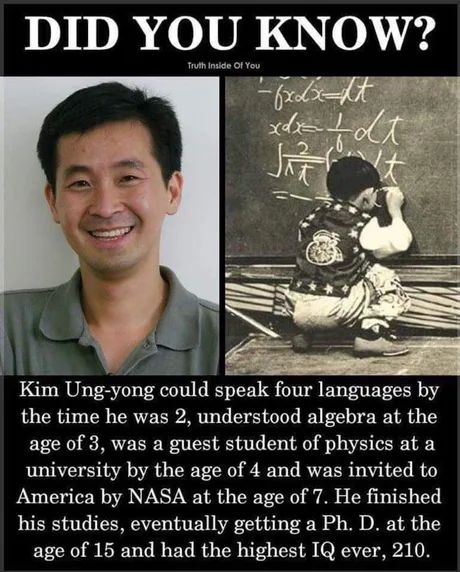
Kim Ung-yong’s intellect manifested at an astonishingly early age. Reports indicate that by the time he was just two years old, he had already mastered four languages, including Korean, Japanese, English, and German. By age three, he was performing complex mathematical calculus and solving intricate algebraic equations that typically challenge university-level students.
His precocious talent quickly drew international attention. By four years old, he was attending physics classes at Hanyang University in South Korea as a guest student. The cognitive abilities required to comprehend advanced physics and higher-level mathematics at such a young age placed him among the rarest intellectual talents in human history.
A Journey to NASA and Early Academic Life
As news of his capabilities spread, foreign research institutions took note. At just seven years old, Kim was invited to the United States to conduct research alongside top scientists at the National Aeronautics and Space Administration (NASA).
During his time working in high-level scientific environments, he continued to advance his academic pursuits rapidly. By the age of 15, he had completed his Ph.D. in physics—an milestone that most academic professionals accomplish in their late twenties or early thirties. During this period, his intelligence quotient was reported to be 210, a score often cited as one of the highest ever measured on standardized cognitive assessments.
The Psychological Pressure on Child Prodigies
While the accomplishments of child prodigies are visually and intellectually inspiring, the internal reality often involves significant personal challenges. High cognitive ability does not automatically grant emotional maturity, social belonging, or long-term personal fulfillment.
Society’s Expectations vs. Personal Well-Being
Gifted children frequently experience intense public scrutiny and immense pressure to achieve extraordinary societal milestones. When a child is treated solely as a scientific marvel or a national treasure, essential developmental experiences—such as play, friendship, and emotional exploration—can take a secondary role.
Research in psychology and education emphasizes that intellectual development must be balanced with social-emotional growth. When elite performance becomes the baseline requirement for self-worth, high achievers risk experiencing burn-out, isolation, and anxiety.
Key Factors for Supporting Gifted Individuals:
- Balanced Social Interaction: Ensuring peer-level socialization outside of academic environments.
- Emotional Resilience Training: Developing coping mechanisms for handling immense public or internal pressure.
- Autonomy in Career Choice: Allowing individuals to select their life path rather than fulfilling external expectations.
Redefining Success: Choosing a Fulfilling Path
After years of intensive research and work in high-pressure scientific settings, Kim Ung-yong made a choice that surprised many observers. He chose to leave the high-stakes world of international physics research and return to South Korea to pursue a more traditional life.
Rather than remaining at prestigious global research institutions, he chose to further his education in civil engineering, later earning degrees at a local university. He subsequently accepted a position as a senior manager at a regional development corporation and served as an adjunct professor.
For many onlookers who expected him to win Nobel Prizes or pioneer monumental scientific breakthroughs, this shift was viewed as unexpected. However, Kim himself has repeatedly shared in interviews that true happiness and success are personal definitions. For him, finding peace, meaningful work, and regular connection with family outweighed the pressures of global fame.
Modern Insights into Human Potential and Cognitive Testing
The story of extreme high IQ raises essential questions about how society measures intelligence and value.
What Does IQ Really Measure?
An Intelligence Quotient (IQ) test measures specific cognitive abilities, such as spatial reasoning, logical analysis, pattern recognition, and mathematical comprehension. While these skills are vital for academic and analytical tasks, they do not account for every aspect of human capability.
Modern cognitive science recognizes multiple dimensions of intelligence, including:
-
Emotional Intelligence (EQ): The ability to understand, manage, and utilize emotions effectively in social settings.
-
Practical Intelligence: Everyday problem-solving capabilities required to navigate complex real-world situations.
-
Creative Intelligence: The ability to innovate, produce novel ideas, and adapt to changing environments.
The Value of Life Balance Over Performance
In high-demand career fields—ranging from technology and investment banking to legal services and higher education—professionals face intense pressures to deliver peak output consistently. Kim Ung-yong’s journey serves as a reminder that long-term career satisfaction and health depend heavily on balance, self-determination, and personal peace.
Practical Lessons for Parents and Educators
-
Focus on the Whole Person: Nurture emotional and social skills alongside academic or technical talents.
-
Avoid Imposing Unrealistic Expectations: Allow young achievers to define their own goals and interests rather than prescribing their future.
-
Value Inner Fulfillment: Recognize that a quiet, happy, and stable life is just as successful as a high-profile international career.
-
Encourage Adaptability: Equip individuals with the mental tools needed to pivot when their goals or life circumstances change.
Conclusion
Kim Ung-yong’s story is fundamentally a human one. While his early record-breaking achievements in mathematics, physics, and linguistics remain a remarkable testament to human potential, his later decisions offer an even deeper lesson. By choosing a life of stability, purpose, and personal happiness over external expectations, he demonstrated that the ultimate form of intelligence may simply be knowing what truly makes life worth living.
Frequently Asked Questions (FAQ)
What was Kim Ung-yong’s reported IQ score?
Kim Ung-yong’s IQ was reported to be 210, placing him among the individuals with the highest cognitive scores ever recorded in modern history.
At what age did he start learning foreign languages?
Reports show that he was speaking four different languages—Korean, Japanese, English, and German—by the age of two.
Did Kim Ung-yong work for NASA?
Yes, as a child prodigy, he conducted research with NASA in the United States starting around the age of seven and continued his academic research into his teens.
What career path did Kim Ung-yong choose later in life?
He transitioned away from international high-level physics to study civil engineering in South Korea, subsequently working in regional development and serving as a university professor.
Why did he decide to live a more ordinary life?
Kim has stated in various interviews that he prioritized personal happiness, family, and mental well-being over the intense public scrutiny and pressure associated with global fame.