


The Cost of Procrastination: How Small Delays Become Big Losses
Procrastination rarely feels like a catastrophic decision in the moment. Delaying a task for an hour, putting off a workout until tomorrow, or postponing a creative project until next week seems harmless. However, when repeated consistently, these tiny delays quietly drain away your energy, ambition, and long-term momentum.
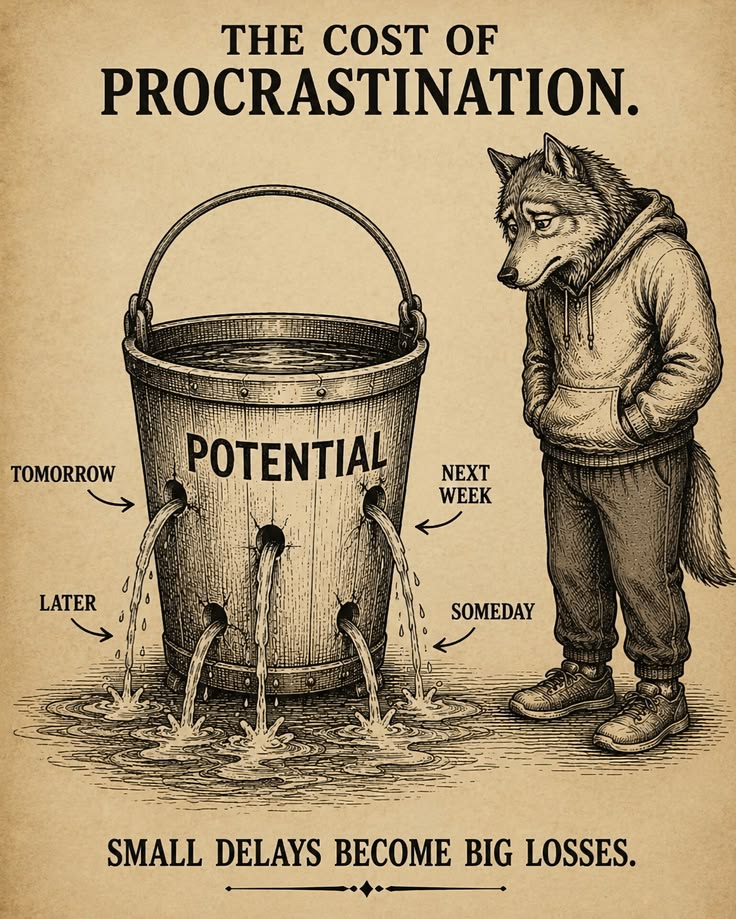
A compelling viral illustration captures this subtle phenomenon under a striking headline:
“THE COST OF PROCRASTINATION.”
The image depicts an anthropomorphic wolf standing sadly beside a wooden bucket labeled “POTENTIAL.” Water streams out of multiple holes drilled into the sides of the bucket, each labeled with a common excuse:
-
“TOMORROW”
-
“LATER”
-
“NEXT WEEK”
-
“SOMEDAY”
At the bottom, a powerful summary statement grounds the message:
“SMALL DELAYS BECOME BIG LOSSES.”
This visual metaphor serves as a vivid wake-up call: potential isn’t lost all at once in a single failure—it leaks out continuously through micro-excuses.
In this guide, we break down the visual symbolism of this artwork, explore the psychological mechanics of potential loss, and share practical ways to plug the leaks in your daily life.
Deconstructing the Image: The Leaking Bucket Metaphor
What makes this visual metaphor so relatable and thought-provoking across social media?
                     [ THE POTENTIAL BUCKET ]
                                |
      ------------------------------------------------------
     |                                                      |
 [ THE BUCKET OF POTENTIAL ]                [ THE EXCUSE LEAKS ]
 • Represents innate talent & energy        • "Tomorrow" / "Later"
 • Filled through focus & ambition          • "Next Week" / "Someday"
 • Drained by hesitation                    • Micro-delays compounding over time
1. The Bucket of Potential
The wooden bucket represents your raw capability, energy, and goals. When you are motivated and focused, the bucket fills with opportunity. However, potential is dynamic—if you don’t take action to store and use that liquid energy, it steadily drains away.
2. The Four Primary Excuses
Each hole in the bucket corresponds to a specific phrasing we use to give ourselves permission to delay:
-
“Tomorrow”: Shifting responsibility to a future version of yourself.
-
“Later”: Pushing immediate focus away without setting a clear commitment.
-
“Next Week”: Assuming future schedules will magically have more free time.
-
“Someday”: A vague catch-all phrase where goals go to die.
Comparative Breakdown: Leaking Potential vs. Plugging the Leaks
| Metric | The Leaking Bucket (Procrastination) | The Sealed Vessel (Immediate Action) |
| Mindset | “I’ll handle this when the time is right.” | “I’ll take a small action right now.” |
| Energy Level | Drained by background anxiety and guilt | Energized by visible progress |
| Long-Term Outcome | Empty potential, regret, missed chances | Compound growth, skill mastery, achievement |
The Psychology: Why Potential Leaks Away
Why does putting off tasks until “later” drain so much mental capacity?
1. The Zeigarnik Effect & Mental Drag
When you delay a task, your brain keeps it open in the background as an unfinished loop. This phenomenon (known as the Zeigarnik Effect) consumes subconscious mental bandwidth, leaving you feeling fatigued even when you haven’t actually accomplished anything.
2. The Illusion of “Future Time”
Humans consistently overestimate how much free energy and motivation they will have in the future. We treat our future selves like superheroes who won’t experience fatigue, distraction, or resistance—leading us to push tasks onto a version of ourselves that will feel just as overwhelmed.
Practical Ways to Stop the Leaks Today
-
Replace Vague Words with Deadlines: Eliminate words like “later” or “someday” from your vocabulary. Replace them with specific calendar appointments (e.g., “Tuesday at 10:00 AM”).
-
Apply the 2-Minute Rule: If a task takes less than two minutes to complete (replying to an email, clearing your desk, scheduling an appointment), do it immediately instead of putting it on a list.
-
Patch One Hole at a Time: Focus on fixing your most frequent excuse first. If “Tomorrow” is your main trap, commit to doing just 5% of the task today.
Conclusion
Your potential isn’t a fixed quantity that stays intact while you wait—it is an active resource that steadily leaks away when left unattended. The takeaway from “Small delays become big losses” is simple: stop letting minor excuses drain your future. Plug the leaks, take small daily actions, and keep your bucket full!
Frequently Asked Questions (FAQ)
What is the main lesson of “The Cost of Procrastination” image?
The illustration shows that procrastination doesn’t destroy goals instantly; instead, common excuses like “later” and “tomorrow” slowly drain your potential over time.
How can I stop telling myself “I’ll do it later”?
Break tasks down into microscopic actions so small that they require almost zero effort to start right now, removing the need to postpone them.