
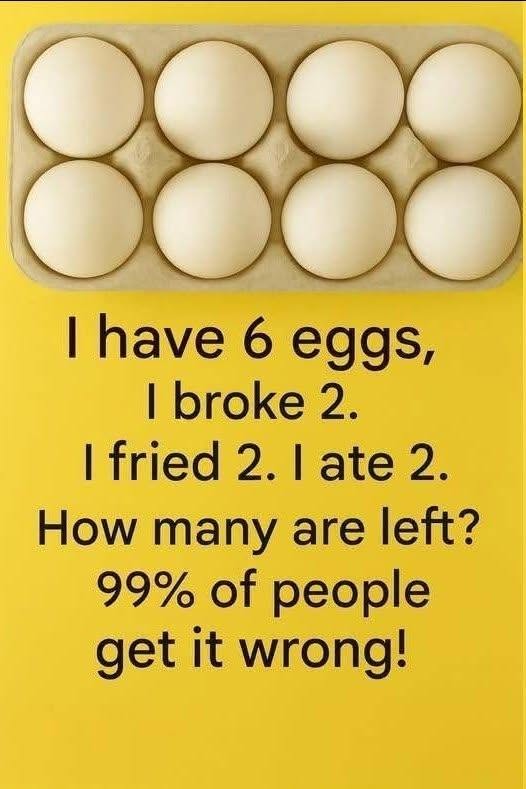


Word riddles that double as math problems have long captivated audiences across digital platforms. A famous example is the classic “6 Eggs” puzzle: “I have 6 eggs, I broke 2, I fried 2, I ate 2. How many are left?” While it appears to be a straightforward arithmetic problem at first glance, the riddle relies heavily on verb tense, sequential logic, and culinary context to trick the reader into over-subtracting.
Understanding how language structure influences mathematical interpretation—alongside exploring egg nutrition, kitchen safety, and financial health—provides an engaging look at both logic and everyday life skills.
Solving the Riddle: Decoding the Logic and Language
To determine the correct answer, we must examine the sequence of actions described in the text:
            [ Start: 6 Whole Eggs ]
                      |
        (Step 1: Break 2 Eggs to Cook)
                      |
        (Step 2: Fry the 2 Broken Eggs)
                      |
         (Step 3: Eat the 2 Fried Eggs)
                      |
  [ Remaining: 4 Intact Eggs + 0 Cooked Leftovers ]
1. Analyzing the Verb Sequence
-
“I broke 2”: To cook eggs, you must first break (crack) them. This action applies to 2 eggs.
-
“I fried 2”: You then fry those same 2 eggs that you just cracked open.
-
“I ate 2”: Finally, you eat those same 2 eggs that were cracked and fried.
2. The Arithmetic Breakdown
Rather than subtracting $2 + 2 + 2 = 6$ eggs (which assumes 6 separate eggs were affected), the three actions (broke, fried, ate) describe a single process performed on the same set of 2 eggs.
Correct Answer: 4 eggs remain whole and unbroken!
Psychological Principles Behind Word Riddles
Why do so many people miscalculate word puzzles on their first attempt? Psycholinguists and cognitive scientists point to a few key mechanisms:
| Psychological Concept | Mechanism in Riddles | Real-World Analog |
| Additive Assumption | Readers naturally assume each listed action refers to a new, distinct set of items. | Misinterpreting multi-step workflow instructions or financial statements. |
| Parsing Efficiency | The brain processes list items rapidly, skipping past contextual overlap to reach quick totals. | Overlooking fine print or critical clauses in legal contracts. |
| Tense Ambiguity | Mixing present tense (“I have”) with past tense (“I broke”) creates subtle timeline confusion. | Miscommunicating project timelines in professional settings. |
Culinary Safety, Nutrition, and Smart Grocery Management
Beyond logic puzzles, eggs are an essential, cost-effective staple in daily nutrition. Understanding proper handling and storage ensures both safety and quality in the kitchen:
1. Freshness Testing (The Water Float Test)
If you are unsure how long eggs have been in your refrigerator, place them in a bowl of cold water:
-
Sinks to the bottom and lies flat: Very fresh.
-
Stands upright on the bottom: Slightly older, but perfectly safe to cook.
-
Floats to the top: Old egg with a large internal air pocket; discard it.
2. Nutritional Powerhouse
Eggs provide complete protein containing all nine essential amino acids, along with vital nutrients like choline (for brain function), lutein, and vitamin B12.
Key Takeaways and Conclusion
Riddles like the “6 Eggs” puzzle test our reading comprehension and attention to detail rather than advanced mathematics. By recognizing that breaking, frying, and eating describe sequential steps applied to the same 2 eggs, we land on the correct answer: 4 eggs remain intact.
Frequently Asked Questions (FAQ)
What is the correct answer to the 6 eggs riddle?
There are 4 eggs left. You broke, fried, and ate the same 2 eggs.
Why do people get 0 as an answer?
People get 0 because they add $2 + 2 + 2 = 6$ and subtract all 6 eggs from the initial count, assuming each action was performed on different eggs.
How do I store fresh eggs safely?
Store eggs in their original carton on an inside refrigerator shelf (rather than the door) at or below 40°F (4°C) to maintain consistent cold temperatures.